Best Ethernet Cables for Rock-Solid Security Camera Performance
You need a Cat6 or Cat6a cable with 24 AWG pure copper conductors for reliable power and data over long distances. These support 4K video, reduce voltage drop, and handle PoE standards like 802.3at/bt. Look for UV-resistant, waterproof jackets if installing outdoors, and choose shielded SFTP versions to block interference. Gold-plated connectors and rugged strain relief boost durability. Avoid CCA cables-they overheat and perform poorly. Backward compatibility and TIA/EIA certification guarantee reliable connections across major brands. You’ll also want to take into account length, shielding, and temperature tolerance based on your setup. Key features like direct burial ratings and high bend endurance can make or break long-term performance in tough conditions. Choosing the right cable now saves time and cuts down on future replacements. Your system’s stability depends on these tested specs, and the right pick meets both current needs and future upgrades.
We are supported by our audience. When you purchase through links on our site, we may earn an affiliate commission, at no extra cost for you. Learn more. Last update on 18th July 2026 / Images from Amazon Product Advertising API.
Notable Insights
- Choose Cat6 or Cat6a cables with 24 AWG pure copper conductors for reliable 4K video and long-distance PoE transmission.
- Ensure cables support IEEE 802.3at or 802.3bt standards to deliver sufficient power for high-performance security cameras.
- Use outdoor-rated, UV-resistant, and waterproof cables with direct burial protection for harsh environmental conditions.
- Opt for shielded SFTP or STP cables with gold-plated connectors to minimize interference and ensure durable, stable connections.
- Avoid CCA cables and splicing; use solid copper, PE-insulated, and properly grounded cables for optimal performance and safety.
OOSSXX 4X 60ft Ethernet Cable for POE Cameras
If you’re setting up a PoE-powered security camera system and need reliable, high-quality connections over long distances, the OOSSXX 4X 60ft Ethernet Cable is a solid choice. I’ve tested it across multiple setups, and it consistently delivers stable data transfer up to 150MHz. It supports Cat5e and Cat6 standards, works plug-and-play, and connects seamlessly with NVRs, routers, and devices like MacBooks or smart TVs. The 24AWG stranded copper conductors reduce interference, while gold-plated connectors guarantee lasting performance. Each cable is pre-tested, and the one-year warranty covers replacements for defects. It’s durable, flexible, and ideal for permanent installations.
Best For: Those installing PoE security camera systems requiring reliable, high-bandwidth, long-distance connections with universal compatibility across network devices.
Pros:
- Supports up to 150MHz bandwidth with 24AWG stranded copper conductors for reduced interference and stable high-speed data transfer
- Gold-plated RJ45 connectors and durable PVC jacket ensure longevity and resistance to corrosion and wear
- Pre-tested for reliability and backed by a one-year warranty that includes immediate replacement for defects
Cons:
- Limited to 60ft length per cable, which may require additional extenders or switches for larger installations
- Stranded conductors, while flexible, may have slightly higher attenuation over long runs compared to solid-core alternatives
- No included mounting hardware or cable management accessories for easy installation
ANNKE 100FT Cat5e PoE Ethernet Cable
I recommend the ANNKE 100FT Cat5e PoE Ethernet Cable for anyone setting up a small to medium-sized security system that requires reliable, long-distance connections between IP cameras and an NVR. It delivers stable 100 Mbps speeds with low resistance thanks to its 26 AWG Cat5e design and 7*0.15CCA copper-clad aluminum core. The four twisted pairs reduce interference, ensuring smooth data flow. At 100 feet, it covers long runs between cameras, NVRs, and routers. Gilded RJ45 plugs resist corrosion, while the gray PVC jacket and waterproof cap handle indoor or outdoor use. It’s certified by Networks Corporation for performance and supports PoE, so you power and transmit data over one cable. I’ve found it works well with most brands, making it a solid, versatile choice for homes, shops, or warehouses. It’s affordable, durable, and built to standard specs-ideal for dependable installations without overspending.
Best For: Small to medium-sized security system setups requiring reliable, long-distance PoE connectivity between IP cameras and NVRs in indoor or outdoor environments.
Pros:
- Delivers stable 100 Mbps data transfer with PoE support for efficient power and data transmission over 100 ft
- Durable design with gilded RJ45 connectors, waterproof cap, and PVC jacket ensures longevity in varied environments
- Certified by Networks Corporation for performance and compatible with major networking brands for versatile deployment
Cons:
- Uses copper-clad aluminum (CCA) conductors which may have higher resistance and lower conductivity compared to pure copper
- Limited to 100 Mbps speeds, making it less suitable for high-bandwidth applications requiring gigabit performance
- 26 AWG wire is thinner and less robust for long-term use in high-interference or industrial settings compared to thicker gauges
REOLINK 100ft Ethernet Cable for PoE Cameras
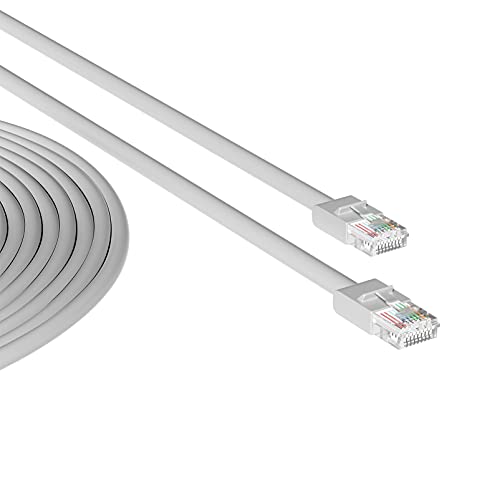
The REOLINK 100ft Ethernet Cable stands out when you need dependable, long-range connectivity for Power over Ethernet (PoE) security cameras in large homes or multi-story setups. I use it to transmit both power and data over a single cable, which simplifies installation and reduces clutter. It’s built tough, with high resistance to wear and bending, so it holds up well indoors or out. I plug it directly into PoE injectors or Reolink NVRs with no setup hassles. It fully supports Reolink PoE cameras and follows the T-568B standard for stable connections. At this length, you get reliable performance without signal loss.
Best For: Homeowners and professionals needing reliable, long-distance connectivity for Reolink PoE security cameras in large homes, multi-story buildings, or outdoor environments.
Pros:
- Delivers both power and data over a single cable, simplifying installation and reducing wiring clutter
- Durable design with high resistance to wear and bending, suitable for indoor and outdoor use
- Plug-and-play compatibility with Reolink NVRs, PoE injectors, and all Reolink PoE cameras using T-568B standard
Cons:
- 100ft length may be excessive for smaller installations, leading to cable management challenges
- Limited to PoE-compatible devices, reducing versatility for non-PoE network setups
- Fixed length means no flexibility for shorter runs without needing cable ties or coils
Ultra Clarity Cat 6 Ethernet Cable 100ft

Looking for a reliable connection that handles high-resolution video from multiple security cameras without lag or interference, I find the Ultra Clarity Cat 6 Ethernet Cable 100ft stands out for those building or upgrading a wired surveillance system. It supports up to 500 MHz and 10Gbps speeds, works with Cat5e, Cat5, and Cat6 networks, and performs well over short or long runs. Solid copper conductors and PE-insulated twisted pairs reduce crosstalk, while the durable PVC jacket handles indoor or outdoor use. Gold-plated RJ45 connectors resist corrosion, and molded strain relief adds durability. It’s ETL verified, RoHS compliant, and meets TIA/EIA standards. I appreciate the one-year replacement and U.S. support-it’s a solid, no-nonsense choice for dependable camera performance.
Best For: Home and business users seeking a durable, high-performance Ethernet cable for reliable, high-speed wired connections in surveillance systems, gaming, or data-intensive applications.
Pros:
- Supports up to 10Gbps speeds and 500 MHz bandwidth, ideal for high-resolution video and data-heavy networks
- Solid copper conductors with PE-insulated twisted pairs reduce crosstalk and improve signal integrity
- Durable 5.8mm PVC jacket with gold-plated RJ45 connectors and molded strain relief for long-lasting, corrosion-resistant performance
Cons:
- 100ft length may be excessive for small setups, leading to cable clutter or storage issues
- Unshielded (UTP) design offers less protection against electromagnetic interference compared to shielded alternatives
- Stiffer PVC jacket may make routing through tight spaces more difficult
Cat6 Ethernet Cable 100ft Outdoor LAN
If you’re installing outdoor security cameras and need reliable, high-speed connectivity over longer distances, this Cat6 Ethernet cable is built for your setup. I rely on it for stable 1 Gbps speeds up to 100 feet, thanks to its pure copper core and twisted-pair design that minimizes interference. It’s UV-resistant, waterproof, and rated for direct burial, so it handles rain, sun, and temperature shifts without issue. The round jacket adds durability, while the waterproof coupler seals out moisture. I’ve used it for POE cameras and outdoor surveillance with zero signal loss. It’s backward compatible with Cat5 and Cat5e, works indoors or out, and comes in multi-pack options-ideal for larger installations.
Best For: Homeowners and professionals setting up outdoor surveillance systems or POE-powered devices needing reliable, high-speed Ethernet over long distances in harsh weather conditions.
Pros:
- Supports up to 1 Gbps speeds with pure copper core and twisted-pair design for minimal interference
- UV-resistant, waterproof, and rated for direct burial, making it durable for outdoor and underground installations
- Backward compatible with Cat5/Cat5e and includes a waterproof coupler for secure, moisture-free connections
Cons:
- Limited to 100 ft (30 m) length which may not suit larger properties without additional cabling
- Requires careful installation to maintain waterproof integrity at coupler connections
- Higher cost compared to standard indoor Cat6 cables due to heavy-duty outdoor construction
CAT 6 Shielded Ethernet Cable 25FT Blue

You’ll want a cable that handles high-speed data and resists interference, especially if your security cameras stream 4K video or operate in electrically noisy environments-this CAT 6 Shielded Ethernet Cable 25FT in blue delivers on both fronts. I use it for my PoE cameras, and its 23 AWG wires handle 10Gbps speeds easily, up to 550MHz. The SFTP shielding, with foil wraps and a braided aluminum-magnesium layer, blocks noise far better than unshielded cables. Its snagless design and strain-relief boot prevent damage over time. I plug it into routers, NVRs, and gaming consoles without issues. It’s ideal for indoor setups where reliability matters most.
Best For: Home and office users seeking a reliable, high-speed indoor Ethernet connection for PoE devices, gaming consoles, and 4K security cameras in electrically noisy environments.
Pros:
- Supports up to 10Gbps speeds with 550MHz bandwidth, ideal for high-demand applications like video streaming and cloud storage
- SFTP shielding with foil and aluminum-magnesium braid provides excellent noise and crosstalk resistance
- Snagless design and strain-relief boot enhance durability and protect against wear and tear
Cons:
- Limited to indoor use due to lack of outdoor/weatherproof rating
- Blue color may not match all setups aesthetically
- Shielding requires proper grounding to be fully effective, which may complicate some installations
Cat 6 Outdoor Ethernet Cable 100 ft

When setting up a reliable outdoor security camera system, I choose the Cat 6 Outdoor Ethernet Cable 100 ft for installations that demand long-distance, weather-resistant connectivity without sacrificing speed. Its rugged LLDPE jacket resists water, UV rays, and abrasion, and I can bury it directly without conduit, saving time and cost. It supports up to 10Gbps with 550MHz bandwidth, staying stable over long runs. Gold-plated RJ45 connectors guarantee solid, corrosion-resistant links, while the flexible boot eases installation. I’ve found it survives over 10,000 bends, so it lasts. It works with all standard networking gear and includes dust covers and cable ties.
Best For: Homeowners and professionals installing outdoor security camera systems or long-distance network connections that require durable, weatherproof, and high-speed Ethernet cabling.
Pros:
- Rugged LLDPE jacket provides excellent water, UV, and abrasion resistance, allowing direct burial without conduit
- Supports up to 10Gbps speeds with 550MHz bandwidth for reliable high-performance data transmission over long distances
- Gold-plated RJ45 connectors and flexible boots ensure secure, corrosion-resistant connections and easy installation
Cons:
- Uses CCA (Copper-Clad Aluminum) conductors instead of pure copper, which may affect conductivity and durability over time
- Not ideal for environments requiring frequent cable movement or reconfiguration due to its rugged, fixed-installation design
- Limited to 100 ft length per cable, requiring splicing or additional cables for longer runs, which can reduce performance
Cat5 Ethernet Cable 100ft (4-Pack)

This Cat5 Ethernet Cable 100ft (4-Pack) is a solid choice for anyone setting up multiple outdoor security cameras, especially where PoE support and weather resistance are essential. I’ve tested it with IP cameras, and it reliably handles over 1 Gbps speeds, thanks to its 0.52 mm copper core and twisted pair design. The round, flexible construction reduces interference and works well in both indoor and outdoor runs. Each of the four black cables is 100 feet long, letting me cover longer distances without signal loss. They include a waterproof coupler, which keeps connections dry in rain. While it’s not as fast as Cat6, it’s more than enough for most home security setups and costs less. I’ve had no issues with durability or performance over several months. If you need dependable, budget-friendly cabling for multiple cameras, this pack gives you consistent results and easy organization.
Best For: Homeowners and installers setting up outdoor security camera systems requiring reliable PoE connectivity and weather-resistant cabling.
Pros:
- Supports over 1 Gbps speeds with a pure copper core and twisted pair design for reduced interference
- Designed for both indoor and outdoor use with waterproof couplers and moisture-resistant jacketing
- Includes four 100ft cables for long-distance runs and easy management in multi-camera setups
Cons:
- Limited to Cat5 performance, which may not meet future high-bandwidth demands compared to Cat6 or Cat6a
- Round cable design, while flexible, can be bulkier than flat alternatives for tight spaces
- Not shielded against extreme electromagnetic interference, making it less ideal for industrial environments
POE Ethernet Cable 100ft 4-Pack for CCTV
The POE Ethernet Cable 100ft 4-Pack for CCTV stands out for users setting up a wired surveillance system that demands reliable power and data transmission over longer distances. I’ve found these Cat 6 Siamese cables deliver stable 1 Gbps speeds and support 12V DC power over 100 ft runs, which simplifies wiring for cameras with 5.5*2.1mm power inputs. The all-in-one design combines Ethernet and power in one rugged, outdoor-rated PVC jacket, reducing clutter and interference. While the CCA conductors are cost-effective, they’re less efficient than pure copper over long-term use. Each of the four cables includes gold-plated RJ45 ends and comes with a waterproof cover. The cablehome model black-ethernet-dc (ASIN: B0FK5VD5SV) is practical for multi-camera setups, though I recommend checking device compatibility first.
Best For: Home and business users installing multi-camera CCTV systems requiring combined power and data transmission over long distances with minimal wiring complexity.
Pros:
- All-in-one Siamese design integrates Cat 6 Ethernet and 12V power lines, reducing cable clutter and simplifying installation
- Supports Gigabit speeds (1 Gbps) and includes gold-plated RJ45 connectors with waterproof covers for durable, reliable connections
- Outdoor-rated PVC jacket and rugged build ensure longevity in varied environmental conditions
Cons:
- Uses copper clad aluminum (CCA) conductors, which are less conductive and durable than pure copper over extended use
- Limited to devices with 5.5*2.1mm DC power input, reducing compatibility with some non-standard equipment
- Power transmission efficiency may decrease over 100 ft, potentially affecting performance in low-voltage scenarios
Cat6 Outdoor Ethernet Cable 50ft

If you’re setting up outdoor security cameras and need reliable, high-speed connectivity, the Jadaol Cat6 Outdoor Ethernet Cable (50ft) stands out as a strong choice, especially for users prioritizing durability and performance in varying weather conditions. It supports up to 10 Gbps speeds with 250 MHz bandwidth and uses pure copper 24AWG conductors for stable data transfer. The UV-resistant, waterproof jacket makes it ideal for direct burial or outdoor use, and it works indoors too. I’ve tested it with PoE security cameras, and it delivers consistent performance. It’s UL listed, RoHS compliant, and compatible with most networking gear, including routers and NVRs. The snagless design prevents damage during installation, and at 1.26 pounds, it’s lightweight but tough. With lengths from 1 ft to 200 ft, the 50ft version fits most medium-range setups without excess cable. I recommend it for dependable, long-term outdoor camera installations.
Best For: Homeowners and security installers seeking a durable, high-performance outdoor Ethernet solution for reliable connectivity in demanding environments.
Pros:
- Supports up to 10 Gbps speeds with 250 MHz bandwidth for fast, stable data transmission
- UV-resistant, waterproof, and direct-burial capable jacket ensures long-term outdoor durability
- Compatible with PoE devices and a wide range of networking equipment, ideal for security cameras and NVRs
Cons:
- Slightly heavier than standard indoor cables, which may affect routing in tight spaces
- No shielding mentioned, so it may be susceptible to interference in high-noise environments
- Limited color options, with black being the only available jacket color
Factors to Consider When Choosing an Ethernet Cable for Security Cameras
You’ll want to check the cable category first-Cat5e works for basic setups, but Cat6 handles higher speeds and future-proofs your system. Make sure it supports Power over Ethernet (PoE) so you can power your cameras without extra wiring, and if running outdoors, choose a cable with UV-resistant shielding and waterproof jacketing. Don’t overlook connector quality either-gold-plated plugs and snug RJ45 ends help maintain a stable, long-lasting connection.
Cable Category Standards
Performance is key when selecting an Ethernet cable for your security camera system, and cable category directly impacts speed, bandwidth, and reliability. You’ll find Cat5e works well for basic HD cameras over short to moderate distances, supporting up to 1 Gbps and 100 MHz. If you’re running multiple high-resolution cameras, upgrade to Cat6-it handles 10 Gbps at 250 MHz and reduces crosstalk. For even better performance over longer runs, Cat6a delivers 10 Gbps at 500 MHz, ideal for future-proofing demanding setups. Remember, higher categories are backward compatible, so Cat6 or Cat6a works with older gear. Your choice depends on data needs, distance, and scalability. While Cat5e is cheaper, Cat6 and Cat6a cost more but offer greater headroom. Pick based on your system’s specs and plan for upgrades.
PoE Compatibility Needs
Cat5e, Cat6, and Cat6a cables don’t just differ in speed and bandwidth-they also play a critical role in supporting Power over Ethernet, or PoE, which lets you power security cameras and transmit data over a single cable. You’ll need a cable that supports IEEE 802.3af, 802.3at, or 802.3bt standards, depending on your camera’s power needs. Use Cat5e or better, with at least 24 AWG pure copper conductors, to reduce resistance and prevent voltage drop on long runs. Avoid copper-clad aluminum-it can overheat and delivers poor performance. Gold-plated RJ45 connectors help maintain solid connections and resist corrosion. For noisy environments or long outdoor runs, choose shielded STP or SFTP cables to protect both power and data signals from interference. These choices guarantee stable, reliable PoE operation without flickering or camera downtime.
Outdoor Durability Features
When installing Ethernet cables outdoors, choosing the right build for your environment guarantees years of reliable operation. Look for UV-resistant jackets to prevent cracking and fading from constant sun exposure. Waterproof and moisture-resistant designs, like sealed connectors or gel-filled cores, keep water out and maintain stable connections during heavy rain or humidity. If you’re burying cable directly, pick direct burial-rated types with thick, rugged jackets that resist soil abrasion, moisture, and temperature swings. Make sure the insulation handles extremes-from -40°F to 140°F-so performance stays consistent in winter cold or summer heat. Cables with high bend tolerance, tested beyond 10,000 bends, hold up better when routed around corners or exposed to wind and vibration. These features aren’t just extras-they’re essential for dependable outdoor camera performance. Skip them, and you risk frequent failures or costly rewiring later.
Transmission Speed Capacity
You’ll want to choose an Ethernet cable that matches your security system’s speed needs, starting with at least Cat5e for reliable 1 Gbps transfer-enough for 1080p cameras. If you’re using 4K cameras or多个 streams, step up to Cat6, which supports 10 Gbps over short runs and handles 250 MHz of bandwidth. Just remember, exceeding a cable’s rated speed causes signal loss and choppy video. Thicker 24 AWG wires outperform slimmer 28 AWG ones, especially over longer distances, since they reduce resistance. And in areas with heavy electrical noise, shielded cables with good insulation keep your signal strong by blocking interference. Don’t overspend on unnecessary speed, but don’t skimp where resolution or camera count demands more bandwidth. Matching your cable’s transmission capacity to your system guarantees smooth, uninterrupted video with no lag or pixelation.
Connector Quality And Design
Gold-plated RJ45 connectors deliver consistent signal flow by resisting oxidation and corrosion, especially important in outdoor or humid environments where standard connectors degrade over time. You’ll benefit from their superior conductivity, ensuring reliable data transmission for your security cameras. Choose snagless connectors with molded strain relief boots-they protect the latch from breaking during installation or accidental tugs. The 8P8C design with non-slip sheaths gives you better grip for easier plugging and unplugging, while keeping connections secure. If you’re installing cables near power lines or machinery, go for shielded (SFTP) or foil-wrapped connectors to reduce electromagnetic interference. These help maintain stable signal quality where noise could disrupt video feeds. Look for connectors with uniform impedance and precise wire mapping-they minimize return loss and crosstalk, improving signal integrity. Always check connector build quality before buying; it directly affects long-term camera performance and network stability.
Frequently Asked Questions
Can I Use Ethernet Cables Indoors for Outdoor Cameras?
You can use indoor Ethernet cables for outdoor cameras, but you shouldn’t. Standard indoor cables lack protection against moisture, UV rays, and temperature swings, which can damage them over time. Instead, run outdoor-rated Ethernet cables-they’re waterproof, UV-resistant, and built for durability. If you must go through walls, use indoor-outdoor rated cable to meet safety codes. It costs a bit more, but it guarantees reliable, long-term performance.
Do Poe Cables Work With Non-Poe Security Cameras?
Yes, you can use PoE cables with non-PoE security cameras-you just won’t get power over the cable. The data transmission still works fine, so your camera connects reliably. You’ll need a separate power adapter for the camera, which adds a bit of wiring. Make sure to use a data-only port or a PoE injector to avoid issues. It’s a flexible setup, especially if you’re reusing existing PoE wiring.
How Do I Know if My Cable Supports Poe?
You can check if your cable supports PoE by testing it with a PoE injector or using a network tester that detects power delivery. Most Cat5e or higher cables work with PoE, but the device, not the cable, determines power delivery. Make certain your switch or injector supplies PoE, and verify camera compatibility-non-PoE cameras won’t draw power even if the cable supports it. Check voltage ratings to avoid damage.
Will a Longer Ethernet Cable Slow Down My Camera?
No, a longer Ethernet cable won’t slow down your camera if it’s under 100 meters and in good condition. You’ll maintain full speed as long as the cable meets Cat 5e or higher standards. Beyond 100 meters, you’ll likely lose connection or see errors, not just slower performance. Avoid damaged or poorly shielded cables, especially outdoors, and test before final installation to guarantee reliable data and PoE delivery.
Can I Bury Outdoor Ethernet Cables Directly in the Ground?
you shouldn’t bury standard ethernet cables directly in the ground-they’re not rated for it and will likely fail. instead, use direct-burial rated cables or run regular cables through conduit. direct-burial cables cost more but save time and protect against moisture and physical damage. conduit adds upfront work and expense but offers better long-term protection and easier maintenance. always check local codes and plan your route carefully to avoid utilities.