Best Home Automation Systems That Make Your House Smarter
You can make your home smarter with reliable systems like the Kasa Smart Plug HS103P4, which offers easy setup and voice control via Alexa or Google without a hub. For advanced users, the Home Assistant Green hub supports local automation with Zigbee and Z-Wave add-ons, enhancing privacy and reliability. Matter-compatible devices like the Linkind smart plug work across platforms but need a hub for full features. Smart bulbs such as Kasa KL125P4 deliver color and scheduling, while Govee’s TV backlight enhances ambiance with accurate edge lighting. Energy monitoring and hub requirements vary, so match devices to your home’s wiring and network. Local processing improves response and security, especially during internet outages. Voice routines and app control simplify daily tasks, and DIY kits like KEYESTUDIO’s ESP32 offer hands-on learning for custom setups. Consider compatibility with your existing assistants, Wi-Fi band, and electrical system to avoid issues. Options range from beginner-friendly plugs to expandable ecosystems, letting you scale from single rooms to whole-home automation. Your choice depends on technical comfort, integration needs, and long-term goals. Different setups suit different homes, and the best choice balances simplicity, control, and future expandability.
We are supported by our audience. When you purchase through links on our site, we may earn an affiliate commission, at no extra cost for you. Learn more. Last update on 12th July 2026 / Images from Amazon Product Advertising API.
Notable Insights
- Choose smart plugs like Kasa or Govee for easy outlet control with app, voice, and scheduling features.
- Opt for Matter-compatible devices like Linkind for seamless integration across Apple, Alexa, and Google ecosystems.
- Use HomeKit-enabled plugs for secure, energy-monitoring smart control with Siri and Apple Home.
- Install Kasa Wi-Fi bulbs for vibrant, dimmable lighting with no hub and full voice control.
- Build a unified system with Home Assistant Green for local control, expandable via Zigbee, Z-Wave, and Thread.
Kasa Smart Plug HS103P4 (4-Pack)

If you want reliable, no-fuss smart plugs that work across voice assistants and give you full control from your phone, the Kasa Smart Plug HS103P4 (4-Pack) is a solid choice for everyday home automation. I use it to turn lights and appliances on or off from anywhere through the free Kasa app. It works with Alexa, Google Assistant, and IFTTT, so voice control is easy. Setup takes minutes-just plug in, connect to 2.4GHz Wi-Fi, and follow the app. No hub’s needed. I schedule my lamps and fan using timers, which saves energy. UL certified and backed by over 5 million users, it’s safe and trustworthy.
Best For: Homeowners and renters looking for an easy-to-use, voice-compatible smart plug system that enables remote control and scheduling of household electronics.
Pros:
- Works seamlessly with Alexa, Google Assistant, and IFTTT for versatile voice control and automation
- Simple setup with no hub required and reliable 2.4GHz Wi-Fi connectivity
- Energy-saving scheduling and timer features with UL certification for safety
Cons:
- Requires 2.4GHz Wi-Fi network, not compatible with 5GHz bands
- App functionality limited to Android 5.0+ and iOS 10.0+, excluding older devices
- No built-in energy monitoring to track power consumption
Home Assistant Green Smart Hub

The Home Assistant Green Smart Hub is ideal for those who value full control over their smart home data and want a plug-and-play solution without sacrificing customization. I run it on a quad-core processor with 4GB RAM and 32GB storage, ensuring smooth automation for lights, climate, and security. It’s fanless, silent, and energy efficient, using just a few watts. I connect via Ethernet, then expand with USB to support Zigbee, Z-Wave, and Thread. All my data stays local, so I own it and don’t rely on the cloud. Released February 22, 2024, by Nabu Casa, it’s a reliable hub ranked #33 in its category.
Best For: Those who want a privacy-focused, locally controlled smart home hub with plug-and-play setup and advanced customization capabilities.
Pros:
- Runs Home Assistant natively with robust hardware (quad-core CPU, 4GB RAM, 32GB storage) for smooth automation
- Fanless, silent design with low power consumption and reliable wired Ethernet connectivity
- Supports Zigbee, Z-Wave, and Thread via USB expansion for broad smart device compatibility
Cons:
- Requires separate USB add-ons for popular wireless protocols, increasing total cost
- Limited to Ethernet connectivity with no built-in Wi-Fi for flexible placement
- Higher price point compared to some competing smart home hubs with similar specs
Home Assistant Connect ZWA-2 Z-Wave Hub

I rely on reliable, long-range connectivity for my smart home, and the Home Assistant Connect ZWA-2 Z-Wave Hub delivers exactly that-it’s the best choice for users committed to a secure, locally controlled automation system. I use it to connect all my Z-Wave devices, and its 800-series chipset guarantees full compatibility and strong performance. The tuned antenna gives me maximum range with minimal interference, and Z-Wave Long Range boosts battery life in supported devices. Setup is simple: plug it in, follow the wizard, and update firmware with one click. It blends into my space with a clean, candle-like design, and I appreciate the included 4.9ft cable. Made by Nabu Casa (model NC-ZWA-9734), it’s reliable, easy to migrate to, and backed by solid customer feedback since its August 2025 release.
Best For: Users who want a reliable, long-range Z-Wave hub with seamless integration into Home Assistant and top-tier local smart home control.
Pros:
- Features the latest 800-series chipset for full Z-Wave compatibility and optimized performance
- Supports Z-Wave Long Range for extended battery life and improved device responsiveness
- Simple plug-and-play setup with one-click firmware updates and easy migration from other adapters
Cons:
- Z-Wave Long Range availability limited to North America and select European regions with few compatible devices currently
- Requires a Home Assistant system, limiting usability for non-Home Assistant users
- Released in August 2025, so long-term durability and support beyond initial feedback remain to be seen
Kasa Smart WiFi Light Bulbs (KL125P4)

You’ll find the Kasa Smart WiFi Light Bulbs (KL125P4) work best if you want reliable, hub-free smart lighting that integrates smoothly into daily routines without technical hurdles. I use them because they connect directly to 2.4GHz Wi-Fi, letting me control brightness, color (16 million options), and temperature (2500K–6500K) via the Kasa app or voice with Alexa and Google Assistant. Each 9W bulb delivers 800 lumens, equal to a 60W incandescent, and supports scheduling, timers, and sunrise offset automation. They’re energy efficient, with real-time usage tracking, UL certified, and backed by a 2-year warranty. I recommend the 4-pack for consistent room lighting or holiday setups.
Best For: Homeowners and renters seeking an easy-to-use, hub-free smart lighting solution that offers full color customization, scheduling, and voice control for everyday convenience and ambiance.
Pros:
- Connects directly to 2.4GHz Wi-Fi without a hub, enabling seamless setup and remote control via the Kasa app
- Offers 16 million colors and adjustable color temperature (2500K–6500K) for versatile lighting scenes and automation
- Compatible with Alexa and Google Assistant for hands-free voice control, plus energy monitoring and UL certification for safety
Cons:
- Supports only 2.4GHz Wi-Fi, limiting compatibility with dual-band routers that lack a dedicated 2.4GHz network
- Operating temperature range (-15°C to 40°C) may restrict use in unheated outdoor environments or extremely cold climates
- No Zigbee or Thread support, reducing integration options with certain smart home ecosystems
Linkind Matter Smart Plug 4-Pack

Linkind’s Matter-compatible smart plugs stand out for users invested in ecosystem flexibility, especially those already using Apple Home, Alexa, Google Assistant, or SmartThings. I rely on them for seamless control across platforms, and they work locally via 2.4GHz Wi-Fi and IPv6, so commands execute even without internet. I use the AiDot app when I don’t want a hub, but they pair best with HomePod or Echo for voice control. I automate lamps, fans, and holiday lights with schedules and timers, cutting energy waste. Each plug handles up to 1800W, and fire-resistant materials with ETL certification guarantee safety. Their compact design fits tight spaces, and local processing means faster, more secure responses without relying on the cloud.
Best For: Users seeking a reliable, multi-platform smart plug solution with local control and seamless integration across Apple Home, Alexa, Google Assistant, and SmartThings ecosystems.
Pros:
- Works with major smart home platforms via Matter, enabling unified control without multiple apps
- Supports local processing over 2.4GHz Wi-Fi and IPv6 for fast, secure, internet-independent operation
- Compact, safety-certified design with 1800W capacity and energy-saving scheduling features
Cons:
- Requires a Matter-certified hub for full voice and remote functionality, adding to initial setup cost
- No 5GHz Wi-Fi support, limiting network flexibility
- Limited standalone functionality outside the AiDot app without a hub
Kasa Smart Light Switch HS200P3 (3-Pack)

Who benefits most from a reliable home automation system? I do-especially with the Kasa Smart Light Switch HS200P3 (3-Pack). These UL-certified switches work on 120V circuits, handle up to 600 watts, and require a neutral wire. I control them via the Kasa app on Android 5.0+ or iOS 10+, using Wi-Fi (2.4 GHz only), with no hub needed. I use voice commands through Alexa or Google Assistant, set schedules, or enable Away Mode to boost security. Installation is app-guided, though I recommend an electrician if you’re not experienced. They’re IP54-rated, durable, and trusted by over 4 million users.
Best For: Homeowners seeking an easy-to-install, app- and voice-controlled smart lighting solution that enhances convenience, security, and energy management without requiring a hub.
Pros:
- Supports remote control, voice commands, scheduling, and Away Mode for improved security and automation
- UL certified and IP54 rated for safety and durability in various environments
- Works with 2.4 GHz Wi-Fi and major voice assistants (Alexa, Google Assistant) without needing a hub
Cons:
- Requires a neutral wire, limiting compatibility with older electrical setups
- App (Kasa or Tapo) required for setup and control, with no 5 GHz Wi-Fi support
- Installation may be challenging for users without electrical experience
Govee Smart Plug 4 Pack WiFi

A single smart plug won’t revolutionize your home, but a four-pack like the Govee Smart Plug 4 Pack WiFi can meaningfully expand control across multiple rooms. I use it to automate lamps, coffee makers, and fans, all via the Govee Home App. Setup took minutes-just connect to 2.4G WiFi or Bluetooth, no hub needed. It works with Alexa and Google Assistant for voice control, supports scheduling, and lets me group devices. The compact plugs fit tightly in outlets and handle up to 1200W, making them safe for everyday appliances. They’re ETL and FCC certified, ensuring reliable, secure operation in any indoor space.
Best For: Homeowners and renters looking to automate multiple devices across rooms with voice control, scheduling, and easy app setup.
Pros:
- Works with Alexa and Google Assistant for seamless voice control
- Supports custom scheduling and group control for multiple devices
- Compact design with ETL and FCC certification for safe, reliable use
Cons:
- Only compatible with 2.4G WiFi, not 5G networks
- Requires Bluetooth for initial setup, which may complicate pairing for some users
- Maximum load of 1200W may limit use with high-power appliances
Govee TV Backlight 3 Lite RGBICW LED Strip

If you’re looking to enhance your viewing experience with precise, responsive ambient lighting, the Govee TV Backlight 3 Lite RGBICW LED Strip stands out as a strong choice for users integrating smart lighting into their home entertainment setup. I use its upgraded Envisual Technology with fish-eye correction for accurate edge lighting, and the RGBICW beads deliver truer whites and richer colors. It fits 55–65-inch TVs, installs easily with adhesive and a gravitational hang design, and connects via Wi-Fi to the Govee Home App. I control it with Alexa or Google Assistant, enable black bar elimination, and sync it with up to seven other devices for full-room ambient effects.
Best For: Home theater enthusiasts and gamers seeking responsive, app-controlled ambient lighting with accurate color matching for 55–65 inch TVs.
Pros:
- Advanced Envisual Technology with fish-eye correction ensures precise edge lighting and accurate screen color replication
- RGBICW LED beads deliver vibrant colors and truer white tones for a more natural ambient glow
- Supports seamless smart home integration with Wi-Fi, voice control via Alexa and Google Assistant, and synchronization with up to seven Govee devices
Cons:
- Requires stable Wi-Fi and app setup, which may be challenging for less tech-savvy users
- Limited to indoor use and lacks battery operation, restricting placement flexibility
- Camera-based color detection may require recalibration with changing lighting conditions or content types
KEYESTUDIO ESP32 Smart Home Starter Kit
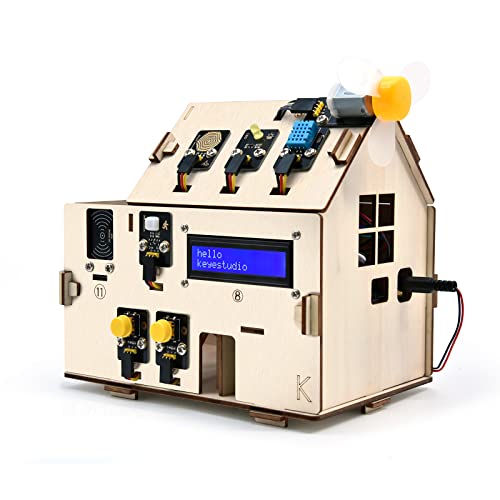
The KEYESTUDIO ESP32 Smart Home Starter Kit stands out for teens and adults enthusiastic to explore home automation with a hands-on, educational approach, especially if you’re new to coding or electronics. I’ve found it’s perfect for learning Arduino and MicroPython through 13 online tutorials covering sensors, LEDs, and automation logic. It includes a PIR sensor, gas alarm, and temperature module, all controllable via Bluetooth from your phone. You’ll need to supply 6 AA batteries and assemble it yourself using web-based guides. Based on the ESP32 processor and FreeRTOS, it’s reliable for DIY smart home projects, though not plug-and-play.
Best For: Teens 15+ and adults new to electronics and coding who want a hands-on introduction to IoT and home automation using Arduino and MicroPython.
Pros:
- Comprehensive STEM learning kit with 13 online tutorials covering sensors, LEDs, and automation logic
- Supports both C and MicroPython programming for versatile learning and project development
- Enables Bluetooth-controlled smart home functions with a variety of included sensors and modules
Cons:
- Requires 6 AA batteries, which are not included
- No physical manual-users must rely on web-based instructions that may be less accessible offline
- Kit is unassembled and unprogrammed, which may challenge absolute beginners without prior DIY experience
Kasa Smart Plug Mini 4-Pack (EP25P4)

You’ll find the Kasa Smart Plug Mini 4-Pack (EP25P4) works best if you’re already invested in the Apple ecosystem, thanks to its native HomeKit support that lets you control connected devices using Siri voice commands. I use mine with an iPad as a hub, so I can manage plugs remotely. It also works with Alexa, Google Assistant, and SmartThings. Each plug fits tightly in outlets without blocking neighbors and delivers accurate energy usage data through the app. They only connect to 2.4 GHz Wi-Fi and require iOS 10 or Android 5.0+. With UL certification, a two-year warranty, and support for up to 1800W, these plugs offer reliable, safe automation for everyday devices.
Best For: Apple users seeking seamless HomeKit integration with reliable voice control and energy monitoring for smart home automation.
Pros:
- Supports Apple HomeKit, Siri, Alexa, Google Assistant, and SmartThings for versatile voice and app control
- Compact design prevents blocking adjacent outlets and includes UL certification for safety
- Provides real-time and historical energy usage tracking with a 2-year warranty
Cons:
- Wi-Fi only 2.4 GHz compatible, not compatible with 5 GHz networks
- Requires a hub (like iPad, Apple TV, or HomePod) for remote HomeKit access
- Minimum app requirements limit compatibility with older Android and iOS devices
Factors to Consider When Choosing Home Automation
You’ll want to check smart device compatibility first, since not all systems work with every brand or voice assistant. Make sure installation is easy and doesn’t require rewiring, especially if you’re setting things up yourself. Think about voice control options, whether you prefer Alexa, Google, or Siri, and decide if local or cloud storage matters for privacy and response speed.
Smart Device Compatibility
Choosing smart devices that work well together starts with checking communication protocols-like Wi-Fi, Zigbee, Z-Wave, or Matter-since all devices in your system must support the same standard to connect reliably. You’ll want to verify compatibility with voice assistants such as Alexa, Google Assistant, or Siri if you prefer hands-free control. Some systems need a hub to manage devices, while others run directly over Wi-Fi, so check whether extra hardware is necessary. Confirm the devices support your smartphone’s operating system, usually requiring Android 5.0+ or iOS 10.0+, for app-based access. Opt for models with local control so your automation keeps working during internet outages and your data stays private. Prioritizing these factors ensures seamless integration, better security, and smoother long-term use across your smart home setup.
Ease Of Installation
While some home automation systems require professional installation, many modern devices are designed for do-it-yourself setup, making it easier to get started without specialized skills. You’ll find app-guided setup common, with step-by-step instructions that simplify the process, especially if you’re unfamiliar with electrical wiring. Look for plug-and-play devices that work with standard outlets-they need no rewiring and deliver immediate use after setup. Wireless systems using Wi-Fi or Bluetooth typically only need power and your network password, reducing complexity. If installing smart switches or lights, check whether a neutral wire is required, since older homes may lack them at switch boxes. Choose models with tool-free mounting or adhesive backing to save time and minimize skill requirements. These features together help guarantee a smoother, faster installation.
Voice Control Options
How much control do you really want over your home? With voice control, you can operate lights, thermostats, and plugs hands-free using simple spoken commands. Most systems work with major voice assistants like Alexa, Google Assistant, or Siri, letting you choose the one you already use. Some devices connect directly over Wi-Fi, while others need a hub to relay commands. If you want flexibility, pick gear that supports multiple assistants. You can also create routines-say, “Goodnight” to turn off lights and lock doors at once. Make sure your devices actually support the voice platform you prefer, since not all brands work with every assistant. Check for natural language understanding so commands feel intuitive. Voice control adds convenience, especially for quick tasks or when your hands are full.
Local Versus Cloud
If you’re setting up smart devices, you’ll need to decide whether to go with local or cloud-based automation. Local systems process commands on your home network, so they respond faster and keep working during internet outages. Since data stays in your home, you also get better privacy and less risk of external hacks. Devices come back online quickly after power loss, with no sync delays. But cloud systems let you control your home from anywhere, even when you’re miles away, and usually integrate more easily with apps and voice assistants across multiple locations. They do need constant internet, though, and can lag or fail if your connection drops. For reliability and security, go local. If remote access is essential, accept the cloud’s trade-offs. Many top systems now blend both, giving you flexibility without sacrificing performance.
Energy Management Features
When managing energy in your smart home, real-time monitoring gives you clear insights into how much power each device uses, so you can spot energy hogs and make informed choices. You can cut waste by scheduling appliances to run only when needed, reducing idle power and lowering bills. Smart plugs rated for 15A/1800W handle most devices and let you automate lamps, fans, or heaters efficiently. Systems with local processing respond faster and use less network energy than cloud-dependent ones. If you use solar or wind power, pick devices that sync with your renewable setup to maximize clean energy use. Look for models that offer detailed usage reports and flexible automation. Avoid overpaying for features you won’t use, but don’t skip essential compatibility checks. Planning around these features helps you save more long-term.
Frequently Asked Questions
Can I Use These Devices Without an Internet Connection?
You can use some devices without an internet connection, but functionality is limited. Smart lights, locks, and thermostats often work locally via Bluetooth or Z-wave, letting you control them manually. However, you lose remote access, voice control, and updates. Systems using Wi-Fi usually require internet for setup and core features. For reliability during outages, choose locally controlled hubs like SmartThings or Home Assistant. These offer offline automation, but you’ll need planning to maintain full functionality without constant internet access.
Are These Smart Devices Compatible With All Voice Assistants?
You can’t assume these smart devices work with all voice assistants, as compatibility varies by brand and model. Most support Amazon Alexa and Google Assistant, but fewer work with Apple Siri or Samsung Bixby. Always check the product specs before buying. If you rely on a specific voice assistant, confirm integration upfront. Some systems require a hub, which may limit options. Choose devices labeled “Works with” your preferred platform to avoid issues.
Do Any of These Products Work With Solar Power Systems?
Yes, some of these products work with solar power systems, especially if your home runs on a solar-powered inverter or battery setup like the Tesla Powerwall. Devices such as smart thermostats, cameras, and doorbells can operate efficiently with low energy demands. You’ll want to check voltage compatibility and guarantee your solar system supports continuous power output. Pairing energy-efficient automation gear with solar reduces grid reliance and cuts long-term costs effectively.
How Do I Reset a Device if It Stops Responding?
You reset a non-responsive device by holding its reset button for 10–15 seconds until the LED blinks. Unplug it first if there’s no button. Check the manufacturer’s app or manual for exact steps, since timing and signals vary. After resetting, reconnect it to your network. Some devices require re-pairing. Write down setup details beforehand. Avoid frequent resets-they can shorten device life. If problems persist, update firmware or contact support.
Can I Schedule Routines Across Different Smart Home Brands?
Yes, you can schedule routines across different smart home brands, but it depends on your hub or voice assistant. Platforms like Google Home and Apple Home allow cross-brand automation if devices support the ecosystem. Alexa handles multi-brand routines well, especially with Matter-compatible products. For best results, use hubs like Samsung SmartThings or Hubitat. Check device compatibility first, as mixed setups may have delays or require workarounds, reducing reliability over time.