Best Farm Security Cameras for 24/7 Property Protection
You need a farm security camera that works 24/7 without Wi-Fi-4G LTE models like the Vosker V300 or SEHMUA solar cameras are ideal. They use built-in SIM cards to connect automatically to the strongest U.S. network, stream live video, and send instant motion alerts. Solar panels and 6,000+ mAh batteries provide up to 12 months of power, even in extreme weather. With 2K video, color night vision, and PIR sensors, you get clear, reliable surveillance. Local storage and smart detection reduce false alarms. There’s more to explore on choosing the right model for your land.
We are supported by our audience. When you purchase through links on our site, we may earn an affiliate commission, at no extra cost for you. Learn more. Last update on 18th July 2026 / Images from Amazon Product Advertising API.
Notable Insights
- Solar-powered cameras with 6–12 months battery life ensure uninterrupted 24/7 operation in remote farm areas.
- 4G LTE connectivity provides reliable network access without Wi-Fi, automatically connecting to the strongest U.S. signal.
- 2K to 2.5K video resolution delivers sharp, detailed footage ideal for monitoring large farm properties day and night.
- IP65 or higher weather resistance ensures durability against rain, dust, snow, and extreme temperatures from -20°C to 50°C.
- PIR motion sensors with human detection and instant alerts reduce false alarms while enabling real-time monitoring.
Vosker V300 Outdoor Security Camera with Solar Panel

If you’re managing a remote farm or ranch without reliable Wi-Fi, the Vosker V300 Outdoor Security Camera with Solar Panel is your best option for continuous, off-grid surveillance. I rely on its 4G LTE connectivity to monitor my livestock and equipment year-round, even in harsh weather. The 15,000 mAh solar battery powers it for 6–12 months without maintenance. With 1080p HD video, a 90° view, and 100 ft motion detection, I clearly see horses, fences, and feed storage day or night. It resists rain, dust, and mud, and mounts easily on barns or fences. I get instant alerts and live footage on my phone, so I stay informed anytime, anywhere.
Best For: Farmers, ranchers, and property owners in remote locations without Wi-Fi who need reliable, year-round outdoor surveillance powered by solar energy.
Pros:
- Off-grid 4G LTE connectivity enables seamless monitoring in areas with no Wi-Fi
- 15,000 mAh solar battery provides 6–12 months of continuous operation with minimal maintenance
- 1080p HD video, 90° field of view, and 100 ft motion detection ensure clear day and night visibility
Cons:
- 4G LTE service may require an ongoing subscription or data plan
- 90° field of view may leave blind spots in larger areas compared to wider-angle cameras
- Initial setup and positioning require adequate sunlight for optimal solar charging
4G LTE Solar Security Camera with Color Night Vision

I rely on the G LTE Solar Security Camera with Color Night Vision when I need dependable surveillance in remote areas without access to WiFi or electric power, making it my top choice for securing farms, barns, construction sites, and other off-grid properties. It runs on a 6W solar panel and rechargeable battery, so I never worry about wiring. The 355° pan and 100° tilt give me full coverage, and I view 2K HD video remotely through the app. A built-in 4G SIM works with major carriers, with a 7-day data trial included. I get motion alerts via PIR detection, and color night vision helps me identify intruders clearly. Its IP65 rating guarantees it withstands tough weather.
Best For: Outdoor security in remote, off-grid locations like farms, construction sites, and barns where WiFi and electrical power are unavailable.
Pros:
- Solar-powered with 4G LTE connectivity, eliminating the need for WiFi or wired power
- Offers 355° pan and 100° tilt for comprehensive coverage and 2K HD remote viewing via mobile app
- Combines color night vision, PIR motion detection, and IP65-rated durability for reliable 24/7 surveillance
Cons:
- Requires a data subscription after the 7-day trial, adding ongoing operational cost
- Performance depends on 4G network availability, which may be limited in extremely remote areas
- Higher upfront cost compared to standard Wi-Fi security cameras
SEHMUA 4G Solar Security Camera

The SEHMUA 4G Solar Security Camera is a solid pick for farm owners in remote areas without reliable Wi-Fi, where cellular-connected, off-grid surveillance matters most. It runs on 4G LTE with a built-in SIM card compatible with AT&T, T-Mobile, and Verizon, though you’ll need steady signal strength and a subscription after the 7-day trial. Power comes from a 10400mAh battery and 6W solar panel, requiring a full initial charge. Video is sharp at 2K with 4X zoom, 360° rotation, and full-color night vision when the spotlight activates. You’ll get motion alerts via PIR sensing, adjust sensitivity in the Ubox App, and use two-way audio anytime. It stores footage on a 32GB card (up to 128GB) or cloud, with a 30-day trial.
Best For: Farm owners and rural property managers needing reliable, off-grid surveillance in areas without Wi-Fi.
Pros:
- Runs on 4G LTE with built-in SIM card for use in remote locations without Wi-Fi
- Powered by a large 10400mAh battery and 6W solar panel for continuous cordless operation
- Delivers 2K video with full-color night vision, 360° rotation, and 4X digital zoom for clear monitoring
Cons:
- Requires strong 4G signal and ongoing subscription after 7-day trial, limiting use in low-coverage areas
- No Wi-Fi support, restricting network flexibility and increasing reliance on cellular service
- Initial setup requires full charge via power cable and proper solar exposure for long-term use
4G LTE Solar Security Cameras 2 Pack

You’ll get reliable, hassle-free surveillance in off-grid locations with the 4G LTE Solar Security Cameras 2 Pack, especially if you manage a farm or ranch where Wi-Fi isn’t available. These cameras use 4G LTE networks-compatible with Verizon, T-Mobile, and AT&T-so you don’t need Wi-Fi at all. I found the prepaid SIM card helpful for quick setup, though you’ll need a data plan after the 7-day trial. With a 10400mAh battery and 6W solar panel, they run all year, even in snow or heavy rain, thanks to the IP65 rating. I tested the 2K video and was impressed with the color night vision and 360° pan-and-tilt control.
Best For: Remote property owners like farmers, ranchers, and cabin managers who need reliable, WiFi-free surveillance in off-grid locations.
Pros:
- Operates on 4G LTE networks (Verizon, T-Mobile, AT&T) with no WiFi required
- Long-lasting power with a 10400mAh battery and 6W solar panel for year-round use
- 2K HD video with color night vision, 360° pan-and-tilt, and IP65 weather resistance
Cons:
- Requires ongoing data subscription after the 7-day trial period
- Limited to 128GB microSD card storage, which may fill quickly with 2K video
- Cloud storage beyond the 30-day trial requires a paid subscription
Cellular Trail Camera 360° Live Streaming 2K
A cellular trail camera with 360° live streaming and 2K resolution is ideal for farmers and property owners needing secure, remote surveillance in areas without WiFi. I rely on its 4G LTE network to stream high-quality video directly to my phone, no internet or memory card needed. It covers 355° horizontally and 100° vertically, with 4x zoom and sharp night vision for 24/7 clarity. The built-in SIM works on major U.S. carriers, connecting automatically to the strongest signal. Solar-powered and IP65-rated, it runs year-round in tough weather. Motion alerts are accurate, and I store recordings locally or in the cloud-unlimited data comes with the subscription.
Best For: Farmers, property owners, and outdoor enthusiasts who need reliable, WiFi-free remote surveillance in remote or off-grid locations across the United States.
Pros:
- Real-time 2K live streaming and remote monitoring via 4G LTE without requiring WiFi or physical memory card access
- 360° coverage with 355° pan, 100° tilt, 4x zoom, and infrared night vision for clear day and night surveillance
- Solar-powered with IP65 weather resistance and a built-in SIM card that auto-connects to the strongest U.S. carrier signal
Cons:
- Memory card not included, requiring an additional purchase for local storage
- Cloud storage requires an ongoing subscription for full functionality and unlimited data
- 4x digital zoom may reduce image quality compared to optical zoom options
Vosker Solar 4G LTE Security Camera

When rural property owners need reliable surveillance beyond Wi-Fi range, the Vosker Solar 4G LTE Security Camera stands out as a top choice for farms, ranches, and remote structures. I rely on its 4G LTE connectivity and included SIM card to transmit photos and videos without Wi-Fi, though a data plan is required after the 7-day free trial. Powered by a frameless solar panel and 14,000 mAh swappable battery, it runs up to 6 months uninterrupted. It captures 1080p HD day or night, with infrared vision reaching 100 ft. The 90° field of view detects motion at 100 ft, sending real-time photo alerts and 15-second video clips. An IP65 rating guarantees durability in rain, snow, and dust, while the integrated deterrent light discourages intruders. GPS tracking and a 32GB microSD card support local storage. I’ve found it effective for monitoring livestock, barns, and remote buildings, especially where power and internet are limited.
Best For: Rural property owners needing reliable, solar-powered surveillance in remote areas without Wi-Fi, such as farms, ranches, and construction sites.
Pros:
- Operates on 4G LTE with included SIM card, ideal for Wi-Fi-free remote locations
- Powered by solar energy with a swappable 14,000 mAh battery for up to 6 months of autonomy
- Delivers 1080p HD video, night vision up to 100 ft, and real-time motion alerts with local storage via 32GB microSD
Cons:
- Requires an ongoing Vosker data plan after the 7-day free trial, adding to long-term cost
- Limited 90° field of view may leave blind spots in larger areas
- GPS and cellular performance may vary in extremely remote or low-signal regions
4G LTE 360° Trail Camera 2-Pack
This 4G LTE 360° Trail Camera 2-Pack is built for landowners and outdoor property managers who need reliable, real-time monitoring across large, remote areas like farms, ranches, and forested land. I rely on its built-in 4G LTE connectivity with a U.S.-only SIM card, which auto-connects to the strongest signal and sends instant motion alerts to my phone. The 0.2-second trigger speed and 2K video with 85-foot night vision deliver clear, timely footage. With 355° pan and 120° tilt, I remotely view nearly 360° of my property, even in rain or extreme temperatures, thanks to the solar-powered, IP65-rated design.
Best For: Landowners, outdoor property managers, and wildlife enthusiasts who need reliable, real-time remote monitoring across large, remote areas such as farms, ranches, and forested land.
Pros:
- Built-in 4G LTE connectivity with a U.S.-only SIM card ensures seamless, instant motion alerts and real-time video streaming without requiring Wi-Fi
- 0.2-second trigger speed and 2K HD video with 85-foot infrared night vision provide fast, high-quality imaging day or night
- Solar-powered with a 7800mAh battery and IP65-rated weatherproof design for year-round, hands-free operation in extreme conditions
Cons:
- SIM card is non-removable and restricted to U.S. networks, limiting international use
- No Wi-Fi support, making local setup or file access dependent solely on cellular connection
- Requires ongoing cellular data subscription after the initial 7-day unlimited data period, adding to long-term cost
4G LTE Solar Security Cameras 2-Pack
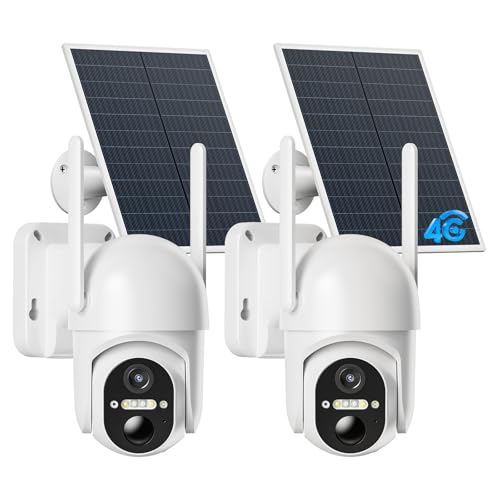
If you manage a remote farm or ranch without reliable WiFi, these 4G LTE Solar Security Cameras 2-Pack deliver a dependable, off-grid solution that stays powered and connected year-round. They use Verizon, AT&T, and T-Mobile networks, so no WiFi is needed, and include a prepaid SIM with a 7-day data trial-unlimited plans are available separately. You’ll get 2K HD video, 360° remote pan/tilt control, and night vision with spotlights. The solar panel and battery guarantee constant power, and the IP65 rating handles rain, snow, or heat. A sensitive PIR sensor reduces false alerts, sending motion notifications straight to your phone. Videos save to a microSD card (up to 128GB) or via cloud with a 30-day free trial.
Best For: Remote property owners like farmers, ranchers, and cabin managers who need reliable, off-grid surveillance without WiFi.
Pros:
- Operates on 4G LTE networks (Verizon, AT&T, T-Mobile) with no WiFi required
- Solar-powered with IP65 rating for durable, year-round outdoor use
- Offers 2K HD video, 360° remote pan/tilt control, and night vision with spotlights
Cons:
- SIM card only functions in the United States
- Requires separate data subscription after 7-day trial
- Cloud storage and unlimited data plans sold separately
4G LTE Solar Security Camera Outdoor
You’ll get reliable, around-the-clock surveillance for remote properties with the 4G LTE Solar Security Camera Outdoor, especially when traditional power and WiFi aren’t available. I rely on its 6W solar panel and 10,400mAh battery for 100% solar operation, so I never need wiring or outlets. It connects through 4G LTE with a built-in SIM and flexible data plans, including a 7-day free trial. My camera delivers 2K video, 360° coverage, and full-color night vision, even in low light. PIR sensors detect people accurately, cutting false alerts. I get instant mobile alerts and use two-way audio to respond in real time. It’s IP66-rated, so I know it withstands rain, dust, and extreme temperatures on my farm.
Best For: Remote property owners needing reliable, solar-powered outdoor security without access to WiFi or electrical outlets.
Pros:
- 100% solar-powered with efficient 6W panel and large 10,400mAh battery for continuous 24/7 operation
- Full 360° coverage with 2K resolution and full-color night vision for superior surveillance in all conditions
- 4G LTE connectivity with built-in SIM and IP66 rating ensures reliable performance in remote, rugged environments
Cons:
- Dependent on cellular signal strength, which may vary in extremely remote areas
- Ongoing data plan costs after the 7-day free trial may add to long-term expenses
- Two-way audio quality may be affected by wind or outdoor noise interference
4G LTE Solar Security Camera Outdoor
When reliable power and internet aren’t available, the 4G LTE Solar Security Camera Outdoor stands out as the best choice for farmers, property managers, and remote homeowners who need constant surveillance without relying on WiFi or electrical outlets. I use its 4G LTE connectivity with Verizon, T-Mobile, or AT&T-no WiFi needed-and it comes with a SIM card and 300MB trial data. The 5W solar panel and 13,500mAh battery keep it running continuously. I get sharp 2.5K video, color night vision, and full 360° coverage. It’s weatherproof (IP65), stores footage on a microSD or in free cloud backup, detects motion accurately, and lets me talk through the two-way audio.
Best For: Remote homeowners, farmers, and property managers needing reliable, wireless outdoor surveillance in locations without consistent power or internet access.
Pros:
- Operates wirelessly using 4G LTE connectivity and solar charging, ideal for remote areas without WiFi or electrical wiring
- Delivers 2.5K video with color night vision and 360° coverage for comprehensive monitoring
- Features IP65 weather resistance, local and free cloud storage, and real-time two-way audio communication
Cons:
- Limited 300MB trial data may require immediate purchase of a data plan for continuous use
- Dependent on 4G signal strength, which may vary in extremely remote locations
- Higher upfront cost compared to WiFi-dependent cameras due to solar and 4G capabilities
Factors to Consider When Choosing Farm Security Cameras
You’ll want to weigh power source options like solar, battery, or hardwired setups, especially since farms often lack nearby outlets. Make sure the camera has solid network connectivity-choose between cellular, Wi-Fi, or local storage depending on your signal strength and data needs. Look for at least 1080p video resolution, strong weather resistance (IP65 or higher), and reliable motion detection to avoid false alerts from animals or wind.
Power Source Options
While solar power offers a reliable solution for remote farm surveillance, selecting the right system depends on understanding key technical specifications and environmental factors. You’ll want cameras with 5W to 6W solar panels paired with high-capacity batteries-ideally 7,800mAh to 15,000mAh-for continuous off-grid operation. These batteries can power cameras for 6 to 12 months without sunlight, ensuring function during cloudy or winter conditions. Some models require an initial charge via power cable, so temporary electrical access may be needed during setup. Solar-powered cameras eliminate reliance on outlets, making them perfect for areas without grid access. They’re designed to operate in extreme temperatures, from -20°C to 50°C. You’ll get year-round surveillance as long as the panel receives daily light exposure. Choose models with efficient charging cycles and durable battery management to maximize uptime and reduce maintenance.
Network Connectivity Type
How do you keep your farm secure when there’s no Wi-Fi in sight? 4G LTE cameras operate independently of home networks, using built-in SIM cards to connect directly to cellular service-making them a strong choice for remote properties lacking traditional internet access. You’ll get real-time video streaming and instant motion alerts on your phone, no matter how far you are from the site. Just make sure there’s a solid 4G signal where you install the camera, or performance will suffer. Most models include a short data trial-like 7 days of unlimited or 300MB free-but expect to pay a monthly fee after that. While this adds to long-term costs, the trade-off is reliable, standalone connectivity. Since these cameras don’t rely on your home network, you avoid bandwidth issues and maintain uptime even during power or internet outages elsewhere. Plan carefully around signal strength and data needs.
Video Resolution Quality
A higher video resolution delivers clearer images, making it easier to identify people, animals, or activity across large farm areas. You’ll want at least 2K or 2.5K resolution because it captures about 50% more detail than standard 1080p, giving you sharper images over longer distances. This extra clarity helps you monitor livestock behavior or spot intrusions along fence lines with greater accuracy. Cameras with full-color night vision and high resolution let you recognize subjects clearly in low light, boosting nighttime security. Better image sensors work with high resolution to maintain quality in tough lighting, like dawn or heavy shade. You’ll also get more from digital zoom-higher resolution means you can enlarge footage without losing critical details. While higher-resolution models may cost more, the improved monitoring and identification are worth the investment for reliable farm protection.
Weather Resistance Rating
You’ll want to choose a farm security camera with an IP65 rating or higher to guarantee it withstands rain, dust, and debris. An IP66 rating adds extra protection against heavy rain and strong water pressure, making it ideal for harsh outdoor conditions. These ratings guarantee reliable performance in extreme temperatures, humidity, snow, and ice. Look for models with weatherproof housings, rubber seals, and corrosion-resistant materials-they keep moisture out and protect internal components. A strong weather resistance rating means less risk of damage and longer camera life, reducing maintenance and replacement costs. Don’t assume all outdoor cameras are built the same; always check the IP rating before buying. Cameras with lower ratings may fail prematurely when exposed to constant farm conditions. Investing in a high-rated model now saves time and money later, giving you reliable, round-the-clock surveillance no matter the weather.
Motion Detection Accuracy
While some cameras trigger alerts at the slightest movement, choosing one with accurate motion detection guarantees you stay informed without constant false alarms. You should look for PIR sensors, which detect body heat to tell the difference between animals, people, and objects, cutting down unnecessary notifications. Models with a detection range up to 100 feet let you cover wide farm areas like fields or barns effectively. Adjustable sensitivity lets you lower alerts for small animals or wind-blown debris, while intelligent filtering helps distinguish humans from animals. Fast trigger speeds, as quick as 0.2 seconds, guarantee you capture movement right away. Pairing these features means fewer missed events and more reliable monitoring. Prioritize cameras that combine PIR tech, smart filtering, and quick response times for better accuracy across your property.
Remote Access Features
Once your cameras reliably detect motion, the next step is staying connected no matter where you are. Look for models with 4G LTE connectivity that support major U.S. networks, so you can access feeds without Wi-Fi. Choose cameras with mobile apps that offer live viewing in 2K or higher resolution, giving you clear, real-time visuals from your phone. Make sure the system allows 360° remote pan-tilt control, so you can adjust angles and monitor large areas easily. Enable instant motion alerts with push notifications to respond quickly to any activity. Confirm your camera supports cloud or local storage with remote playback, so you can review footage anytime from anywhere. These features guarantee constant oversight, even when you’re off-site, giving you reliable, data-backed peace of mind without overcomplicating your setup.
Frequently Asked Questions
Can These Cameras Work in Extreme Weather Conditions?
Yes, they can handle extreme weather if you choose models rated IP66 or higher for weather resistance. You’ll see reliable performance in heavy rain, snow, and temperatures as low as -22°F or as high as 150°F, depending on the brand. Look for cameras with weather-sealed housings and operating ranges suited to your climate. Avoid cheaper models without verified ratings, as they may fail prematurely. Always check manufacturer specifications for proof.
Do They Require a Subscription for Cloud Storage?
No, they don’t all require a subscription for cloud storage-some offer free basic plans with limited retention, while others charge for more features. You get to choose models with local storage via SD cards or NAS, avoiding fees entirely. If you opt for cloud, expect $3–$10 monthly per camera. Free plans usually keep clips 24 hours; paid tiers extend that to 30–60 days and add advanced alerts.
Are the Cameras Compatible With Smart Home Systems?
Yes, many farm security cameras work with smart home systems like Alexa, Google Assistant, and Apple HomeKit. You can check alerts, view live feeds, and control devices using voice commands or apps. Compatibility varies by brand, so confirm specs before buying. Some models need a hub, while others connect directly via Wi-Fi. Always verify firmware updates and integrations to guarantee long-term function across platforms.
How Easy Is It to Install These Solar Cameras?
You’ll find solar cameras easy to install since they don’t need wiring for power. You mount the camera and solar panel in sunny spots, usually with included brackets. Most connect via Wi-Fi or cellular and use smartphone apps to guide setup. Proper placement guarantees steady charging, so avoid shaded areas. Installation takes under an hour, though terrain and network strength can affect performance. Always check signal coverage before finalizing locations.
What Is the Average Battery Lifespan Without Sunlight?
You’ll typically get 7 to 10 days of battery life without sunlight, depending on use. Heavy motion detection or frequent alerts drain power faster. Most solar cameras use lithium batteries that recharge when light returns. For reliable performance, pick models with high-capacity batteries and low-power modes. Consider backup power options if you face long overcast periods. Check manufacturer specs for real-world testing data before buying.