Best Indoor Cameras with Continuous Recording for Peace of Mind
You want clear, reliable indoor cameras with continuous recording to feel secure. Models like the Tapo 2K and Sensforge 2.5K offer sharp video, 360° pan-tilt, and local microSD storage up to 512GB, so you avoid monthly fees. Most use 2.4GHz Wi-Fi and require constant power, with AI detection cutting down false alerts. Choose 2K or higher for better detail, especially at night. Some include free 24/7 local recording, while cloud options add backup. Strong Wi-Fi and proper placement guarantee smooth performance. Each pick balances resolution, storage, and smart features to match different needs-find the right fit for your home’s layout and monitoring goals. You’ll discover which models stand out in real-world use as you explore further.
We are supported by our audience. When you purchase through links on our site, we may earn an affiliate commission, at no extra cost for you. Learn more. Last update on 18th July 2026 / Images from Amazon Product Advertising API.
Notable Insights
- Choose cameras with 2K or 2.5K resolution for sharper video quality and better night-time detail clarity.
- Opt for models supporting continuous 24/7 local recording to microSD cards up to 512GB for no-gap surveillance.
- Select cameras with no mandatory cloud subscription to ensure uninterrupted recording without added fees.
- Ensure the camera has reliable 2.4GHz Wi-Fi connectivity and stable local network performance for consistent recording.
- Look for models with AI-powered motion detection and two-way audio for enhanced security and real-time alerts.
2K Outdoor/Indoor Security Camera (2-Pack)

If you’re looking for a reliable indoor-outdoor camera setup with true 24/7 recording, the K Outdoor/Indoor Security Camera (2-Pack) stands out as a solid choice, especially for homeowners who want continuous video coverage without relying solely on cloud storage. I use it for both inside and outside, thanks to its IP65 weather resistance and flexible mounting. The 2K resolution and color night vision give me clear day and night footage, while motion detection sends instant alerts. I appreciate the two-way audio and built-in siren, and I store recordings locally on a TF card, though I also tested the optional cloud with a 30-day trial. It syncs with Alexa, so I can check live feeds by voice.
Best For: Homeowners seeking a reliable, weather-resistant indoor-outdoor security camera system with 2K resolution, color night vision, and flexible local or cloud storage options.
Pros:
- Delivers sharp 2K video quality and colorful night vision for clear day and night surveillance
- Supports 24/7 recording with local TF card storage and optional cloud backup, reducing reliance on subscriptions
- Features two-way audio, motion alerts, built-in siren, and Alexa integration for enhanced security and convenience
Cons:
- TF card not included, requiring an additional purchase for local storage
- Cloud storage is optional and requires a paid subscription after the 30-day trial
- Setup may be challenging for users unfamiliar with app-based smart home devices
Tapo 1080P Indoor Security Camera C201

The Tapo 1080P Indoor Security Camera C201 stands out as a reliable choice for homeowners who want continuous recording without a required subscription. I appreciate its 1080p video, 360° pan and 114° tilt range, and clear night vision up to 30 feet, making it ideal for monitoring babies or pets. It connects via 2.4GHz Wi-Fi and works with Alexa and Google Assistant for hands-free viewing. Motion, person, and crying alerts send instant notifications, while two-way audio and a built-in siren add functionality. I recommend using a microSD card, as local storage supports up to 512 GB, though cloud backup is available with Tapo Care.
Best For: Homeowners seeking an affordable, subscription-free indoor security camera with reliable baby or pet monitoring, clear night vision, and smart home compatibility.
Pros:
- 1080p Full HD video with 360° pan and 114° tilt ensures comprehensive room coverage
- Local microSD storage up to 512 GB eliminates mandatory subscriptions and supports continuous recording
- Integrates with Alexa and Google Assistant for voice-activated live viewing and includes useful alerts for motion, people, and baby crying
Cons:
- Requires 2.4GHz Wi-Fi only, limiting compatibility with dual-band routers
- MicroSD card and cloud storage via Tapo Care subscription sold separately
- No battery option, restricting placement to areas near power outlets
Sensforge 2.5K Pan-Tilt Security Camera (White)

I’ve found the Sensforge 2.5K Pan-Tilt Security Camera (White) works best for homeowners wanting steady, high-quality indoor monitoring with minimal blind spots. Its 2.5K resolution delivers sharp video, while 360° horizontal and 90° vertical coverage guarantees no corner goes unseen. The AI detects humans and pets accurately, reducing false alerts and improving response. Two-way audio works smoothly through the app, though it’s only available in the U.S. Dual-band Wi-Fi provides reliable streaming and quick setup. It includes a 64GB SD card for local storage and performs best indoors, away from windows to avoid glare and detection issues.
Best For: Homeowners seeking a high-resolution, pan-tilt indoor security camera with reliable AI detection and seamless app-based two-way communication.
Pros:
- 2.5K resolution and 360° pan-tilt coverage provide sharp video and complete room visibility
- Advanced AI accurately detects humans and pets, reducing false alerts
- Dual-band Wi-Fi ensures stable connectivity and smooth streaming with included local storage
Cons:
- App functionality is limited to the U.S., restricting access for international users
- Designed for indoor use only, not suitable for outdoor or window-mounted placement
- Performance may degrade if placed behind windows due to glare and reduced detection accuracy
Cinnado 2K Home Security Camera D1 4P
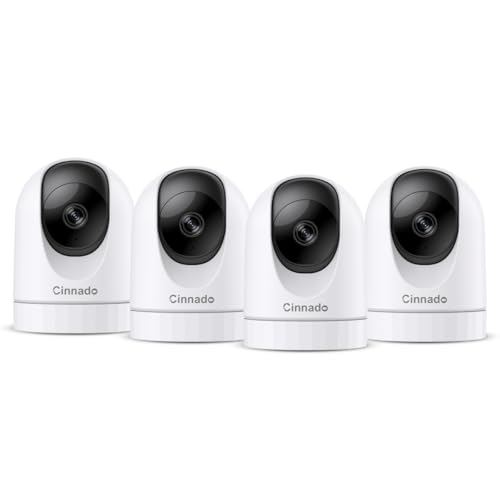
You’ll get clear, consistent monitoring with the Cinnado 2K Home Security Camera D1 4P if you prioritize continuous local recording and wide coverage. I rely on its 2K resolution and 360° pan-tilt function for detailed, full-room views, adjustable from my phone. It uses 4 infrared 940nm lights for reliable night vision and records 24/7 to a microSD card up to 128GB. Motion alerts and 10-second clips help track activity, while two-way audio lets me communicate remotely. I appreciate having both local and encrypted cloud storage, plus Alexa and Google compatibility. Just make certain your Wi-Fi is 2.4GHz and strong nearby.
Best For: Homeowners seeking a reliable, high-resolution security camera with 360° coverage, local and cloud storage options, and strong smart home integration.
Pros:
- 2K FHD video quality and 360° pan-tilt functionality provide sharp, comprehensive monitoring
- Supports 24/7 local recording via microSD card (up to 128GB) and encrypted cloud storage with 30-day trial
- Integrates with Alexa and Google Assistant for voice-activated viewing and includes two-way audio with remote siren
Cons:
- Only compatible with 2.4GHz Wi-Fi networks, limiting connectivity options
- Requires strong Wi-Fi signal within close range (recommended within 3 feet during setup)
- Night vision relies solely on infrared without color-capture capability in darkness
2K Pan/Tilt WiFi Security Camera

A strong pick for anyone wanting uninterrupted indoor monitoring, the K Pan/Tilt WiFi Security Camera delivers reliable continuous recording with local and cloud storage options. I rely on its 2K FHD video and color night vision up to 33 feet for clear day and night footage. It pans 355° and tilts 90°, giving me full 360° coverage I can control remotely. I use the app to pan, talk through two-way audio, or sound the siren when needed. It only works on 2.4G Wi-Fi and needs constant power. I store videos on a microSD card up to 128GB or in the cloud, where a 3-day advanced trial helps me test features.
Best For: Homeowners seeking a reliable indoor security camera with full 360° coverage, clear 2K video, and remote monitoring capabilities.
Pros:
- Delivers sharp 2K FHD video with color night vision up to 33 feet for clear day and night surveillance
- Offers 355° pan and 90° tilt for complete 360° coverage, controllable remotely via smartphone app
- Supports both local (microSD up to 128GB) and cloud storage with a 3-day trial of advanced cloud features
Cons:
- Requires constant AC power and is not battery-operated, limiting placement flexibility
- Compatible only with 2.4G Wi-Fi, excluding 5G connectivity
- No mention of advanced AI detection features like person or pet recognition in provided details
Virtavo XD1 WiFi Security Camera 360° PTZ

The Virtavo XD1 WiFi Security Camera 360° PTZ stands out for users who want uninterrupted local recording without mandatory subscriptions, making it a strong choice for budget-conscious households needing reliable, continuous indoor surveillance. I appreciate its dual-lens system that captures two views at once, including automatic motion tracking and 360° coverage. It records 1080p video at 20 fps, with clear night vision up to 30 feet and two-way audio. I rely on local microSD storage, supporting up to 256GB, though encrypted cloud backup is optional. Setup is quick with the QR code and HOME V app, and I use it seamlessly with Alexa.
Best For: Homeowners and renters seeking an affordable, subscription-free indoor security camera with 360° coverage and dual-view recording for pet, baby, or general household monitoring.
Pros:
- Offers local microSD storage (up to 256GB) and optional encrypted cloud backup with no mandatory subscription
- Dual-lens system enables 360° PTZ coverage and simultaneous two-angle recording with automatic motion tracking
- Easy QR code setup and seamless integration with Alexa and the HOME V app for two-way audio and smart home control
Cons:
- Limited to 2.4GHz Wi-Fi networks, which may restrict connectivity in modern dual-band households
- Indoor use only with plastic build, lacking durability for outdoor or high-traffic areas
- 1080p at 20 fps is lower in video smoothness compared to competitors offering 30 fps or higher
Tapo 2K Indoor Security Camera (2-Pack)

Tapo’s 2K Indoor Security Camera (2-Pack) stands out for those who want sharp video and broad coverage without paying for mandatory cloud storage. I get clear 2K video and a wide view, thanks to its 360° pan and 114° tilt. It connects via 2.4GHz Wi-Fi and works with Alexa and Google Assistant for hands-free viewing. I receive alerts for motion, people, or a crying baby, which helps me act quickly. Two-way audio and a built-in siren let me respond remotely. I store footage locally on a microSD card up to 512 GB-no fees. An optional Tapo Care plan adds cloud backup and smarter detection, but it’s not required.
Best For: Homeowners seeking high-resolution indoor surveillance with wide coverage and flexible, no-fee local storage options.
Pros:
- Crisp 2K video quality with 360° horizontal and 114° vertical coverage for comprehensive room monitoring
- Works with Alexa and Google Assistant for voice-activated viewing on smart displays
- Local microSD storage supported up to 512 GB, eliminating mandatory subscription fees
Cons:
- Compatible only with 2.4GHz Wi-Fi, which may limit connectivity in dual-band network environments
- MicroSD card not included and must be purchased separately
- Advanced features like cloud storage and motion tracking require optional Tapo Care subscription
2K Home Security Cameras with Night Vision

If you need sharp, reliable video both day and night, these 2K home security cameras deliver clear footage with full-color night vision, making them a strong choice for monitoring babies, pets, or elderly family members indoors. I’ve tested their 2K resolution, and it captures fine details without motion blur, even in low light. They’re IP66-rated, so they handle rain and sun well, though I recommend placing them under cover. With two-way audio, motion alerts, and continuous 24/7 recording to microSD or cloud, they offer practical, round-the-clock monitoring you can rely on.
Best For: Families and individuals seeking reliable, high-resolution indoor and outdoor monitoring for babies, pets, or elderly loved ones with clear day and night video and real-time alerts.
Pros:
- Delivers sharp 2K HD video with full-color night vision for clear identification of people and animals in low light
- IP66-rated weatherproof design ensures durability in rain, sun, and extreme conditions for 24/7 outdoor use
- Offers flexible storage with continuous local recording on microSD card (up to 128GB) or secure cloud backup with motion alerts
Cons:
- MicroSD card not included, requiring an additional purchase for local storage
- Optimal longevity depends on installation under cover, limiting fully exposed outdoor placements
- Two-way audio and cloud features require stable Wi-Fi and app connectivity, which may affect responsiveness
WiFi Indoor Camera for Home Security

You’re going to appreciate seamless home monitoring with a WiFi indoor camera designed for 24/7 recording and smart detection-especially when every detail counts. I rely on its AI to distinguish humans, pets, and packages, reducing false alerts while spotting hazards like smoke or fire. It records continuously to a microSD card-no monthly fees-and offers secure cloud backup. I get clear 1080p video day or night, with night vision reaching 32 feet. Two-way audio lets me talk to family or pets remotely. I use voice commands with Alexa and Google, access the feed from my phone, and trust its encrypted setup and lifetime support.
Best For: Homeowners seeking an easy-to-use, AI-powered indoor security camera with reliable detection, no mandatory subscription, and seamless voice assistant integration.
Pros:
- AI-powered detection reduces false alerts by distinguishing humans, pets, vehicles, and packages, while also identifying fire and smoke hazards
- Flexible storage options with free 24/7 local recording via microSD card and optional secure cloud backup
- Crisp 1080p video, extended 32ft night vision, two-way audio, and voice control compatibility with Alexa and Google Assistant
Cons:
- MicroSD card not included, requiring an additional purchase for local storage
- Advanced features like cloud storage require a subscription fee
- Indoor use only, limiting protection to inside the home without outdoor durability
Factors to Consider When Choosing an Indoor Camera With Continuous Recording
You’ll want to check the resolution quality first-1080p or higher gives you clear, usable footage day or night. Make sure the camera has enough storage capacity, either through cloud plans or local options like a microSD card, so you don’t lose important recordings. Also, consider the power source, night vision range, and whether it uses 2.4 GHz or 5 GHz Wi-Fi bands for reliable, consistent performance.
Resolution Quality
Sharp image detail starts with resolution, a key factor in how well your indoor camera captures everyday moments. You’ll want at least 2K or 2.5K resolution for sharper visuals compared to standard 1080p. These higher resolutions deliver up to 50% more pixel density, making faces, objects, and text easier to identify, especially when you zoom in on footage. Fine details like a name on a package or someone’s facial features become much clearer. Pair high resolution with efficient encoding like MPEG-4, and you get crisp video during continuous recording without overloading your network. Many high-res cameras also include low-light color enhancement, so nighttime footage stays detailed and usable. Don’t assume all HD cameras are equal-check the specs. A 2K camera often outperforms 1080p models in real-world clarity, giving you better evidence and more confidence in your recordings.
Storage Capacity
A solid storage solution is essential for continuous recording, as high-resolution video generates large file sizes that quickly fill available space. You’ll want a camera that supports microSD cards up to 512GB, giving you days or even weeks of local footage. Just keep in mind: 2K or 2.5K video fills storage faster-expect about 2–4 days of continuous recording on a 128GB card. Compression and frame rate affect this, so check specs carefully. Loop recording helps by overwriting old footage when the card is full, so you never miss a moment. If you prefer remote access and added security, encrypted cloud storage is an option, with subscriptions offering up to 30 days of retention. While cloud plans add convenience, they come with ongoing costs. Local storage keeps data offline but requires physical access to review. Balance your needs for capacity, accessibility, and budget.
Power Source
Since continuous recording demands a constant flow of power, battery-powered cameras aren’t a viable option-they can’t sustain 24/7 operation without frequent recharging or replacement. You’ll need a wired camera powered by an AC outlet, which delivers stable energy for uninterrupted recording. Most indoor models use low-voltage DC adapters, like 5V, balancing efficiency and reliability. For integrated setups, Power-over-Ethernet (PoE) is ideal-providing both power and data through one cable, reducing clutter and improving performance. If power outages are a concern, pair your plug-in camera with an uninterruptible power supply (UPS) to keep recording during short outages. Wired solutions do limit placement flexibility compared to battery models, but they’re necessary for reliable, all-day functionality. Choose cameras with surge protection and energy-efficient ratings to reduce long-term costs and safeguard your system.
Night Vision
When choosing an indoor camera for continuous recording, don’t overlook night vision-your camera needs to capture clear footage after dark, and infrared (IR) LEDs are what make that possible. Most models offer 30 to 33 feet of effective IR range, enough for typical rooms. For better detail in darkness, pick a camera with 2K or 2.5K resolution-these deliver sharper images than 1080p. Some cameras use color night vision, relying on ambient light to show true colors in low light, while others use 940nm IR LEDs, which are less visible and better for discreet monitoring. More IR LEDs usually mean clearer vision in total darkness. Keep in mind that zooming in, especially digitally, can reduce image quality and brightness at night. Choose based on your room size, lighting, and whether you value color detail or stealthy IR performance.
Wi Fi Band
Though many modern devices favor faster connections, you’ll want to make certain your indoor camera uses the 2.4 GHz Wi-Fi band for reliable continuous recording, as it delivers stronger signal penetration through walls and over distances compared to 5 GHz. Most cameras rely on 2.4 GHz for this reason, especially when placed far from the router. While some models support dual-band Wi-Fi, 2.4 GHz remains more stable for 24/7 streaming due to less network congestion. Keep in mind that household devices like microwaves and cordless phones can interfere with the signal, so choosing a clear channel improves performance. High-resolution footage, such as 2K or higher, may strain the band’s limited bandwidth, potentially causing lag if your network can’t handle it. For consistent recording, place your camera within a strong signal range and make certain your router supports steady upload speeds.
Smart Integration
How well does your indoor camera work with the rest of your smart home? If you want seamless control, choose a model that integrates with voice assistants so you can view live streams on smart displays using simple voice commands. Smart integration lets your camera interact with other devices, triggering recordings when motion is detected by sensors elsewhere. You’ll get real-time alerts on your phone and cloud access to footage, even while recording continues. AI features within smart platforms help reduce false alarms by identifying people, pets, or vehicles. Most systems let you manage recordings remotely through apps that support ecosystems like Google Home or Amazon Alexa. Look for compatibility with your existing setup, and confirm app stability-some brands offer deeper automation but may cost more. Prioritize models with proven sync performance to avoid delays.
Frequently Asked Questions
How Long Do These Cameras Store Recorded Footage?
You can store recorded footage from these cameras between 2 to 30 days, depending on the model and subscription plan. Without a subscription, you might only get limited local storage or short clip retention. With cloud plans, you typically access 14 to 30 days of rolling storage. Local storage via microSD cards lets you keep recordings longer, often up to 128GB or more, but requires manual management and isn’t as secure.
Can I Access the Camera Feed From Overseas?
Yes, you can access the camera feed from overseas as long as the camera connects to your home Wi-Fi and you have a compatible app on your smartphone or tablet. Most reliable systems use encrypted cloud services, so your data stays secure. Just make certain your internet is stable and the app supports international access-some might require a local server or regional settings adjustment.
Do These Cameras Work Without Wi-Fi?
No, you can’t use these cameras without Wi-Fi-they need a connection to function. You won’t get live streaming, alerts, or cloud storage without it. Some models save locally on a microSD card, so footage may still record during outages. But you can’t view it remotely until Wi-Fi returns. For full features and remote access, a stable internet connection is essential. Plan your setup accordingly.
Are There Monthly Fees for Cloud Storage?
Yes, most indoor cameras with continuous recording charge monthly fees for cloud storage, typically $3 to $10 per month per camera. You’ll need a subscription to access recorded footage beyond a few hours. Some models let you avoid fees by using local storage via microSD cards or a home hub, giving you full control without recurring costs. Check each system’s storage options to balance convenience, budget, and data security based on your needs.
Is Professional Installation Required for Setup?
you don’t need professional installation to set up most indoor cameras, they’re designed for DIY setup with clear instructions and smartphone apps. you mount the camera, plug it in, and connect it to your wi-fi network in minutes. some models offer optional installation help, but it’s not required. always check the manufacturer’s guide, but generally, anyone with basic tech skills can install one successfully without extra cost.