Best Smart Home Automation Hub Systems for Ultimate Control
You gain ultimate control with hubs like the Hubitat Elevation C-8 Pro, which supports Zigbee, Z-Wave, and local processing for fast, offline automation. The Aeotec Smart Home Hub adds Matter support, ensuring broad device compatibility. Home Assistant Green offers full local control, high device capacity, and expandable protocols via USB. Each provides strong privacy and reliable performance. Choose based on your preferred ecosystem, protocol needs, and technical comfort-your ideal setup balances connectivity, autonomy, and long-term flexibility. More details follow to help match features to your priorities.
We are supported by our audience. When you purchase through links on our site, we may earn an affiliate commission, at no extra cost for you. Learn more. Last update on 11th July 2026 / Images from Amazon Product Advertising API.
Notable Insights
- Choose hubs with broad protocol support like Z-Wave, Zigbee, Wi-Fi, and Matter for maximum device compatibility.
- Prioritize local automation to ensure fast response times and reliable operation during internet outages.
- Opt for hubs with offline functionality and on-device processing to enhance privacy and system resilience.
- Select systems with multi-voice assistant integration for seamless control via Alexa, Google Assistant, or Siri.
- Ensure high device capacity and expandability to support large installations and future smart home growth.
Aeotec Smart Home Hub with Z-Wave, Zigbee, Matter
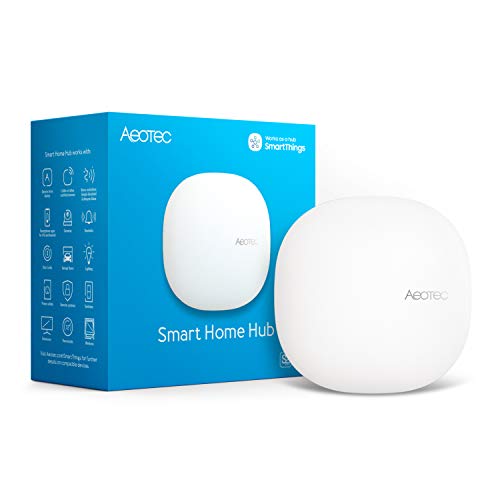
If you’re building a smart home with devices across multiple protocols, the Aeotec Smart Home Hub stands out by supporting Z-Wave, Zigbee, Wi-Fi, and Matter in one reliable unit. I use it as my central hub because it integrates seamlessly with SmartThings, Alexa, and Google Assistant. It’s Matter-certified and runs many automations locally, so responses are fast and still work during internet outages. Setup was quick using the SmartThings app on my phone, and I connected it via Ethernet for stability. It supports top brands for lighting, security, and climate, but it’s designed for North America, so check voltage compatibility if you’re elsewhere.
Best For: Smart home enthusiasts in North America seeking a reliable, multi-protocol hub that supports Z-Wave, Zigbee, Wi-Fi, and Matter with local automation and broad ecosystem integration.
Pros:
- Supports multiple wireless protocols (Z-Wave, Zigbee, Wi-Fi, Matter) for broad device compatibility
- Runs automations locally for faster response and offline reliability
- Integrates seamlessly with SmartThings, Alexa, Google Assistant, and major smart home brands
Cons:
- Designed for North American voltage and regions, limiting international use
- Requires SmartThings app for setup and management, adding ecosystem dependency
- No built-in battery backup or mobile app for standalone hub management
Home Assistant Green Smart Hub

The Home Assistant Green Smart Hub stands out as the best choice for users who prioritize local control and data privacy in their smart home setup. I rely on it because all my data stays in my home-no cloud needed. It’s built by Nabu Casa, runs Home Assistant out of the box, and connects with just power and Ethernet. The fanless design is silent, uses little power, and packs a quad-core processor, 4GB RAM, and 32GB storage. I use USB add-ons for Z-Wave, Zigbee, and Thread, so I can control lights, locks, and sensors in one place. It cuts app clutter and keeps my automation fast, private, and reliable.
Best For: Users who prioritize local data control, privacy, and a unified smart home ecosystem without reliance on cloud services.
Pros:
- Runs Home Assistant out of the box with seamless integration and no cloud dependency
- Silent, fanless design with low power consumption and robust hardware (quad-core, 4GB RAM, 32GB storage)
- Supports expandable connectivity via USB add-ons for Z-Wave, Zigbee, and Thread
Cons:
- Requires Ethernet connection, limiting placement flexibility
- Higher upfront cost compared to some consumer smart hubs
- Advanced features may require technical know-how for setup and customization
Hubitat Elevation Home Automation Hub (C-8 Pro)

You’ll want the Hubitat Elevation C-8 Pro if keeping your smart home running without the cloud matters to you-this hub processes every command locally, so automations fire faster and stay online even when your internet drops. I rely on its built-in Zigbee 3.0 and Z-Wave 800 support for lights, locks, and sensors, and appreciate its Matter compatibility, which guarantees seamless integration with major brands. It works with Apple HomeKit, Alexa, and Google Home, letting me use voice controls without sacrificing local processing. The external antennas boost range, ideal for larger homes. Setup takes time, including updates and reboots, but the clear documentation and device compatibility list help me avoid mistakes.
Best For: Users who prioritize local processing for faster, more reliable smart home automation without relying on cloud connectivity.
Pros:
- Processes automations locally for enhanced speed, reliability, and privacy
- Supports multiple protocols including Zigbee 3.0, Z-Wave 800, and Matter for broad device compatibility
- Integrates with Apple HomeKit, Amazon Alexa, and Google Home while maintaining local control
Cons:
- Initial setup requires multiple updates and reboots, which can be time-consuming
- Limited beginner-friendliness despite available documentation
- Requires careful device selection using compatibility list to avoid integration issues
Aeotec Smart Home Hub2 – V4
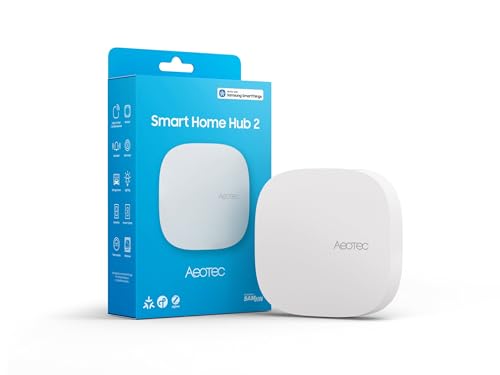
I rely on the Aeotec Smart Home Hub2 – V4 when I need a no-fuss hub that fully supports SmartThings and Matter, making it a top pick for users already invested in Samsung’s smart home ecosystem. It connects via Wi-Fi or Ethernet and sets up quickly, usually in minutes. I use it to control lights, sensors, plugs, switches, and thermostats that support Zigbee or Matter, though it doesn’t support Z-Wave. I can create automations for security or energy use, and many run locally, so they still work if my internet drops. I also link it to Alexa and Google Assistant for voice control, giving me flexible, reliable command across platforms without delays or complications.
Best For: Users deeply invested in Samsung’s SmartThings ecosystem who want a reliable, Matter-compatible hub with local automation and voice control support.
Pros:
- Seamlessly integrates with SmartThings and supports both Matter and Zigbee for broad device compatibility
- Enables local automation that continues to function during internet outages
- Works with Alexa and Google Assistant for flexible, multi-platform voice control
Cons:
- Does not support Z-Wave devices, limiting compatibility for some smart home setups
- Limited to Samsung’s SmartThings platform, reducing flexibility for non-SmartThings users
- Lacks advanced customization features found in more developer-focused hubs
Aqara Smart Home Hub M3

Though some users prioritize cloud-based control, I prefer the Aqara Smart Home Hub M3 for those wanting strong local automation and multi-protocol support without relying heavily on the internet. It handles Zigbee, Thread, Bluetooth, Wi-Fi, and IR, and acts as a Thread Border Router and Matter Controller. I can connect up to 127 devices per network type and sync with Apple HomeKit, Alexa, or Home Assistant. It runs automations locally, stores data in 8GB encrypted memory, and works without constant internet. I appreciate its PoE option, IR blaster for AC control, and lack of camera or mic. I recommend a 2A power adapter and good router placement for best results.
Best For: Users seeking robust local automation, multi-protocol smart home integration, and privacy-focused control with support for Matter, Thread, and IR devices.
Pros:
- Supports multiple protocols (Zigbee, Thread, Bluetooth, Wi-Fi, IR) and acts as a Matter Controller and Thread Border Router
- Enables local edge control with 8GB encrypted local storage, minimizing cloud dependency
- Includes Power over Ethernet (PoE), IR blaster for HVAC control, and integrates with Apple HomeKit, Alexa, and Home Assistant
Cons:
- Requires a 2A USB power adapter (not included) and stable Wi-Fi placement for optimal performance
- Limited to one AC device exposed to Matter, with functionality varying across ecosystems
- Thread network coverage may require additional repeaters for larger homes
Amazon Echo Hub 8” Smart Home Control Panel

The Amazon Echo Hub 8” Smart Home Control Panel stands out for users deeply invested in the Alexa ecosystem, serving as a central command post that unifies voice, touch, and automation across a wide range of smart devices. I use it to control lights, locks, cameras, and thermostats with ease, thanks to built-in support for WiFi, Bluetooth, Zigbee, Matter, Sidewalk, and Thread. I customize the dashboard with widgets for quick access, check camera feeds, and arm security systems remotely via the Alexa app. It mounts on walls or stands on a table, hides cords neatly, and connects to external speakers. I appreciate the mic-off button and that it’s made with 27% recycled materials.
Best For: Smart home enthusiasts deeply embedded in the Alexa ecosystem who want a centralized, customizable touchscreen hub to control and monitor a wide range of compatible devices.
Pros:
- Seamlessly integrates with thousands of Alexa-compatible devices using multiple wireless protocols including Wi-Fi, Zigbee, Thread, and Matter
- Customizable dashboard with widgets for quick access to cameras, routines, thermostats, and security systems
- Flexible installation options with wall-mount, tabletop stand, and cord-concealment features for a clean setup
Cons:
- Requires additional accessories like a power-over-ethernet adapter or stand, which are sold separately
- Limited appeal for users not already invested in the Alexa and Amazon smart home ecosystem
- Privacy concerns may persist despite the mic-off button and Amazon’s data policies
SmartThings Hub 3rd Gen (GP-U999SJVLGDA)

Since it supports Zigbee, Z-Wave, and cloud-to-cloud integrations, the SmartThings Hub 3rd Gen (GP-U999SJVLGDA) is best for users who want broad compatibility with a wide variety of smart home devices without needing multiple hubs. I use it to control lights, locks, and sensors through one app, and it reliably triggers routines based on motion, door status, or occupancy. It works with Alexa and Google Home, so I can use voice commands. Setup is straightforward, and the smartphone app gives me full control remotely. I appreciate the automation options and solid performance, though it requires a stable Wi-Fi connection and monthly cloud service is free with no current fees.
Best For: Users seeking a versatile, protocol-diverse smart home hub that integrates Zigbee, Z-Wave, and cloud-to-cloud devices for unified control through a single app.
Pros:
- Supports multiple communication protocols (Zigbee, Z-Wave, cloud-to-cloud) for broad device compatibility
- Enables robust automation routines using motion, door, and occupancy triggers with voice assistant support
- Offers reliable remote control via smartphone app with free cloud service and no monthly fees
Cons:
- Requires a stable Wi-Fi connection for consistent performance and remote access
- Limited offline functionality if internet connectivity is lost
- Advanced features may have a learning curve for first-time smart home users
Lutron Caseta Smart Hub (L-BDG2-WH)
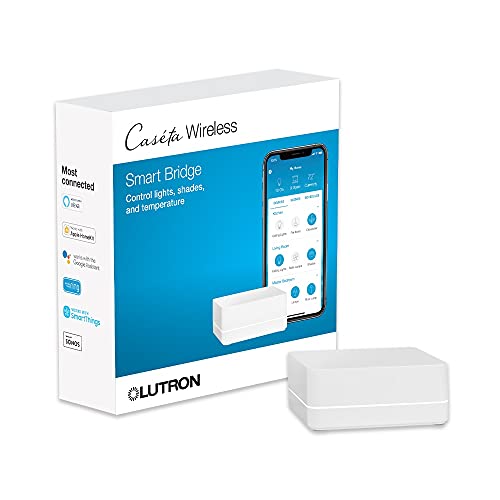
If you’re building a reliable, scalable smart lighting system that works seamlessly across multiple voice platforms, the Lutron Caseta Smart Hub (L-BDG2-WH) is a strong choice. I use it to control lights, fans, and shades with voice commands through Alexa, Google Assistant, or Apple HomeKit. It supports up to 75 devices, so I can expand my setup over time. The hub runs on Clear Connect Technology, which won’t interfere with my Wi-Fi. Setup was simple-plug it in, connect to my router, and configure through the Lutron app. I had no complex wiring. The hub doesn’t include switches or dimmers, so I bought those separately.
Best For: Homeowners seeking a reliable, scalable smart lighting and shading system with broad voice assistant compatibility and easy setup.
Pros:
- Seamlessly integrates with Amazon Alexa, Google Assistant, Apple HomeKit, and other smart home platforms for comprehensive voice and app control
- Supports up to 75 devices and uses Clear Connect Technology to avoid Wi-Fi interference, ensuring stable performance
- Simple plug-and-play installation with intuitive setup via the Lutron app, no complex wiring required
Cons:
- Hub does not include dimmers, switches, or accessories-they must be purchased separately
- Devices are limited to the Caseta ecosystem, which may limit compatibility with non-Caseta smart home products
- Advanced automation features may require more setup effort compared to fully integrated systems like SmartThings
Tapo Smart Hub with Chime (H100)

Looking for a streamlined way to expand your smart home without overloading your Wi-Fi? I’ve found the Tapo Smart Hub H100 does just that by connecting up to 64 Tapo devices using a sub-1G wireless protocol, which reduces interference and extends range up to 30 meters indoors. It’s energy-efficient, boosting battery life in connected sensors up to 10 times versus Wi-Fi models. I can set automations-like turning on lights when a door opens-and trigger actions from button presses. When paired with Tapo sensors, it activates a loud 90 dB siren, enhancing security. The hub doesn’t connect directly to Wi-Fi devices, so plan your setup around Tapo’s ecosystem.
Best For: Smart home users seeking a reliable, energy-efficient hub to manage multiple Tapo devices with extended range and automation capabilities without relying on Wi-Fi connectivity.
Pros:
- Connects up to 64 Tapo devices for centralized control using a sub-1G wireless protocol with reduced interference
- Extends battery life of connected sensors up to 10 times compared to Wi-Fi-based devices
- Built-in 90 dB siren enhances home security when paired with Tapo sensors
Cons:
- Does not directly connect to Wi-Fi devices, limiting integration to Tapo ecosystem only
- Requires specific Tapo devices for full functionality, reducing cross-platform compatibility
- Performance and range may vary depending on indoor environment and obstructions
Home Assistant Connect ZWA-2 Z-Wave

The Home Assistant Connect ZWA-2 Z-Wave is the best choice for users already invested in or moving to the Home Assistant ecosystem, especially those needing reliable, whole-home Z-Wave coverage. I use its 800-series chipset daily, and it delivers strong performance with all Z-Wave devices while minimizing interference. Its long-range signal penetrates thick walls effectively, making it ideal for large homes. The plug-and-play setup guides you through configuration, and I found migrating from older adapters simple. Firmware updates are one-click, and the tuned antenna guarantees stable connections. It even looks nice, blending in like a candle with soft ambient glow.
Best For: Home Assistant users seeking a reliable, long-range Z-Wave hub with seamless integration and elegant home-friendly design.
Pros:
- Certified 800-series chipset ensures compatibility, low interference, and strong signal penetration through walls
- Plug-and-play setup with guided onboarding and one-click firmware updates for hassle-free management
- Stylish candle-like design with ambient lighting blends naturally into home decor
Cons:
- Higher price point compared to generic Z-Wave dongles
- Limited benefit for users not already in the Home Assistant ecosystem
- Ambient light cannot be disabled, which may bother some in dark rooms
Factors to Consider When Choosing a Smart Home Automation Hub
You’ll want to check protocol compatibility first, since not all hubs work with every smart device type-Zigbee, Z-Wave, or Wi-Fi. Think about local versus cloud processing, as hubs that run automations locally keep working even if your internet goes out. Also make sure your preferred voice assistant integrates smoothly, and confirm the hub can handle the number of devices you plan to connect while offering reliable automation features.
Protocol Compatibility
While no single protocol works best for every smart home setup, choosing a hub with support for multiple standards-like Zigbee, Z-Wave, Wi-Fi, Thread, and Matter-gives you more flexibility to mix and match devices across brands. You’ll benefit from Zigbee and Z-Wave’s dedicated frequencies, which reduce Wi-Fi congestion and boost reliability for critical tasks like security alerts. Thread adds strong mesh networking with low power use, keeping devices connected even in large homes. Wi-Fi offers high bandwidth and easy setup but can suffer from interference and higher energy use. Hubs with built-in Matter support simplify control by bridging ecosystems, so your lights, locks, and sensors work together seamlessly. You’ll avoid being locked into one brand and future-proof your setup as more Matter-certified devices arrive. Prioritize hubs with broad protocol coverage for better performance, compatibility, and long-term value.
Local Versus Cloud Processing
When your smart home devices need to react quickly and reliably, choosing a hub that processes commands locally instead of in the cloud can make a meaningful difference. You get faster responses-often under a second-since data doesn’t travel online. If your internet drops, local processing keeps automations running, so lights, locks, and sensors still work. Your privacy improves too, because usage patterns and sensor data stay inside your home network. Cloud-based hubs, in contrast, depend on constant internet access, adding delays and risks during outages or server failures. While they offer wider remote access and third-party integrations, you trade off speed and control. For dependable, secure, and responsive automation, prioritize local processing. It guarantees reliability, strengthens privacy, and reduces lag-key factors for everyday performance and home security.
Voice Assistant Integration
Voice assistant integration builds on the reliability of local processing by enabling hands-free control of your smart home devices through widely used platforms like Alexa, Google Assistant, and Siri. You can adjust lighting, climate, security, and entertainment systems using simple voice commands. Choose a hub that supports multiple assistants so you can switch platforms or assign them per room. Look for local voice processing, which speeds up response times and keeps your data private by reducing cloud dependence. Make sure the hub supports key communication protocols-Wi-Fi, Zigbee, or Matter-so your devices respond reliably when triggered by voice. Hubs with broad compatibility give you flexibility and future-proof your setup. Check if your preferred voice assistant works natively with the hub to avoid extra steps. A well-integrated system saves time and simplifies daily control.
Automation Capabilities
What truly sets a smart home hub apart? Its ability to automate your environment reliably and intelligently. You want local automation execution so your routines keep working without internet, offering faster response and uninterrupted control during outages. Choose a hub with edge processing-it runs automations on-device, boosting privacy and reliability by minimizing cloud dependence. Look for support of environmental triggers like motion, temperature, or occupancy to automate lighting, climate, and security seamlessly. Some systems maintain core functions offline, thanks to onboard processing, while others fail when connectivity drops. Though device limits matter, automation capacity also depends on how many custom rules and complex logic chains the hub supports. You’ll benefit from systems allowing hundreds of routines with multi-condition triggers. Always check processing type and automation flexibility to guarantee consistent, long-term performance you can depend on.
Device Connection Limits
Most smart home hubs support between 50 and 200 devices, but the exact limit depends on the model and its supported protocols. You’ll find some hubs cap at 127 devices per protocol, so if you’re using both Zigbee and Thread, each network has its own separate limit. High-end models handle over 200 total devices, while budget options may only support around 50. If you exceed the limit, you’ll likely experience slower responses, delayed automations, or unresponsive devices. Hubs with mesh networking help maintain stable connections, as devices relay signals to extend range and reduce dropout. When planning your setup, account for future expansion and mix device types across protocols if needed. Choosing a hub with headroom guarantees smooth performance as your smart home grows.
Setup And Installation Ease
While some smart home hubs demand technical know-how, many now offer plug-and-play setup that gets you running in minutes. You just plug in the hub, connect it to Wi-Fi or Ethernet, and follow the mobile app’s step-by-step instructions. These guides walk you through network selection, firmware updates, and pairing devices smoothly. If the hub uses local processing, setup is usually faster since it doesn’t wait on cloud servers to verify settings. Be ready, though-some models reboot multiple times during initial configuration, which can add a few extra minutes. For best results, place the hub within 6 to 19 feet of your router to guarantee a strong signal and avoid connectivity hiccups early on. Hubs positioned too far or behind thick walls may struggle to connect, so plan placement wisely. Overall, most modern systems make setup simple, but checking these factors helps avoid delays and keeps your installation on track.
Privacy And Data Control
A smart home hub that processes data locally keeps your information within your home network, so you don’t have to rely on cloud servers that could expose sensitive details. You retain control because your automation logic and preferences stay on-device, reducing third-party access. Choose hubs without microphones or cameras to eliminate unwanted audio or video capture. End-to-end encrypted local storage guarantees your configurations remain secure, even if someone gains physical access. With offline functionality, your automations keep running without internet, cutting data transmission risks. You also decide whether or not to share data-no forced cloud syncing. This means you can view, manage, or export your information freely. Prioritize hubs that offer full local control and transparency in data practices. These features give you stronger privacy protection without sacrificing performance or convenience.
Frequently Asked Questions
Can I Use Multiple Hubs Together?
Yes, you can use multiple hubs together, and many people do to expand coverage or support different device types. You maintain control through a central app or voice assistant, but syncing them requires planning. Some hubs overlap in function, which might cause conflicts. Make sure protocols like Zigbee, Z-Wave, or Wi-Fi are compatible across devices. Using multiple hubs increases complexity and cost, so assess your needs first-larger homes often benefit, while smaller setups may not.
Do Hubs Work During Power Outages?
You lose hub functionality during power outages unless you add backup power. Most hubs rely on home electricity and your router, so when the power fails, they go offline. You can keep them running with a UPS battery backup, which gives limited runtime-usually 30 minutes to a few hours. Without it, smart devices won’t respond to commands or automations, even if your sensors or locks have batteries. Plan for outages by pairing your hub with a UPS.
Are Hubs Vulnerable to Hacking?
Yes, hubs can be vulnerable to hacking if not properly secured. You should always enable encryption, use strong unique passwords, and update firmware regularly. Some models offer two-factor authentication and local processing, which reduce online exposure. Choose hubs with a strong security reputation and frequent updates. Avoid default settings, and consider network segmentation to limit access. These steps greatly reduce your risk of unauthorized entry.
Can I Control Hubs Without Wi-Fi?
Yes, you can control hubs without Wi-Fi if they use other protocols like Zigbee or Z-Wave. You’ll still manage connected devices locally through the hub’s network. However, remote access and voice commands require internet. Some hubs work with mobile hotspots as backup. Check compatibility and offline features before buying-brands like Hubitat and Home Assistant offer strong local control. This setup boosts reliability during outages.
Do Hubs Require a Monthly Fee?
No, most hubs don’t require a monthly fee. You buy the device once and use it without recurring charges. Some brands offer optional paid services for extra features like cloud storage or professional monitoring, but core functions work without them. Always check the manufacturer’s policy, as a few ecosystems might bundle services. For basic automation-controlling lights, locks, or sensors-you’ll keep full control without ongoing costs.