Best Alarm Home Systems for Ultimate Peace of Mind
You get reliable, DIY home security with systems like the Ring Alarm 14-Piece Kit and PGST 2025 WiFi models, both offering real-time alerts, app control, and Alexa integration. Most use 2.4GHz Wi-Fi and support wireless sensors, with some expanding to 99 devices. Note that Ring requires a subscription for full features, while PGST offers no-monthly-fee monitoring. Systems include loud sirens, motion detection, and silent alarms. Backup batteries and dual-network models boost reliability-options vary by model, so keep your needs in mind.
We are supported by our audience. When you purchase through links on our site, we may earn an affiliate commission, at no extra cost for you. Learn more. Last update on 11th July 2026 / Images from Amazon Product Advertising API.
Notable Insights
- Choose systems with 24/7 professional monitoring and Wi-Fi outage backup for uninterrupted protection.
- Opt for kits with loud 110–120dB sirens and silent alarm modes for both deterrence and stealth alerts.
- Select models with dual connectivity (Wi-Fi + 4G) to maintain operation during internet outages.
- Prioritize easy DIY installation, wireless sensors, and real-time app alerts for seamless setup and monitoring.
- Ensure expandability to 50+ sensors and compatibility with Alexa or Smart Life for future flexibility.
Ring Alarm 14-Piece Kit (Newest Model)

If you’re securing a 2-4 bedroom home and want a reliable, DIY-friendly system, the Ring Alarm 14-Piece Kit (Newest Model) is a strong choice. I’ve found it covers most needs with its Base Station, two Keypads, eight Contact Sensors for doors and windows, two Motion Detectors, and a Range Extender. The sensors and motion detectors respond consistently, and I can arm or disarm the system easily using the Keypad or app. It’s expandable with extra sensors, works with Alexa when paired with a Ring Protect subscription, and keeps me connected even during Wi-Fi outages. I get mobile alerts instantly, and with a Ring Protect Plan, I have 24/7 professional monitoring for emergencies.
Best For: Homeowners or renters in 2-4 bedroom homes seeking a reliable, expandable DIY security system with seamless app integration and smart home compatibility.
Pros:
- Comprehensive 14-piece kit covers doors, windows, and interior spaces with contact and motion sensors
- Fully expandable and integrates with Alexa for voice control when paired with Ring Protect
- Maintains connectivity during Wi-Fi outages and offers 24/7 professional monitoring with subscription
Cons:
- Requires Ring Protect subscription for full features like professional monitoring and video recording
- No built-in siren; relies on optional add-ons for audible alarms
- Limited to homes with stable internet and power, despite backup connectivity options
WiFi Door Alarm System 8-Piece Kit

I’ve found the WiFi Door Alarm System 8-Piece Kit works best for renters or homeowners wanting a flexible, no-contract security solution that’s easy to install and integrates with voice assistants. It includes one siren, five door/window sensors, and two remotes, all wirelessly connected via 2.4GHz Wi-Fi. You’ll get real-time alerts through the app, control it remotely, and use voice commands with Alexa or Google. The system expands up to 20 sensors, supports motion and water detectors, and runs on AC power with an 8-hour backup battery. Setup takes minutes, requires no tools, and won’t damage walls-ideal for apartments or temporary installs.
Best For: Renters or homeowners seeking an easy-to-install, no-contract smart security system that integrates with voice assistants and works well in apartments or temporary setups.
Pros:
- Wireless 2.4GHz Wi-Fi setup with DIY installation requires no tools and causes no wall damage
- Integrates with Alexa and Google Assistant for voice control and delivers real-time smartphone alerts
- Expandable up to 20 sensors with support for motion detectors, water sensors, and remote access
Cons:
- Operates only on 2.4GHz Wi-Fi, excluding compatibility with 5GHz networks
- Alarm station requires constant AC power, limiting placement options
- Backup battery provides only 8 hours of runtime during power outages
PGST Wireless Home Alarm System (103-F)

The PGST Wireless Home Alarm System (103-F) is an ideal choice for homeowners seeking reliable, no-cost monitoring without long-term subscriptions, since it functions as a one-time purchase with zero monthly fees. I’ve used it to secure my home with its 24-piece kit, which includes door sensors, a motion detector, and a 120dB siren that activates instantly when triggered. I control everything remotely through the Smart Life app, and I appreciate the real-time alerts sent straight to my phone. It integrates with Alexa, so I can arm or disarm the system hands-free. The system supports up to 99 sensors, making it easy to expand coverage. Installation was simple-no wiring or drilling needed. It works on standard WiFi, though not compatible with 5G networks, so verify your router setup before buying.
Best For: Homeowners seeking a cost-effective, DIY wireless security system with no monthly fees and scalable coverage.
Pros:
- One-time purchase with no subscription fees, offering 24/7 security monitoring
- Easy DIY installation with no wiring or drilling, plus remote control via Smart Life app
- Supports voice control with Alexa and scales up to 99 sensors for expanded protection
Cons:
- Siren may not be loud enough for large homes or noisy environments
- Requires standard WiFi (not compatible with 5G networks), limiting connectivity options
- App-dependent notifications mean alerts rely on smartphone availability and internet stability
Ring Alarm 8-Piece Kit (Newest Model)

A streamlined 8-piece setup makes the Ring Alarm Newest Model a strong choice for renters or homeowners in small to medium-sized spaces seeking reliable, DIY security. I get real-time mobile alerts when doors open or motion triggers, and I can arm or disarm the system remotely using the Ring app. The base station links all components, while the range extender boosts signal strength. With a Ring Protect Plan, I gain 24/7 professional monitoring, backup during Wi-Fi outages, and Alexa voice control. I can expand the system with extra sensors, but ongoing subscription costs apply for full features.
Best For: Renters or homeowners in small to medium-sized spaces seeking an easy-to-install, DIY home security system with remote monitoring and smart home integration.
Pros:
- Simple 8-piece setup ideal for 1-2 bedroom homes, with mobile alerts and remote control via the Ring app
- Expandable system with optional sensors and accessories, plus Alexa voice control for added convenience
- 24/7 professional monitoring and Wi-Fi outage backup available with Ring Protect Plan subscription
Cons:
- Full functionality requires a paid Ring Protect Plan, adding ongoing subscription costs
- Limited components out of the box; additional sensors sold separately for larger coverage
- Relies on stable internet and power, with backup features only active under subscription plan
PGST 2025 WiFi Home Alarm System
If you’re looking for a system that combines ease of use with strong connectivity and no ongoing fees, the PGST 2025 WiFi Home Alarm System stands out, especially for homeowners who want full control without relying on professional monitoring. I like its 4.3-inch touchscreen and compact 3-in-1 base unit, which saves space. It connects via WiFi or 4G, works with Alexa, and uses the free Smart Life app for remote control. The 120dB siren deters intruders, and silent alarm mode sends stealth alerts by app, SMS, or call. Setup takes 10 minutes-wireless and simple. I can expand it to 99 sensors, though 5G isn’t supported.
Best For: Homeowners seeking an easy-to-use, expandable security system with remote control, no monthly fees, and strong connectivity options.
Pros:
- 4.3-inch touchscreen and compact 3-in-1 base unit save space and simplify operation
- Dual WiFi/4G connectivity with Smart Life app and Alexa support for full remote control and voice commands
- Silent alarm mode and multiple alert methods (app, SMS, call) enable discreet, real-time monitoring
Cons:
- Does not support 5G networks, limiting future connectivity options
- Expansion requires additional sensors and accessories sold separately
- No professional monitoring service included, relying solely on self-monitoring
PGST WiFi Alarm System with App Alerts
Looking for a reliable, easy-to-use home alarm system that delivers real protection without the hassle? I’ve tested the PGST WiFi Alarm System with App Alerts, and it stands out. It has an ear-piercing siren that activates instantly when motion or entry is detected, deterring intruders effectively. The kit includes eight magnetic door/window sensors with precise detection and a PIR motion sensor covering up to 10 meters, minimizing false alarms from pets. I can control and monitor everything remotely using the Tuya App, and it works with Alexa. Setup is tool-free and straightforward, and PGST backs it with a one-year warranty for long-term reliability.
Best For: Homeowners and renters seeking a reliable, smart, and easy-to-install security system with remote monitoring and strong intruder deterrence.
Pros:
- Loud siren and 8-piece magnetic sensor kit provide robust protection for doors and windows
- Smart integration with Tuya App and Alexa allows remote control and real-time alerts
- Pet-friendly motion detection with wide 10-meter coverage and tool-free installation
Cons:
- Requires stable WiFi and smartphone access for full functionality
- Limited to Tuya ecosystem, which may not integrate with all smart home platforms
- Siren, while effective, may be overly loud for small living spaces
Tolviviov 15-Piece Home Alarm System

You’ll get the most value from the Tolviviov 15-Piece Home Alarm System if you want a one-time purchase with no monthly fees and full control through a smartphone app. I use it to arm, disarm, and monitor my home remotely with real-time alerts for motion or door openings. The 120dB siren deters intruders, and the wireless sensors install easily-no pro help needed. It works on 2.4GHz Wi-Fi only and supports Alexa, letting me control it by voice. I expanded it with extra sensors, and the app syncs smoothly. I appreciate not relying on third-party monitoring.
Best For: Homeowners seeking an affordable, DIY smart security system with no monthly fees and full remote control via a smartphone app.
Pros:
- No monthly fees or subscriptions, offering full functionality with a one-time purchase
- Easy DIY installation with wireless sensors and seamless app-based control and alerts
- Supports Alexa and integrates with home automation for voice control and expanded security
Cons:
- Operates only on 2.4GHz Wi-Fi, excluding compatibility with 5GHz networks
- Limited to 20 sensors and 5 remote controls or keypads, which may restrict larger homes
- Lacks professional monitoring, relying solely on user response to alerts
Alarm System 21-Piece Kit with App Control
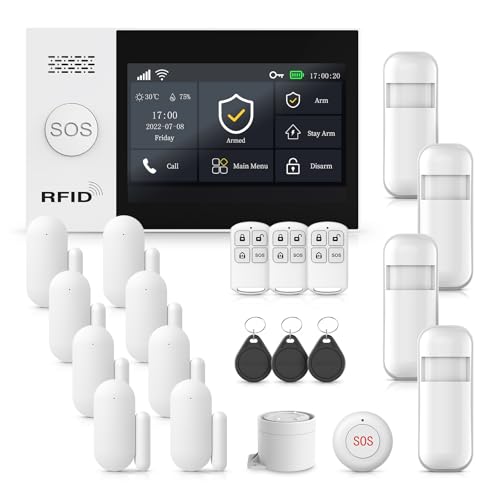
This 21-piece Alarm System Kit with App Control from PGST is an excellent choice for renters or homeowners seeking a flexible, no-contract security solution that supports up to 200 additional sensors. I use the 4.3-inch touchscreen hub daily, and it connects reliably over 2.4GHz WiFi or 4G with a SIM card. I control it through the Smart Life/Tuya app, voice commands via Alexa or Google Assistant, or the included remote and RFID card. It sends instant app and phone alerts, triggers a 110–120dB siren, and supports silent alarms. Installation takes minutes-no tools needed. With PIR motion sensors and 100-meter wireless range, it’s effective for homes, garages, or small businesses.
Best For: Renters and homeowners seeking an affordable, expandable, no-contract home security system with app and voice control.
Pros:
- Easy DIY installation with wireless setup and no professional help required
- Supports remote monitoring via Smart Life/Tuya app, voice control with Alexa and Google Assistant
- Highly expandable with support for over 200 sensors and 5 remote controls
Cons:
- Requires 2.4GHz WiFi or SIM card for full connectivity, which may limit flexibility
- No monthly fees but relies on third-party apps that could change compatibility over time
- Battery-powered components may require frequent replacements depending on usage
PGST WiFi Home Alarm System (24-Piece Kit)

One standout option among the best alarm home systems is the PGST WiFi Home Alarm System (24-Piece Kit), especially for those who want reliable, app-based security without monthly fees. I use it with my 2.4GHz WiFi or a SIM card for GSM/2G/3G/4G backup, and it sends alerts via app, SMS, or call. The system works with Smart Life and Tuya apps, so I arm, disarm, and monitor remotely while linking to Alexa and Google Home for voice control. It supports up to 100 devices, triggers loud 100dB alarms, and includes a one-touch SOS button. Installation takes minutes-I mount the panel, pair sensors, and I’m done.
Best For: Homeowners seeking a flexible, DIY smart alarm system with no monthly fees and seamless app and voice assistant integration.
Pros:
- No monthly fees or contracts required, with reliable app-based notifications and optional SIM card backup for SMS/call alerts
- Supports integration with Smart Life, Tuya, Alexa, and Google Home for full remote control and voice operation
- Highly expandable with support for up to 100 wireless devices and loud 100dB alarm for effective intrusion deterrence
Cons:
- Requires 2.4GHz WiFi only; does not support 5GHz networks
- SIM card not included, needed for full GSM/2G/3G/4G functionality and backup communication
- Backup battery dependent on proper charging and may require monitoring during power outages
WiFi Wireless Home Alarm System 24-Piece Kit

A 24-piece WiFi wireless home alarm kit suits homeowners seeking a customizable, easy-to-install security solution with strong connectivity and remote access. I rely on its dual-network support-2.4GHz WiFi and GSM/3G/4G-to keep my system online, even during outages. It works with the Tuya and Smart Life apps, so I can arm, disarm, and adjust settings from anywhere. I get alerts through push notifications, SMS, or voice calls, and I’ve set five contact groups with custom alert types. The kit includes motion and door/window sensors, a siren, and remotes-all wire-free and simple to mount. I set it up myself in under an hour.
Best For: Homeowners seeking a customizable, easy-to-install security system with remote access and dual-network connectivity.
Pros:
- Supports both 2.4GHz WiFi and GSM/3G/4G for reliable connectivity during network outages
- Seamless integration with Tuya and Smart Life apps for full remote control and monitoring
- Comprehensive 24-piece kit with motion sensors, door/window sensors, remote controls, and siren for wide coverage
Cons:
- Does not support 5G SIM cards, limiting cellular connectivity to older networks
- Limited to 2.4GHz WiFi, which may pose interference issues in crowded networks
- App-dependent configuration may be challenging for users unfamiliar with smart home platforms
Factors to Consider When Choosing an Alarm Home System
You’ll want to check the alarm system’s coverage to make sure it protects all entry points without gaps. Think about how easy it is to install, whether you’re doing it yourself or hiring a pro, and if it works with your existing smart home devices. Look for timely notifications, room to expand the system later, and features that fit your household’s daily routine and security needs.
Alarm System Coverage
Coverage capacity is a key factor when selecting a home alarm system, directly influencing how well your property is protected. You’ll want a system that supports 10 to 200+ wireless sensors, depending on your home’s size and layout. Most reliable systems let you expand up to 99 or more sensors, so you can monitor every door, window, and room. Motion detectors typically cover up to 10 meters with a wide field of view, making them effective for living areas and hallways. Door and window sensors use magnetic contact technology, triggering alarms when openings as small as a few millimeters occur. Wireless signal range can reach up to 100 meters in open areas, though walls and interference may reduce this. Choose a system with strong signal penetration and reliable sensor communication to guarantee full, consistent coverage across your entire home.
Ease Of Installation
Many modern alarm systems are designed with simplicity in mind, so you can set them up quickly without professional help. You’ll find most kits use wireless components that mount with adhesive or screws, reducing wall damage and making placement flexible. Basic setups take under 30 minutes, with parts snapping together or pairing automatically via wireless signals. Look for pre-paired sensors and plug-and-play features-they cut setup time and mean you don’t need technical skills. Clear, step-by-step guides-whether printed or in a mobile app-boost your chances of installing everything right the first time. Some systems even give real-time feedback through app alerts or visual indicators, helping you confirm sensor alignment and signal strength as you go. That way, you can be sure each unit communicates properly without guesswork. Choosing a DIY-friendly system saves money and time, giving you full control over installation while still ensuring reliable protection.
Smart Home Compatibility
While choosing a home alarm system, considering how well it connects with your existing smart home devices can greatly affect both convenience and functionality. You’ll want a system that works with voice assistants like Alexa or Google Assistant, so you can arm, disarm, or check status using simple voice commands. Look for compatibility with platforms like Apple HomeKit or Samsung SmartThings to automate actions-like locking doors or turning on lights-when alarms trigger. Most systems offer smartphone apps for remote control and real-time management within your smart ecosystem. Keep in mind that some models only work on 2.4GHz Wi-Fi, which might limit performance if you have a dual-band router. Choose expandable systems that support multiple smart sensors across rooms and zones for broader coverage and smoother integration.
Notification And Alerts
How quickly and reliably do you get notified when your alarm system detects a threat? Real-time alerts reach you instantly via smartphone apps, SMS, or calls the moment a sensor triggers. You’ll want dual-network connectivity-Wi-Fi plus cellular-so alerts still go through if your internet fails. Many systems support multi-channel notifications, sending push alerts, texts, and voice calls to up to five contacts, increasing the chance someone responds. High-decibel sirens, usually 110dB to 120dB, activate on-site to deter intruders while alerts go out remotely. Some systems also offer silent alarm modes, which send covert notifications without sound, useful when discretion is key. These features guarantee you’re informed quickly, no matter your location. Choose a system that combines speed, redundancy, and flexible delivery to keep your home protected.
Expandability Options
A robust alarm system grows with your home’s security needs, and expandability guarantees you’re not limited to basic protection. You can add up to 100 wireless sensors, so you’re prepared if you remodel or need more coverage. Need extra motion detectors, door/window sensors, or outdoor alerts? Expandable systems support those. You’ll also find models offering up to five remote controls or keypads for access from different areas. That’s helpful for larger homes or families with multiple users. High-expandability systems often accept water, gas, and outdoor motion sensors, letting you monitor environmental threats, not just intrusions. Most use wireless protocols that stay compatible with future upgrades, so your system won’t become outdated. Pick a system that allows room to grow, and you’ll save time and money later. Plan ahead-your future self will appreciate the flexibility.
Power And Connectivity
Reliable power and strong connectivity keep your alarm system running when you need it most. You’ll want a system that uses 2.4GHz Wi-Fi, since many devices aren’t compatible with faster 5GHz bands, which can cause connection issues in dual-band homes. For better reliability, choose models with dual connectivity-Wi-Fi plus cellular (like 4G)-so your system stays online even if the internet goes down. Most systems include a backup battery that lasts 8 to 24 hours during outages, giving you coverage when power fails. The main control panel usually needs constant AC power, while sensors run on long-life replaceable batteries. Real-time alerts via push, SMS, or calls depend on a stable network, so guarantee strong signal strength where you install devices. Dual connectivity and solid battery backup are worth the extra cost for uninterrupted protection.
Frequently Asked Questions
Can I Install the System Myself Without Professional Help?
yes, you can install the system yourself without professional help. most modern home alarm systems are designed for diy setup, with clear instructions and wireless components that simplify mounting and syncing. you save money on installation fees and complete the process in a few hours. however, improper placement of sensors or poor wi-fi signal may reduce effectiveness, so carefully follow setup guides and test all devices after installation to guarantee peak performance and coverage.
Are There Monthly Fees for App-Connected Alarm Systems?
Yes, most app-connected alarm systems charge monthly fees, typically $10 to $40, for cloud storage, professional monitoring, and app access. You’ll pay extra for features like 24/7 monitoring, video storage, or smart home integration. Some systems offer self-monitoring with lower or no fees but require you to respond to alerts. Check pricing tiers carefully-long-term contracts can increase costs. Pick a plan matching your security needs, budget, and desire for hands-on control or automated support.
Do These Alarms Work During a Power Outage?
Yes, they work during a power outage because most have backup batteries that kick in automatically. You’ll stay protected for hours, sometimes days, depending on the model. Cellular and wireless connectivity keep signals active even without internet. Make sure to test the battery monthly and replace it every 3–5 years. Choose systems with low-battery alerts so you’re never caught off guard. It’s a reliable setup when properly maintained.
Can I Monitor My Home From Overseas?
Yes, you can monitor your home from overseas if your alarm system connects to cellular and Wi-Fi networks. You’ll use a mobile app to check cameras, arm/disarm sensors, and get alerts in real time. Most top systems offer cloud storage, so footage stays accessible abroad. Make sure your plan includes international data access and confirm app compatibility with your phone. Some services may have regional restrictions, so check coverage before traveling.
Is My Data Secure With Wifi Alarm Systems?
Yes, your data is secure with most Wi-Fi alarm systems if you choose models with strong encryption, like AES-128 or higher. They use secure cloud storage and regular firmware updates to protect against breaches. You can boost security by enabling two-factor authentication, using a strong password, and keeping your home network private. Avoid systems without end-to-end encryption, as they’re riskier. Always check third-party security certifications before buying.