Best Canadian Home Security Systems for Total Peace of Mind
You get reliable protection with Canadian home security systems that combine DIY installation, 2.4GHz Wi-Fi and 4G backup, and no long-term contracts. Top options like PGST, OSI, and Lorex offer loud 100–120dB sirens, real-time app alerts, and Alexa/Google Assistant control. Many support up to 100+ sensors, include battery backups, and work without monthly fees. For added safety, some provide optional professional monitoring starting at $15/month. You’ll find scalable, smart-ready solutions designed for both renters and homeowners-details on each follow.
We are supported by our audience. When you purchase through links on our site, we may earn an affiliate commission, at no extra cost for you. Learn more. Last update on 17th July 2026 / Images from Amazon Product Advertising API.
Notable Insights
- Choose systems with 4G backup like OSI Alarm Gen 2 or Lorex for reliable connectivity during Wi-Fi outages.
- Opt for no-contract, DIY setups such as PGST or KERUI for flexibility and renter-friendly installation.
- Ensure strong smart home integration with Alexa, Google Assistant, and Tuya/Smart Life app control.
- Prioritize loud sirens (115dB–120dB+) and real-time alerts via call, SMS, or app for instant threat response.
- Select scalable systems supporting 100+ sensors for expanded coverage as security needs grow.
PGST WiFi Alarm System 24-Piece Kit

If you’re looking for a flexible, no-contract home security system that works without ongoing fees, the PGST WiFi Alarm System 24-Piece Kit stands out as a solid choice for renters or homeowners who want full control. I use its 2.4GHz Wi-Fi and optional SIM card support-though 5GHz isn’t compatible-for reliable connectivity. I control everything through the Smart Life/Tuya app, including arming, real-time alerts, and voice monitoring. It works with Alexa and Google Home, which I find convenient. Installation took me minutes, no pro needed. The siren hits 100dB, and I appreciate the one-touch SOS button. I’ve paired over 20 sensors so far, well under its 100-device limit.
Best For: Renters and homeowners seeking a flexible, contract-free home security system with DIY installation and smart home integration.
Pros:
- Supports app-based control, voice assistants, and up to 100 wireless devices for customizable, scalable security
- Easy DIY setup with no professional installation required and includes essential mounting hardware
- Offers multiple connectivity options including 2.4GHz Wi-Fi and GSM/3G/4G via SIM card (sold separately) for reliable alerts
Cons:
- Does not support 5GHz Wi-Fi, limiting compatibility with faster modern networks
- SIM card not included, required for SMS and cellular backup functionality
- App-dependent operation may be a drawback for users preferring standalone system control
Home Alarm System 21-Piece Kit with App Control
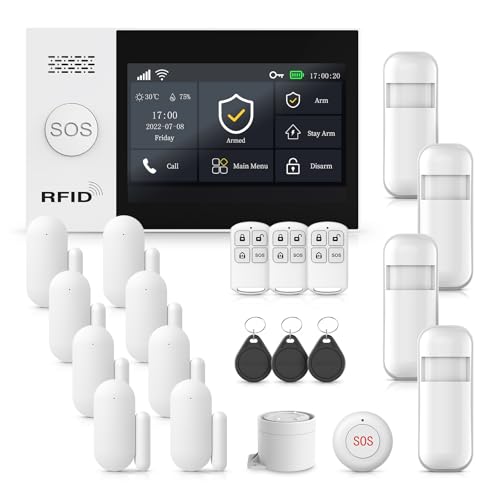
One standout choice for renters and homeowners seeking a reliable, no-contract security solution is the Home Alarm System 21-Piece Kit with App Control. I use its 4.3-inch touchscreen hub daily-it’s simple for all ages. The system connects via 2.4GHz WiFi or 4G with a SIM card, ensuring constant connectivity. I appreciate the 120dB+ siren and silent alarm mode, plus SOS button for emergencies. It integrates with Smart Life/Tuya apps and works with Alexa and Google Assistant. I control sensors, remotes, and motion detectors remotely, and the system supports over 200 wireless sensors. Installation is wireless, tool-free, and quick-no monthly fees, no contracts.
Best For: Renters and homeowners seeking a flexible, no-contract security system with easy DIY installation and smart home integration.
Pros:
- Wireless, tool-free setup with support for over 200 sensors and expandable configurations
- App and voice control compatible with Smart Life/Tuya, Alexa, and Google Assistant
- Multi-channel alerts including 120dB+ siren, silent alarm, and SOS emergency button
Cons:
- Requires 2.4GHz WiFi or 4G SIM card for full connectivity, which may incur data costs
- Touchscreen hub may be less durable in high-traffic or harsh environments
- Limited smart automation features compared to higher-end security systems
Tolviviov Wireless Home Security System 10-Piece Kit
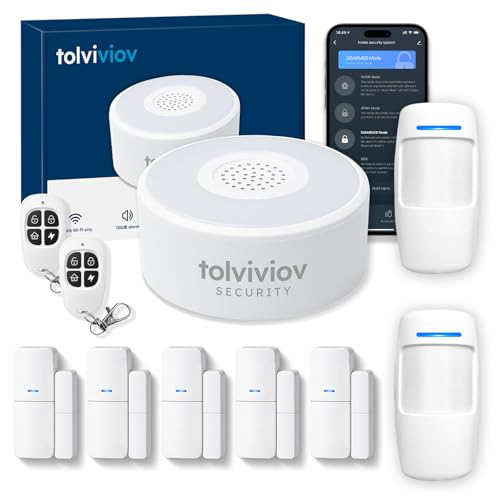
The Tolviviov Wireless Home Security System 10-Piece Kit is a strong choice for renters or homeowners seeking an affordable, no-contract security solution that’s easy to install and control remotely. I appreciate its DIY setup-no professional help is needed, and it connects via Wi-Fi in minutes. With 5 door sensors, 2 motion detectors, and a 120 dB siren, it provides solid coverage. I can arm or disarm the system from my phone, receive real-time alerts, and use Alexa for voice control. It supports up to 20 sensors, so I can expand later. There are no monthly fees, and the 24-month warranty plus responsive support gives me confidence.
Best For: Renters or homeowners seeking an affordable, no-contract, easy-to-install wireless security system with remote control and smart home integration.
Pros:
- DIY installation with no professional setup or monthly fees required
- App-enabled remote control, real-time smartphone alerts, and Alexa compatibility
- Expandable up to 20 sensors and backed by a 24-month warranty with responsive customer support
Cons:
- Limited to Wi-Fi connectivity, which may affect performance in low-signal areas
- No professional monitoring service included
- Remote controls and sensors may require frequent battery replacements
Home Alarm System with Camera (23-Piece)
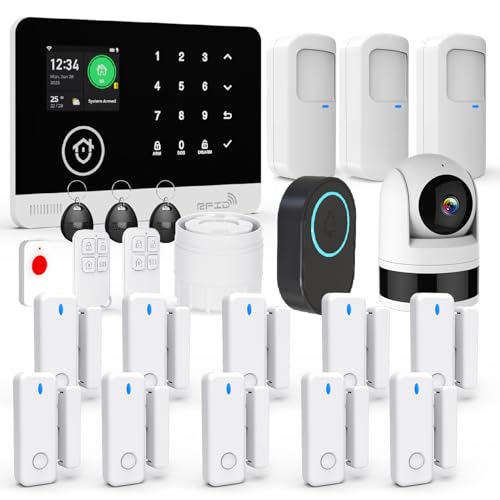
This 23-piece home alarm system with camera stands out for Canadian homeowners seeking a thorough, scalable security setup that combines reliable intrusion detection with smart home integration. I rely on its 10 door/window sensors, 3 motion detectors, and 1080P night vision camera for full coverage. The system supports up to 100 wireless zones, so I can expand it as needed. I use the Tuya app to arm, disarm, and monitor everything remotely, and I get real-time alerts when activity is detected. It works with Alexa and Google Assistant for voice control, and the 120dB siren deters intruders. Dual Wi-Fi and GSM connectivity guarantees it stays online even during outages.
Best For: Canadian homeowners seeking a scalable, smart-integrated security system with comprehensive coverage and reliable remote monitoring.
Pros:
- Comprehensive 23-piece kit with 10 door/window sensors, 3 motion detectors, and a 1080P night vision camera for full home coverage
- Supports expansion up to 100 wireless zones and integrates with Alexa and Google Assistant for voice control and smart home convenience
- Dual Wi-Fi and GSM connectivity ensures reliable operation and alarm transmission, even during network outages
Cons:
- Camera resolution listed as “200W” is ambiguous and potentially misleading compared to standard 1080P specification
- Wi-Fi support limited to 2.4GHz only, excluding 5GHz for faster, less congested connections
- Requires Tuya app and third-party platform, which may raise privacy or long-term compatibility concerns for some users
KERUI WiFi Home Security Alarm System 8-Piece

If you’re looking for a budget-friendly yet expandable home security system that integrates smoothly with smart home devices, the KERUI WiFi Home Security Alarm System 8-Piece stands out as a solid choice, especially for renters or homeowners in Canada who want reliable, DIY protection without long-term contracts. I use the Tuya Smart app to control everything from my phone, and it sends instant alerts over 2.4GHz WiFi-just note it doesn’t work on 5GHz networks. I’ve added extra sensors, since it supports up to 30 wireless ones and 20 remotes. I can arm, disarm, or set modes using Alexa or Google Assistant, which makes daily use simple. Pressing the S button on the remote triggers a loud 115dB siren and sends emergency alerts right away. The system also pairs with other KERUI hubs, giving me more flexibility as I expand. I followed the manual closely during setup and reached out to customer support when needed-they responded quickly. Overall, it’s a practical, no-frills option that delivers reliable, scalable protection.
Best For: Renters or homeowners in Canada seeking an affordable, expandable DIY home security system with smart home integration and no long-term contracts.
Pros:
- Easy smartphone control and instant alarm alerts via the Tuya Smart app over 2.4GHz WiFi
- Supports up to 30 wireless sensors and 20 remotes for customizable, scalable coverage
- Voice control compatibility with Alexa and Google Assistant for hands-free operation
Cons:
- Operates only on 2.4GHz WiFi, not compatible with 5GHz networks
- Requires careful setup following the user manual for optimal performance
- Limited to integration with Tuya-compatible devices, which may restrict some smart home ecosystems
WiFi Alarm System for Home Security (24Pcs)

You’ll find the WiFi Alarm System for Home Security (24Pcs) best suits homeowners with large, multi-story properties who want reliable, subscription-free protection. I rely on its dual 2.4GHz WiFi and 2G/4G cellular backup to keep my system online, even during outages. The 4.3-inch touchscreen is easy to use, and I can control everything via app, remote, or voice with Alexa and Google Assistant. It includes 5 motion detectors, 10 door sensors, and supports up to 100 sensors total. I get instant alerts through the app, SMS, or call-no fees. Installation took me under 15 minutes, and the battery backup keeps it running during power failures.
Best For: Homeowners with large, multi-story homes seeking a reliable, scalable, and subscription-free security system with dual network backup and voice control integration.
Pros:
- Dual 2.4GHz WiFi and 2G/4G cellular connectivity ensures uninterrupted operation during network or power outages
- Easy installation and intuitive 4.3-inch touchscreen interface with app, voice, and remote control options
- Supports up to 100 sensors and includes essential components for comprehensive home coverage out of the box
Cons:
- Does not support 5G networks, limiting future connectivity options
- 120dB siren may be excessively loud for small spaces or sensitive individuals
- Limited to SMS and app alerts without advanced smart home automation features beyond Alexa and Google Assistant
PGST WiFi Alarm System (24 PCS)
When budget-conscious homeowners want reliable protection without monthly fees, the PGST WiFi Alarm System (24 PCS) stands out as a practical choice. I’ve found it delivers real-time alerts through the Smart Life Tuya App and a 4G GSM card, sending calls or messages during emergencies. It offers Arm, Disarm, and Stay at Home modes for flexible control, and its loud siren deters intruders effectively. The system supports expansion with smoke detectors and cameras, uses accurate motion detection and allows DIY installation. Plus, it comes with a 1-year warranty and includes 24 wireless components, so setup is simple for all ages.
Best For: Budget-conscious homeowners seeking a reliable, no-monthly-fee security system with easy DIY installation and remote monitoring capabilities.
Pros:
- Delivers real-time alerts via the Smart Life Tuya App and 4G GSM calling/text notifications without recurring fees
- Offers flexible alarm modes (Arm, Disarm, Stay at Home) and supports expansion with smoke detectors and cameras
- Simple DIY setup with user-friendly interface suitable for all ages, backed by a 1-year warranty
Cons:
- Dependent on Wi-Fi and smartphone app for full functionality, which may limit accessibility for some users
- Limited smart home integration beyond the Tuya ecosystem
- Motion detection may occasionally produce false alerts in high-traffic or pet-friendly homes
OSI Alarm System Gen 2 (11pc)
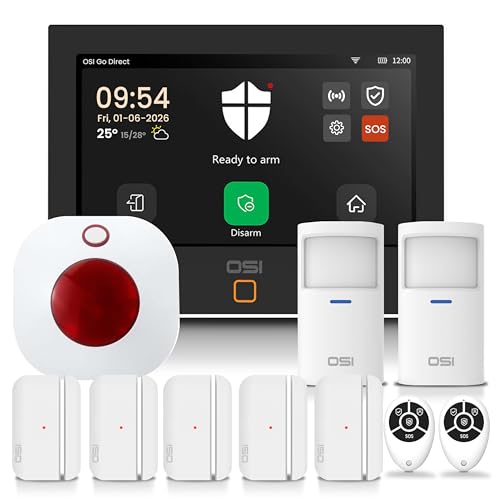
The OSI Alarm System Gen 2 (11pc) stands out in the Best Canadian Home Security Systems lineup for users who want full control without long-term commitments, since it supports both self-monitoring at no extra cost and optional 24/7 professional monitoring starting at $15/month with a 1-year subscription-available only in Canada. I like that it has no contracts, so I can cancel anytime. Its 4G panel works with an optional SIM card for SMS alerts, though cell fees apply. The HD touchscreen is responsive, and setup is guided, making installation simple. I get free system updates, a 24-hour backup battery, and the ability to scale up to 160 sensors. I can create one admin and five user accounts, which helps when managing access for guests or renters. The SOS button on the panel, app, and remote instantly triggers the siren and alerts shared users, adding a reliable emergency layer.
Best For: Canadian homeowners and renters seeking a flexible, contract-free security system with self-monitoring options and scalable expandability.
Pros:
- No monthly fees for self-monitoring and no long-term contracts, with optional 24/7 professional monitoring available in Canada
- 4G-enabled panel with SMS alerts via optional SIM card and responsive HD touchscreen for easy interaction
- Highly scalable system supporting up to 160 sensors and multiple access accounts, ideal for rentals or shared spaces
Cons:
- 24/7 professional monitoring only available in Canada with a minimum 1-year subscription
- Optional SIM card and active talk/text plan required for SMS alerts, incurring additional cell provider fees
- Backup battery only lasts 24 hours during power outages, which may be insufficient for extended outages
2026 WiFi/4G Home Security Alarm System

I find the 2026 WiFi/4G Home Security Alarm System especially well-suited for Canadian homeowners who want reliable, flexible protection without being locked into a single network type. It supports WiFi (2.4GHz), 4G, GSM, and GPRS, ensuring connectivity even during internet outages. The 120dB siren triggers instantly, while the app sends real-time alerts to your phone. I can control it via the Tuya App, Alexa, or remote controls, and expand it with extra sensors. It integrates with Tuya devices like cameras and smart switches, and supports zone naming in 10 languages. Low-battery alerts keep the system fully operational.
Best For: Homeowners in Canada seeking a reliable, multi-network security system that ensures uninterrupted protection with flexible connectivity and smart home integration.
Pros:
- Supports multiple connectivity options (WiFi 2.4GHz, 4G, GSM, GPRS) for reliable operation during internet outages
- 120dB siren and instant mobile alerts provide effective, real-time intrusion deterrence and response
- Fully integrates with Tuya ecosystem, supports voice control via Alexa, and allows expansion with additional sensors
Cons:
- WiFi only supports 2.4GHz band, not compatible with 5GHz networks
- Requires subscription or internet service for full app and cloud functionality
- Limited language support with only 10 available options, may not cover all regional languages
Alarm Security System with App & Alexa
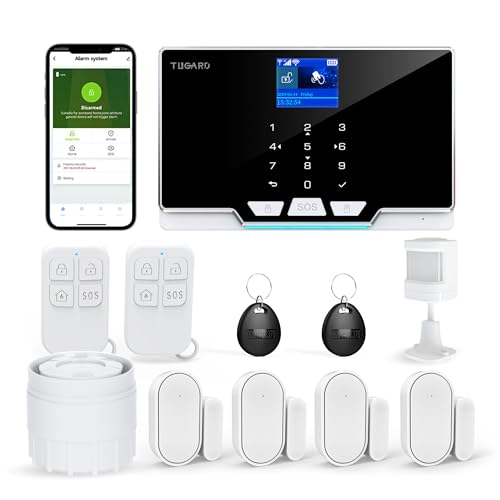
You’ll want this alarm security system if you need reliable, app-based control with hands-free Alexa compatibility-perfect for tech-savvy homeowners who value remote access and real-time alerts. I use the Tuya/Smart Life app to arm, disarm, and monitor my system from anywhere, and Alexa voice commands make daily use seamless. The 4G/WiFi control panel supports 100 wireless zones, and I’ve added extra sensors without monthly fees. With push alerts, SMS, and voice monitoring, I stay informed instantly. The color touchscreen is intuitive, and multilingual menus help customize settings. I appreciate the flexibility-custom zones, timed automation, and scalable support for remotes and RFID cards give me full, long-term control over my home’s security.
Best For: Tech-savvy homeowners who want reliable, app-based security with Alexa integration, remote access, and customizable, scalable protection without monthly fees.
Pros:
- Seamless control via Tuya/Smart Life app and Alexa voice commands for arming, disarming, and monitoring
- Dual 4G/WiFi connectivity with multiple alert options including push notifications, SMS, and voice monitoring
- Highly scalable system supporting up to 100 wireless zones and flexible configuration with custom security zones and automation
Cons:
- WiFi only supports 2.4GHz networks, excluding 5GHz compatibility
- Wireless sensors operate at 433MHz frequency, which may have limited range or interference in dense environments
- No mention of battery backup for control panel or sensors, posing a risk during power outages
Factors to Consider When Choosing Canadian Home Security Systems
You’ll want to check that your chosen system works with your home’s existing network, since reliable connectivity keeps everything running smoothly. Think about how easily it connects to smart devices you already own, because seamless integration means fewer hassles down the line. Also, keep an eye on how simple the setup is, whether you can expand the system later, and how quickly you’ll get alerts if something’s wrong.
Network Compatibility Requirements
When selecting a home security system in Canada, network compatibility plays a critical role in guaranteeing reliable performance. Make sure your system supports 2.4GHz Wi-Fi, since many devices aren’t compatible with 5GHz networks. Choose one with dual-network connectivity-combining Wi-Fi and GSM/4G-so it keeps working if your internet goes down. Look for multi-channel alerts sent via app notifications, SMS, and voice calls, which don’t rely solely on internet access. Check that cellular backup is compatible with local providers, keeping in mind that 2G, 3G, or 4G support affects functionality, especially as older networks phase out. If your area has strong cellular coverage, go for systems with built-in SIM card support to maintain monitoring without depending on home Wi-Fi. This setup guarantees consistent protection, even during outages.
Smart Home Integration Options
Reliable network connectivity guarantees your security system stays online, but pairing it with smart home integration expands its usefulness. You can use voice commands through popular assistants to arm your system or check lock status hands-free. Most systems offer mobile apps that let you monitor, arm, disarm, and manage alerts remotely in real time. Automation lets you schedule routines, like locking doors and turning off lights when the alarm arms. Many platforms work seamlessly with smart lights, locks, cameras, and sensors for unified control across devices. Some support multi-user access, so family members can have personalized permissions and alerts. Choose systems with strong interoperability to avoid compatibility issues. Look for apps with intuitive layouts and reliable push notifications. Prioritize platforms that allow gradual expansion as your smart home grows. Integration enhances convenience and responsiveness without complicating daily use.
Installation And Setup Ease
Though setup complexity varies by brand, most modern Canadian home security systems emphasize ease of installation, especially wireless models designed for DIY deployment. You can typically install these systems in 10–15 minutes using the included mounting hardware and clear guidance from a mobile app. Pre-paired components let you activate the system right away without syncing each device manually. Tool-free mounting and adhesive-backed sensors make it simple to place detectors on doors, windows, or walls-no drilling or wiring needed. Color touchscreen hubs guide you with visual prompts and multilingual menus, helping users of all ages follow along. The mobile app walks you through setup with step-by-step wizards and voice-guided instructions, reducing errors and confusion. With these features, you get a reliable, properly configured system fast, without needing professional help or technical expertise.
Expandability And System Capacity
If you’re planning to grow your setup over time, expandability and system capacity matter-most modern Canadian home security systems support between 50 and 200 wireless sensors, giving you room to cover every entry point and add devices as needed. You can integrate up to 10 remote controls or keypads, making access easy for family members or trusted users. Systems handle up to 100 wireless zones, letting you define areas as entry/exit, perimeter, or 24-hour, so you can customize responses based on activity. You’ll also expand with motion detectors, door/window sensors, smoke alarms, and cameras, ensuring broad coverage. Larger homes or multi-level layouts benefit from high-capacity systems, which manage complex setups without signal loss or lag. Choosing a scalable system now saves money and installation hassle later, letting your security evolve with your needs.
Alarm Notification Methods
How do you want to be alerted when your home security system detects a threat? You’ll want instant mobile app notifications sent to your smartphone the moment sensors detect entry or motion. Many systems offer multi-channel alerts, so you get warnings through push notifications, SMS, and voice calls at once. A built-in siren, usually 100dB to 120dB, adds on-site deterrence. Look for dual-network connectivity that switches between Wi-Fi and cellular to keep alerts reliable during outages. If stealth matters, silent alarm modes let you notify monitoring services or emergency responders without making noise, ideal during break-ins. Choose systems with customizable notification settings so alerts match your lifestyle and response plans. Reliable, fast, and flexible alert delivery guarantees you stay informed no matter where you are.
Voice Control Support
When choosing a home security system in Canada, considering voice control support can streamline how you manage your system daily. You can arm, disarm, or check your system’s status using simple voice commands through compatible smart assistants like Alexa or Google Assistant. To use this feature, you’ll need a connected smart speaker and a security app that supports the same ecosystem. Most systems work over 2.4GHz Wi-Fi, so a stable internet connection is key for reliable performance. You can trigger custom modes like “away,” “home,” or “night” with voice commands, which adjusts settings automatically. Make sure your devices are synced correctly, and test responsiveness regularly. While convenient, voice control depends on network uptime and device compatibility, so confirm these before deciding. It’s a practical feature if you already use smart speakers at home.
Emergency Response Features
What happens during a break-in, fire, or medical emergency could depend on how quickly help arrives-so why leave response times to chance? You need emergency response features that act fast and reliably. Look for systems with one-touch SOS buttons that trigger loud sirens and send real-time alerts to your phone. Multi-channel notifications-like app alerts, texts, and automated calls-ensure you get the message, even if one method fails. Silent alert modes let you notify emergency contacts without alarming an intruder, which is ideal during home invasions. Systems should support 24/7 monitoring of smoke detectors and panic buttons, so threats never go unnoticed. Always choose models with backup power to stay active during outages. These features give you faster response times, round-the-clock detection, and peace of mind that your home stays protected, no matter what happens.
Frequently Asked Questions
Can I Install These Systems Myself Without Professional Help?
Yes, you can install these systems yourself without professional help. Most modern kits use wireless components that snap or stick into place. You’ll connect the control panel to Wi-Fi and pair sensors via simple apps. Setup usually takes under two hours. You’ll save on installation fees, though mistakes can create gaps in coverage. Follow the manufacturer’s guide closely, test every sensor, and position devices properly to guarantee reliable performance and full system integration.
Are Monthly Monitoring Fees Required for These Security Systems?
Yes, you usually need monthly monitoring fees for most security systems to get full protection. Without them, you lose professional alerts and emergency responses. Some DIY systems skip fees but rely on self-monitoring through your phone. Always check what’s included-24/7 monitoring, cloud storage, or app access-since costs vary. Weigh the pros of constant oversight against the ongoing price. Plans start around $20/month, so factor that into your long-term budget.
Do These Systems Work During Power Outages?
Yes, these systems work during power outages because they include battery backups that keep core components running for several hours. You’ll still get alarms and monitoring if the main power fails. Most use cellular backup too, so internet or phone line loss won’t stop alerts. Check battery life and whether professional monitoring includes 24/7 dispatch. Some DIY systems warn you when power drops, letting you act fast.
Can I Connect Multiple Cameras to One Security System?
Yes, you can connect multiple cameras to one security system, and most modern setups support four to eight cameras, with some allowing up to 16. You’ll need a hub or recorder with enough channels and sufficient bandwidth. Wired systems offer stability, while wireless gives flexibility. Check your system’s specs before expanding-adding too many cameras can slow performance or require extra storage and a stronger internet connection.
Are There Contracts Required for App-Connected Security Systems?
You don’t always need a contract for app-connected security systems. Many Canadian providers let you pay month-to-month, giving you flexibility. Some companies offer discounts if you sign a contract, but others charge early termination fees. Check the terms carefully. Systems like Ring and Arlo work without contracts. Confirm setup costs, monitoring fees, and cancellation policies before committing. Always read the fine print to avoid surprises.