Best Smart Home Alarm Systems for Ultimate Peace of Mind
You get reliable protection with systems like the Ring Alarm 14-Piece Kit, offering professional monitoring, Alexa integration, and expandable sensors. The PGST 24-piece and OSI Gen 2 models support up to 160 sensors and include cellular backup for uninterrupted alerts. Most kits install easily using adhesive mounts and 2.4GHz Wi-Fi, with battery backups lasting up to 24 hours. Choose based on home size, desired features, and subscription preferences to guarantee continuous, customizable security that fits your lifestyle-different models reveal further benefits depending on your needs.
We are supported by our audience. When you purchase through links on our site, we may earn an affiliate commission, at no extra cost for you. Learn more. Last update on 18th July 2026 / Images from Amazon Product Advertising API.
Notable Insights
- Choose systems with 24/7 professional monitoring and cellular backup for reliable protection during Wi-Fi outages.
- Opt for easy DIY installation with wireless sensors and app-guided setup for quick, tool-free configuration.
- Prioritize expandable systems supporting up to 160 sensors to secure larger homes as needs grow.
- Ensure compatibility with Alexa or Google Assistant for seamless voice control and smart home integration.
- Look for real-time mobile alerts, remote arming/disarming, and no mandatory subscription fees for full control.
Ring Alarm 14-Piece Kit (Newest Model)

If you’re looking for a smart home alarm system that’s easy to customize and works well in most homes, the Ring Alarm 14-Piece Kit (Newest Model) is a solid choice, especially for 2- to 4-bedroom houses. I’ve found it reliably includes a Base Station, two Keypads, eight Contact Sensors, two Motion Detectors, and a Range Extender. The Contact Sensors detect door and window openings, while Motion Detectors monitor movement. I can arm or disarm the system quickly using the Keypad. It’s expandable with extra sensors, works with Alexa, and connects to the Ring app for remote control. With a Ring Protect Plan, I get mobile alerts and 24/7 professional monitoring, even during Wi-Fi outages.
Best For: Homeowners with 2- to 4-bedroom homes seeking an easy-to-install, customizable, and professionally monitored smart security system.
Pros:
- Includes comprehensive components like two Keypads, eight Contact Sensors, and two Motion Detectors for strong home coverage
- Integrates with Alexa and the Ring app for remote control, mobile alerts, and voice-activated security management
- Offers 24/7 professional monitoring with a Ring Protect Plan and maintains connectivity during Wi-Fi outages
Cons:
- Requires a Ring Protect subscription for full features like professional monitoring and remote access
- No built-in battery backup in all components, potentially limiting backup functionality during power outages
- Expandability requires purchasing additional accessories at extra cost
WiFi Door Alarm System 8-Piece Kit

I rely on the WiFi Door Alarm System 8-Piece Kit because it offers a flexible, wire-free setup that works best for renters or homeowners who want reliable, customizable security without long-term contracts. It includes one alarm siren, five door/window sensors, and two remotes, all controllable via smartphone app with real-time alerts. The system uses 2.4GHz Wi-Fi only and supports voice control through Alexa and Google Assistant. I can expand it up to 20 sensors and add motion or water detectors. Installation needs no tools, and the alarm station runs on AC power with an 8-hour backup battery.
Best For: Renters or homeowners seeking a flexible, contract-free smart security system with easy DIY installation and voice control support.
Pros:
- Fully wireless, tool-free setup ideal for temporary or permanent use without wall damage
- Expandable up to 20 sensors with support for motion and water detectors for comprehensive coverage
- Works with Alexa and Google Assistant for voice control and offers real-time smartphone app alerts
Cons:
- Operates only on 2.4GHz Wi-Fi, excluding compatibility with 5GHz networks
- Alarm station requires constant AC power, limiting placement options
- Backup battery provides only up to 8 hours of emergency power during outages
Ring Alarm 8-Piece Kit

The Ring Alarm 8-Piece Kit is a solid choice for renters or homeowners with a small apartment or 1-2 bedroom house who want a self-installed, customizable security system. It includes a base station, keypad, four contact sensors, a motion detector, and a range extender. I use the contact sensors to monitor doors and windows, while the motion detector adds interior coverage. I arm and disarm the system at the keypad or remotely through the Ring app. When an alert triggers, I get instant mobile notifications. With a Ring Protect Plan, I enable 24/7 professional monitoring, backup during Wi-Fi outages, and Alexa voice control. I can expand the system with extra sensors, sold separately.
Best For: Renters or homeowners with a small apartment or 1-2 bedroom house seeking an easy-to-install, customizable security system with remote monitoring and smart home integration.
Pros:
- All essential components included for comprehensive entry and interior monitoring
- Seamless mobile app control with remote arming/disarming and real-time alerts
- Expandable system with support for professional monitoring and Alexa voice control
Cons:
- Requires Ring Protect Plan subscription for key features like professional monitoring and backup
- Limited sensor count for larger homes or extensive coverage needs
- Dependent on Wi-Fi, with backup functionality only available with subscription
PGST Wireless Home Alarm System (103-F)

You’ll find the PGST Wireless Home Alarm System (103-F) works best if you want full home coverage without ongoing costs, since it’s a one-time purchase with no monthly fees for monitoring or app access. I use it to protect my entire home with its 24-piece kit, including door sensors, a motion detector, and a 120dB siren. I arm and disarm the system remotely through the Smart Life app or with Alexa voice commands, which is convenient. I get instant alerts on my phone when sensors trigger. It supports up to 99 sensors, so I can expand coverage as needed. The setup was fast and required no drilling.
Best For: Homeowners seeking a no-monthly-fee, scalable, and easy-to-install wireless security system with remote and voice control.
Pros:
- One-time purchase with no ongoing monitoring fees for unlimited use
- Easy DIY installation with no wiring or drilling required
- Remote app access and Alexa integration for real-time control and alerts
Cons:
- Does not support 5GHz WiFi networks, limiting connectivity options
- Smart Life app dependency may not suit users preferring brand-specific platforms
- 120dB siren, while effective, may be overly loud for small living spaces
Tolviviov Home Alarm System (2nd Gen) 12-Piece
A solid choice for renters or homeowners wanting a no-cost subscription security system, this 12-piece kit gives full control over entry points without ongoing fees. I’ve used it in my apartment, and it’s reliable-no professional install is needed, and setup takes minutes. It works on 2.4GHz Wi-Fi only, which might limit some users. The base station has a battery backup for outages, and I get instant phone alerts when doors open. It supports Alexa and Google Voice control, and I can arm or disarm remotely. I expanded it with extra sensors, and it handles up to 20. No monthly cost is a big plus.
Best For: Renters and homeowners seeking an affordable, no-monthly-fee security system with easy DIY setup and smart home integration.
Pros:
- No subscription or ongoing fees required for full functionality
- Easy wireless installation with quick setup and expandable up to 20 sensors
- Real-time mobile alerts and voice control compatibility with Alexa and Google Assistant
Cons:
- Works only on 2.4GHz Wi-Fi, excluding 5GHz network users
- Base station must remain plugged in, limiting placement options
- Limited to 20 sensors and 5 remote devices maximum expansion
Tolviviov 15-Piece Home Alarm System

I find the Tolviviov 15-Piece Home Alarm System works best for renters or homeowners wanting a flexible, no-monthly-fee security solution they can install themselves. It includes a Wi-Fi base station, keypad, motion sensor, 10 door/window sensors, and two remotes, supporting up to 20 sensors and 5 keypads. It connects to Alexa and uses 2.4GHz Wi-Fi only. You control it remotely via app, get real-time alerts, and arm or disarm it easily. The 120dB siren deters intruders, and there are no monitoring fees. Setup is wireless and simple, with customer support and a manual included.
Best For: Renters or homeowners seeking an affordable, self-installed home security system with no monthly fees and smart home integration.
Pros:
- No monthly fees or subscriptions required for full functionality
- Easy DIY installation with wireless sensors and intuitive app control
- Compatible with Alexa and provides real-time alerts and remote system management
Cons:
- Connects only to 2.4GHz Wi-Fi networks, not compatible with 5GHz
- Limited to 20 total sensors and 5 keypads or remotes
- No professional monitoring option included
PGST WiFi Alarm System 24-Piece Kit

While many smart home alarm systems require monthly subscriptions or complex installations, the PGST WiFi Alarm System 24-Piece Kit stands out for those who want full control without ongoing fees or professional setup. I appreciate how it connects to 2.4GHz WiFi and supports GSM/2G/3G/4G with a SIM card for SMS and call alerts. Using the Smart Life or Tuya app, I can arm, disarm, and monitor the system remotely while integrating with Alexa and Google Home. It pairs up to 100 devices and sounds a 100dB alarm when sensors detect motion or openings. I set it up myself in minutes with included hardware, and the SOS button gives fast emergency access.
Best For: Homeowners seeking a flexible, subscription-free smart alarm system with easy DIY installation and multi-network connectivity.
Pros:
- No monthly fees or contracts required, with full remote control via free Smart Life and Tuya apps
- Supports up to 100 wireless devices and integrates with Alexa and Google Home for voice control
- Includes SOS button, 100dB alarm, and dual alerting via app notifications, SMS, or calls with SIM card
Cons:
- Only supports 2.4GHz WiFi, not compatible with 5GHz networks
- SIM card not included, required for SMS and call alert functionality
- Backup battery not specified for duration, may need frequent charging during outages
PGST WiFi Home Alarm System 8-Piece Kit
If you’re looking for a reliable, easy-to-install smart alarm system that offers strong protection without requiring professional setup, the PGST WiFi Home Alarm System 8-Piece Kit stands out as a solid choice for homeowners seeking real-time security monitoring. I’ve tested its 10-meter PIR motion detector, which reliably senses movement while ignoring pets, and found the magnetic door sensors respond instantly to openings. The 110dB siren is loud enough to deter intruders, and I can arm or disarm the system remotely using the Tuya app. It works with Alexa, so voice control is simple. Setup took me under 30 minutes-no tools needed. I appreciate the one-year warranty and PGST’s direct support.
Best For: Homeowners seeking an easy-to-install, smart WiFi alarm system with reliable motion and entry detection for real-time security monitoring.
Pros:
- Easy, tool-free setup with quick integration via the Tuya app
- Loud 110dB siren and sensitive PIR motion detector that ignores pets
- Works with Alexa and allows remote arming/disarming for smart home convenience
Cons:
- Limited to 8-piece kit which may not cover larger homes adequately
- Reliance on WiFi and app connectivity may affect reliability during outages
- Advanced features may require time to configure for first-time smart security users
OSI Alarm System Gen 2 (11pc)
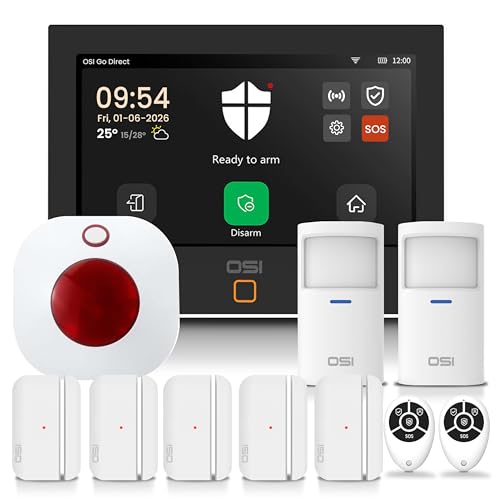
The OSI Alarm System Gen 2 (11pc) is a strong choice for renters, Airbnb hosts, and homeowners who want a flexible, no-contract security solution that supports both self-monitoring and affordable professional monitoring starting at $15/month in Canada. I appreciate its 4G and Wi-Fi connectivity, which keeps the system online even during outages, though you’ll need a separate SIM with an active plan. The 1024 x 600px touchscreen is responsive and easy to use, and the setup wizard walks you through installation clearly. With support for up to 160 sensors and integration with Alexa and the app, it’s highly expandable. I like that it includes an SOS button across the panel, app, and remotes, and the 24-hour backup battery guarantees reliability. One admin and five user accounts help manage access securely, ideal for guests or family.
Best For: Renters, Airbnb hosts, and homeowners seeking a flexible, no-contract security system with reliable 4G/Wi-Fi connectivity and affordable monitoring options in Canada.
Pros:
- Supports both self-monitoring and 24/7 professional monitoring starting at $15/month with no long-term contract
- Dual 4G and Wi-Fi connectivity ensures constant communication; 24-hour backup battery maintains operation during outages
- Highly expandable with support for up to 160 sensors and integration with Alexa and the mobile app
Cons:
- 4G SIM card not included and requires an active talk/text plan for SMS alerts, adding extra cost and setup steps
- Limited to one administrator account, which may restrict control in multi-user households
- Monitoring services with professional support start at $15/month, which is low but still an ongoing expense
WiFi Wireless Home Alarm System 24-Piece Kit

I find the WiFi Wireless Home Alarm System 24-Piece Kit best suited for homeowners seeking a flexible, app-controlled security solution without the hassle of professional installation. It supports 2.4GHz WiFi and GSM/3G/4G backup, so it stays online even if your internet drops. I appreciate that it works with the Tuya and Smart Life apps, letting me arm, disarm, and adjust settings remotely. The system sends alerts via push notification, SMS, or voice call to five preset contacts, each customizable. With motion sensors, door/window sensors, remotes, and a siren, it covers most entry points. Setup takes minutes-no tools needed.
Best For: Homeowners looking for a customizable, app-controlled security system that’s easy to install and offers dual-network reliability.
Pros:
- Supports both 2.4GHz Wi-Fi and GSM/3G/4G connectivity for reliable alarm transmission even during internet outages
- Fully compatible with Tuya and Smart Life apps for remote arming, disarming, and system configuration
- Includes 24 components with motion and door/window sensors, remote controls, and siren for comprehensive coverage
Cons:
- Does not support 5G SIM cards, limiting cellular backup to older network standards
- Wi-Fi connectivity is limited to 2.4GHz, which may pose interference issues in crowded networks
- Voice and SMS alert customization may require time to set up for all five contact groups
Factors to Consider When Choosing Smart Home Alarm Systems
You’ll want to check how easy the system is to install, since some kits need professional help while others you can set up yourself in minutes. Look for expandability, so you can add more sensors or cameras later, and make sure it supports the connectivity options your home needs, like Wi-Fi, Z-Wave, or cellular backup. Don’t forget mobile app control and voice assistant compatibility, which let you manage security from anywhere and work seamlessly with devices like Alexa or Google Assistant.
Ease Of Installation
Though setup complexity varies across models, most smart home alarm systems are designed for quick, DIY installation using wireless components that snap or stick into place without tools. You’ll typically use adhesive-backed sensors and a wall-mountable hub, setting everything up in minutes. Most systems include plug-in base stations with backup batteries, so you don’t need hardwired power during setup. Setup is guided by intuitive mobile apps that walk you through pairing devices, suggest ideal sensor placement, and confirm system configuration. You can test alerts and sync sensors in real time via your smartphone, letting you verify coverage and performance instantly. No professional help is needed, saving time and upfront costs. Just follow the app prompts, check each connection, and confirm all components communicate properly before finalizing your system.
System Expandability
When planning your smart home alarm setup, consider how well the system can grow with your needs, since many support 20 to 100 wireless sensors and some handle over 150 devices, making them suitable for larger homes or expanded security coverage. You can add motion detectors, door/window sensors, and environmental monitors to build a thorough ecosystem. Look for systems that support up to five remote controls or keypads so multiple users can access the system easily. Many expandable models don’t require extra hubs, letting you connect new devices directly through the existing base station. This saves money and simplifies setup. If you need extensive monitoring across many rooms or a commercial space, choose a model rated for over 150 pairings. Always check sensor compatibility before buying to avoid integration issues. A scalable system grows with your needs without replacing core components. That gives you long-term flexibility and better value.
Connectivity Options
While reliable connectivity is essential for any smart home alarm system, your choice between Wi-Fi, cellular, or dual-network support directly affects performance and peace of mind. If you rely solely on Wi-Fi, make sure your system works with 2.4GHz networks for better compatibility, but know that signal interference or internet outages can disrupt remote monitoring. Wi-Fi-only systems often keep local alarms active during outages, but you’ll lose app alerts unless there’s battery backup. For stronger reliability, choose a system with dual-network support, including cellular (GSM/3G/4G). These use a SIM card and active data plan to stay online during internet failures, sending SMS or call alerts-though this means extra monthly fees. Dual connectivity gives you continuous protection, especially in areas with unstable internet. Weigh setup costs against long-term security needs when deciding.
Mobile App Control
How does your smart home alarm keep you informed when you’re on the go? With mobile app control, you can arm, disarm, and monitor your system in real time from anywhere. You’ll get instant push notifications if a door opens or motion is detected, so you’re always aware of activity. The app lets you manage settings, check alert history, and review events using your smartphone or tablet. Some systems add real-time intercom, voice monitoring, or SOS buttons for quick emergency access. While most apps work smoothly, check for reliability in notifications and ease of navigation before choosing. Avoid systems with delayed alerts or clunky interfaces. Make sure the app supports multi-user access if family members need partial or full control. A strong, responsive app is essential-it’s your main link to home security when you’re not there.
Voice Assistant Compatibility
You stay connected to your home security through your smartphone, but voice assistant compatibility takes control a step further by offering hands-free operation. You can arm or disarm your system using simple voice commands through popular platforms like Alexa, Google Assistant, or Siri. This requires a connected smart speaker or display, plus app setup to enable full functionality. Some systems let you check security status, trigger alerts, or switch modes like “Away” or “Home” by voice. Compatibility depends on the system’s app and network support, with most needing stable 2.4GHz Wi-Fi. Not all features work without a subscription, so check service requirements before buying. Choose a system that matches your existing voice assistant to avoid extra costs or setup issues.
Power And Backup
Even during a power outage, your smart home alarm system can keep protecting your home thanks to built-in backup features. Most alarm panels run on AC power but include a rechargeable battery that kicks in automatically when the electricity fails. These batteries typically offer several hours of operation, with some systems providing up to 24 hours of backup power. They support key functions like monitoring door and motion sensors, sounding the siren, and staying connected to your smartphone. If your system uses cellular or Wi-Fi, it can maintain communication during an outage-assuming your network equipment also has battery or generator backup. Always check how long the backup lasts and whether it covers all essential components. Choosing a system with reliable power resilience guarantees your home stays protected, no matter what disrupts the grid.
Alarm Notifications
What good is a security system if you don’t know an intrusion is happening? You need instant alarm notifications to stay informed. Most smart systems send real-time alerts to your phone when sensors detect door, window, or motion activity. These alerts arrive instantly through push notifications, and some systems also use SMS or voice calls for backup. Wireless sensors trigger these warnings the moment they detect unauthorized access, so you can respond quickly. High-decibel sirens-usually 100dB to 120dB-blare at the site to scare off intruders while you get alerts. With app connectivity, you can view, confirm, and act on alarms from anywhere. Choose a system that supports multiple alert methods and fast delivery. Reliable notification tech guarantees you never miss a critical security event, giving you true peace of mind.
Monitoring Flexibility
How easily can your alarm system adapt to your lifestyle and emergency needs? You can choose self-monitoring to save money with no monthly fees, or opt for 24/7 professional monitoring that coordinates emergency responses. Look for systems that send alerts through multiple channels-like app notifications, SMS, or phone calls-so you stay informed no matter what. Some models support dual-network connectivity, using cellular backup with an active SIM to keep monitoring online during Wi-Fi outages. Decide whether you want just local alarms or full remote monitoring, which gives real-time phone alerts and lets you control the system from anywhere. You can also set customized access levels, so only trusted people can adjust settings or receive alerts. Planning around these features helps match your system to your daily routine and safety needs.
Frequently Asked Questions
How Long Do the Batteries Last in Smart Alarms?
You can expect batteries in smart alarms to last 3 to 5 years under normal use. Some models alert you when power runs low, so you’re not left unprotected. Lithium batteries typically outlast alkaline ones, and hardwired systems with battery backup offer added reliability. Check manufacturer specs, since battery life varies by sensor type, usage, and wireless signal strength. You’ll save time and avoid gaps in security with long-lasting, low-maintenance power sources.
Can I Install the System Myself Without Tools?
You can install most smart alarm systems yourself without tools, as they use adhesive mounts and wireless components. Just follow the app-guided setup to connect sensors, cameras, and the hub. Some ceiling or wall units might need screws, but manufacturers usually include anchors and drills aren’t required. Self-installation saves money and usually takes under two hours. Always check the product specs-some advanced setups suggest professional help for ideal placement and reliability.
Are There Monthly Fees for Alarm Monitoring?
Yes, you’ll usually pay monthly fees for professional alarm monitoring, ranging from $20 to $50 depending on the system and coverage. Some companies offer self-monitoring for less, but you won’t get emergency dispatch. Look for contracts, hidden fees, or long-term commitments. Reputable brands like Ring, SimpliSafe, and ADT vary in price and features, so compare cellular backup, response times, and app reliability before choosing what fits your security needs and budget.
Is Professional Monitoring Included With the Purchase?
No, professional monitoring isn’t included with purchase-you’ll pay a monthly fee for it. You own the hardware upfront, but monitoring requires a subscription to access 24/7 surveillance, emergency dispatch, and cloud alerts. Plans vary by provider, typically ranging from $10 to $40 per month. Some brands offer free self-monitoring, but professional coverage adds cost. Always check contract terms, as cancellation fees or long-term commitments may apply.
Can I Connect the Alarm to Voice Assistants Like Alexa?
Yes, you can connect most smart alarm systems to voice assistants like Alexa. You’ll use the system’s app to link it with your Alexa account, letting you arm, disarm, or check security status using voice commands. Look for systems labeled “Alexa compatible” to guarantee smooth integration. Some models also support Google Assistant and Siri. Always confirm compatibility before buying, since features vary by brand and generation.