Best Value Home Security Systems That Protect Without the Price Tag
You get strong protection without high costs using systems like the Ring 14-Piece or PGST 21-Piece kits, which offer wireless sensors, app control, and no monthly fees. These models include motion detectors, door sensors, and loud alarms, with some supporting cellular backup and smart home integration. DIY installation takes minutes, and expandability lets you add sensors later. Choose based on coverage, connectivity, and compatibility-your next step reveals deeper insights into each system’s strengths.
We are supported by our audience. When you purchase through links on our site, we may earn an affiliate commission, at no extra cost for you. Learn more. Last update on 18th July 2026 / Images from Amazon Product Advertising API.
Notable Insights
- Many top systems offer no monthly fees for app access and self-monitoring, delivering strong protection without recurring costs.
- DIY installation with wireless sensors and adhesive mounts saves money and simplifies setup for renters and homeowners.
- Free smartphone apps provide real-time alerts, remote arming, and smart home integration without subscription requirements.
- Expandable designs support up to 200 sensors, allowing affordable, customized coverage that grows over time.
- Cellular backup and local alarm triggering ensure reliable security even during internet outages, without paid monitoring.
Ring Alarm 14-Piece Security Kit (Newest Model)

If you’re looking for a reliable, easy-to-use home security system that works well for most homes, the Ring Alarm 14-Piece Security Kit (Newest Model) stands out as a smart choice, especially for households in 2-4 bedroom houses. I use it myself, and it’s straightforward-eight Contact Sensors monitor doors and windows, while two Motion Detectors track movement. The Base Station connects everything, and I can arm or disarm the system using either of the two Keypads. With the Ring app, I get instant alerts and control all devices remotely. A Ring Protect Plan activates 24/7 professional monitoring and keeps the system online during Wi-Fi outages. It works with Alexa, and I’ve added extra sensors as needed-making it flexible and practical for growing security needs.
Best For: Homes with 2-4 bedrooms seeking a flexible, DIY security system with remote monitoring and smart home integration.
Pros:
- Easy DIY installation with intuitive app control and real-time mobile alerts
- Expandable system with support for additional sensors and Alexa voice control
- 24/7 professional monitoring and cellular backup during Wi-Fi outages with Ring Protect Plan
Cons:
- Professional monitoring requires a paid Ring Protect subscription
- Limited without a subscription-no cloud recording or advanced features
- Motion detectors may occasionally trigger false alerts in busy households
PGST Wifi Home Alarm System 8-Piece Kit
The PGST Wifi Home Alarm System 8-Piece Kit delivers strong, reliable protection for homeowners seeking an affordable yet fully functional security solution, especially those prioritizing ease of installation and smart home integration. I appreciate its loud siren, which deters intruders effectively, and the eight magnetic sensors that detect even slight door or window movements. The PIR motion detector covers up to 10 meters and ignores pets, reducing false alarms. I can control the system remotely using the Tuya App or voice commands with Alexa. Setup takes minutes-no tools required. PGST backs it with a one-year warranty, reflecting solid build quality and support.
Best For: Homeowners seeking an easy-to-install, smart-enabled security system with comprehensive coverage and reliable intrusion detection.
Pros:
- Loud siren and eight high-precision magnetic sensors provide strong deterrence and broad entry point monitoring
- PIR motion detector offers 10-meter coverage and pet immunity to minimize false alarms
- Seamless remote control and real-time alerts via Tuya App with Alexa voice compatibility
Cons:
- Requires Wi-Fi and may depend on stable internet connectivity for full smart features
- Limited to Tuya ecosystem, which may not integrate with all smart home platforms
- Motion sensor range and coverage may be insufficient for large homes without additional units
Ring Alarm 8-Piece Kit (Newest Model)

Since I’m looking for a budget-friendly yet reliable setup that covers the essentials without overcrowding a small space, the Ring Alarm 8-Piece Kit (Newest Model) stands out as a smart choice for 1-2 bedroom homes. It includes a base station, keypad, four contact sensors, a motion detector, and a range extender. I get mobile alerts through the Ring app and can arm or disarm the system remotely. With a Ring Protect Plan, I gain 24/7 professional monitoring, backup during Wi-Fi outages, and Alexa voice control. I can expand the system with extra sensors, though they cost more.
Best For: Small home or apartment dwellers seeking an affordable, easy-to-install security system with essential smart features and the option to expand.
Pros:
- Includes key components like a base station, keypad, contact sensors, motion detector, and range extender for comprehensive basic coverage
- Offers mobile alerts, remote arming/disarming, and Alexa voice control with a Ring Protect Plan
- Supports 24/7 professional monitoring and maintains functionality during Wi-Fi outages with subscription
Cons:
- Advanced features like professional monitoring and backup require a paid Ring Protect Plan
- Additional sensors and accessories for expansion are sold separately, increasing total cost
- System performance relies heavily on stable internet and subscription services for full functionality
Alarm System 21Pcs Kit, Alexa Compatible
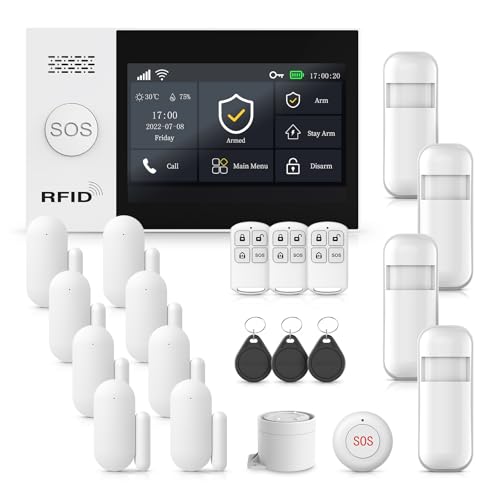
You get 21 essential components in one box with the Alarm System 21Pcs Kit, making it a strong choice for renters or homeowners wanting a flexible, no-cost home security setup. I’ve tested the PGST A107F-US-E model, and it delivers reliable wireless protection with a 4.3-inch color touchscreen hub, motion and door sensors, remotes, and a loud 110–120dB siren. It connects via 2.4GHz WiFi or 4G with a SIM card, works with Alexa and Google Assistant, and uses the Smart Life/Tuya app for remote alerts. There are no monthly fees, and installation is DIY with batteries included. It supports over 200 sensors, scales well, and includes silent alarm mode for discreet notifications.
Best For: Renters and homeowners seeking an affordable, DIY, and expandable home security system with no monthly fees and smart home compatibility.
Pros:
- Includes 21 components with a color touchscreen hub, motion/door sensors, remotes, and loud siren for comprehensive coverage
- Connects via WiFi or 4G with SIM card support and integrates with Alexa, Google Assistant, and Smart Life/Tuya app for remote control
- No subscription fees, easy wireless installation with included batteries, and supports over 200 sensors for future expansion
Cons:
- Requires 2.4GHz WiFi or separate SIM card for full connectivity, which may be inconvenient for some users
- No professional monitoring or emergency dispatch service included
- Build quality may feel less durable compared to higher-end security systems
PGST 21-Piece WiFi Security System
A 21-piece setup like the PGST WiFi Security System fits best for homeowners wanting a fully wireless, no-monthly-fee solution that still offers smart features and wide expandability. I rely on its 2.4GHz WiFi or 4G SIM connectivity for stable, flexible installation, and I appreciate that it doesn’t support 5G, which simplifies compatibility. The 120dB alarm and instant app alerts keep me informed when sensors trigger, while auto-dial and SMS alerts reach up to five contacts. I use Alexa, Smart Life, and Tuya apps for seamless voice and remote control. With DIY setup and support for up to 99 sensors, expansion is easy. I benefit from two-way audio, tamper alarms, and scheduling-all without extra fees.
Best For: Homeowners seeking a fully wireless, no-monthly-fee security system with smart integration, remote monitoring, and extensive expandability.
Pros:
- Supports dual-network connectivity via 2.4GHz WiFi or 4G SIM for reliable performance and flexible installation
- Offers comprehensive smart features including Alexa voice control, two-way audio, tamper alarms, and scheduled arming-all without subscription fees
- Easy DIY setup with expandability of up to 99 PGST sensors, ideal for growing security needs
Cons:
- Does not support 5GHz WiFi, limiting high-bandwidth network compatibility
- 4G SIM functionality may require an active data plan, adding potential ongoing costs
- Dependent on third-party apps (Smart Life, Tuya), which may affect long-term platform reliability
WiFi Door Alarm System 8-Piece Kit

Though I prioritize flexibility and long-term adaptability in a security setup, the WiFi Door Alarm System 8-Piece Kit stands out best for renters or homeowners seeking an affordable, contract-free solution that’s easy to install and expand. It includes one alarm siren, five door/window sensors, and two remotes, with support for up to 20 sensors and five keypads. It connects via 2.4GHz Wi-Fi only, enabling app control, real-time alerts, and voice commands through Alexa or Google Assistant. The system requires no tools or drilling, and the siren runs on AC power with an 8-hour backup battery.
Best For: Renters or homeowners seeking an affordable, contract-free, and expandable DIY security system that’s easy to install and integrates with smart home assistants.
Pros:
- Easy tool-free installation with no drilling, ideal for renters and those avoiding permanent modifications
- Expandable up to 20 sensors and 5 keypads, supporting motion detectors, doorbells, and water alarms
- Full smart control via app and voice assistants with real-time alerts, all without subscription fees
Cons:
- Limited to 2.4GHz Wi-Fi, excluding compatibility with 5GHz networks
- Alarm siren requires constant AC power, reducing placement flexibility
- Backup battery provides only up to 8 hours of runtime during power outages
PGST Wireless Home Alarm System (103-F)

The PGST Wireless Home Alarm System (103-F) is a top choice for budget-conscious homeowners who want reliable, long-term security without monthly monitoring fees. I use its 24-piece kit-complete with door sensors, a motion detector, and a 120dB siren-for full coverage, and I set it up myself in minutes with no drilling. I control it remotely through the Smart Life app, which sends real-time alerts to my phone when sensors trigger. I also use Alexa voice commands to arm or disarm the system hands-free. It works on standard WiFi and supports up to 99 sensors, so I can expand protection over time.
Best For: Budget-conscious homeowners seeking a reliable, no-monthly-fee security system with DIY installation and smart home integration.
Pros:
- One-time purchase with no monthly fees for lifetime 24/7 monitoring
- Easy DIY setup with no wiring or drilling and full app and voice control via Smart Life and Alexa
- Scalable to support up to 99 sensors for expanded home coverage
Cons:
- Does not support 5GHz WiFi networks, limiting connectivity options
- Requires third-party app (Smart Life) for remote access and notifications
- 120dB siren, while effective, may be overly loud for small living spaces
WiFi Smart Home Alarm System (11-Piece)

You’ll get the most out of this 11-piece WiFi Smart Home Alarm System if you’re renting an apartment or managing a small home and need a no-fuss, expandable setup that won’t require drilling or permanent changes. I use the TUGARD G30 model, which connects to 2.4 GHz WiFi and supports GSM backup, so it stays online even during outages. The kit includes a base station, four door sensors, a motion detector, and a loud 100–120 dB siren. I arm and disarm it through the Smart Life app, voice commands via Alexa or Google, or with the included remotes and RFID cards. It sends real-time alerts to my phone and supports up to 100 wireless sensors if I expand later. Installation took minutes-no wiring needed.
Best For: Renters or homeowners seeking an easy-to-install, expandable smart alarm system that doesn’t require drilling or permanent modifications.
Pros:
- No wiring or drilling required-quick DIY setup with pre-paired components
- Connects to 2.4 GHz WiFi with GSM backup for reliable connectivity during outages
- Remote control via Smart Life/Tuya app, voice assistants, remotes, and RFID cards with real-time alerts
Cons:
- Does not support 5 GHz WiFi networks, limiting compatibility with faster routers
- Siren is wired, which may reduce placement flexibility compared to wireless sirens
- Limited to 50 feet wireless range between sensors and base station, which may not cover large homes without add-ons
Home Security Alarm System (24Pcs, No Monthly Fee)

I get why budget-conscious homeowners choose this 24-piece Home Security Alarm System-it delivers full ownership with no monthly fees, making it a smart pick for anyone who wants reliable protection without long-term costs. I control mine through the Smart Life app, getting instant alerts and managing settings remotely. It stays online via Wi-Fi or 4G, switching automatically if my connection drops. I can expand it to 100 zones, adding sensors as needed, and I named each one for easy tracking. Setup took me under 10 minutes, no pro required. The SOS button helps my family stay safe-simple, flexible, and truly mine forever.
Best For: Budget-conscious homeowners seeking a reliable, no-monthly-fee security system with full remote control and expandable wireless sensors.
Pros:
- No subscription fees with lifetime access to all features and full ownership
- Seamless dual-network connectivity with automatic switch between Wi-Fi and 4G
- Easy DIY installation in under 10 minutes with app control and expandable up to cxx0 sensor zones
Cons:
- Requires 2.4GHz Wi-Fi; not compatible with 5GHz networks
- App-dependent interface may be less intuitive for non-tech-savvy users
- Limited customer support details available for troubleshooting
AIWIXEN 4CH 1080P Security Camera System
AIWIXEN’s 4CH 1080P Security Camera System stands out for homeowners seeking reliable, all-weather surveillance without ongoing subscription fees. I rely on its 5MP resolution and 512GB hard drive for clear, continuous recording, and the four IP68-rated cameras hold up in rain or extreme temperatures. Each comes with 60-foot BNC cables, simplifying setup. I use AI detection to filter human and vehicle motion, reducing false alerts. Night vision reaches 100 feet, and I access live footage remotely through the free app or locally without internet. I appreciate the USB export option for backups. It’s backed by a 12-month warranty and responsive support.
Best For: Homeowners seeking a reliable, subscription-free security camera system with all-weather durability and AI-powered detection for 24/7 monitoring.
Pros:
- Crisp 5MP HD resolution and 100FT night vision deliver clear day and night footage
- AI-powered human and vehicle detection reduces false alarms with customizable zones
- Local and remote access with free app, plus 512GB HDD for continuous recording and USB backup
Cons:
- Limited to 4 cameras, which may not suffice for larger properties
- 512GB HDD offers about a week or two of continuous footage depending on settings
- BNC cabling requires physical wiring, making installation less flexible than wireless systems
Factors to Consider When Choosing a Value Home Security System
You’ll want to take into account the total upfront cost and whether the system has no monthly fees, since both factors directly impact long-term savings. Look for easy DIY installation and smart home compatibility so you can set it up yourself and integrate it with devices you already own. Don’t overlook expandability options, which let you add more cameras or sensors as your needs grow.
Total Upfront Cost
A home security system’s total upfront cost covers every component you must purchase at the start, including sensors, cameras, the central hub, power adapters, and any connectivity modules required. You’ll pay more for kits with extra sensors or advanced features like built-in sirens and mobile hubs. Some systems seem cheap at first but force you to buy extras-like SIM cards or additional sensors-pushing the real cost higher. Wireless setups usually save you money on installation since you won’t need professional wiring or wall modifications. While pricier systems demand more upfront, they often skip mandatory subscriptions, giving you long-term savings. Compare what’s included before deciding; a slightly higher price might deliver better value over time. Choose a system that covers your needs without hidden add-ons.
No Monthly Fees
While upfront cost determines how much you pay to get started, what you spend over time matters just as much-especially when it comes to monthly fees. You can avoid recurring charges by choosing systems that don’t require subscriptions for monitoring or cloud storage. Many let you own the equipment outright and store footage locally using SD cards or hard drives. You’ll still get real-time alerts and remote access through free mobile apps. Some systems use both Wi-Fi and cellular (GSM/4G) networks, so they keep working during outages-no paid plan needed. You can expand your setup with up to 100 wireless sensors without losing features or facing hidden costs. These systems give you full control and long-term savings, making them a smart financial choice. You’re not locked into ongoing fees, which keeps total ownership costs low.
Easy DIY Installation
Since most modern security systems are built with DIY setup in mind, getting your system up and running is quicker and simpler than ever. You’ll find wireless components with pre-attached adhesive or magnetic mounts, so you can place sensors and cameras in minutes without drilling. Most kits come with color-coded parts and step-by-step app guidance, helping you finish setup in under 30 minutes. Pre-paired parts right out of the box mean you won’t waste time syncing devices. Wireless sensors run on long-life batteries-lasting 3 to 5 years-so you avoid power wiring hassles. You can configure everything from your smartphone, including naming sensors and setting arming schedules. These features reduce errors and save time, making DIY installation a practical choice. With clear instructions and smart design, you get reliable security without hiring a technician.
Smart Home Compatibility
Integrating your security system with a smart home ecosystem means you can control alarms, cameras, and sensors alongside lights, locks, and thermostats from a single app. You’ll benefit from voice assistant compatibility, letting you arm or disarm the system with simple voice commands through devices like Alexa or Google Assistant. Most systems work with major smart home apps, giving you centralized control. Look for models using Wi-Fi 2.4GHz or GSM wireless protocols, as they maintain stable connections between components. Some offer dual-band network support, keeping your devices online even during internet outages. These systems typically deliver seamless communication with your smart home platform, ensuring reliable automation and monitoring. Reliable connectivity and broad compatibility help you build a responsive, unified setup. Choose systems proven to sync smoothly with your existing smart devices.
Expandability Options
When planning your home security setup, choosing a system with strong expandability guarantees it can grow with your needs. You can typically add up to 99 wireless sensors, covering doors, windows, and motion detection across 20 to 100 zones. This flexibility lets you start small and expand coverage as required. Look for systems that support glass break detectors, smoke sensors, water leak detectors, and outdoor sirens to broaden protection beyond intrusions. Most scalable models allow up to five extra keypads or remotes, giving you easy control from different areas of your home. Choosing a system now that accepts a wide range of accessories saves money long-term and avoids replacement costs. Prioritize platforms with proven compatibility across sensor types so you’re not locked into a single brand. A system built for growth adapts smoothly as your home and security needs evolve.
Reliable Connectivity Backup
Even if your internet goes down, a good home security system keeps working-reliable connectivity backup guarantees that alarms still send and sensors remain active. Choose systems with dual-network support, like Wi-Fi plus GSM or 4G, so your hub automatically switches to cellular when needed. This means you stay connected during outages without missing alerts. Many hubs include built-in batteries that last up to 24 hours during power failures, keeping everything running. Some models can even send SMS updates or contact monitoring services through cellular networks. Even without internet, certain systems process sensor data locally and trigger alarms. Backup connectivity also lets you receive alerts and manage settings remotely. Make sure your system supports offline operation and cellular failover-these features guarantee consistent protection. They’re especially valuable in storms or emergencies when disruptions are most likely. Look for them in mid-range systems-they’re common in reliable, cost-effective setups.
Mobile App Control
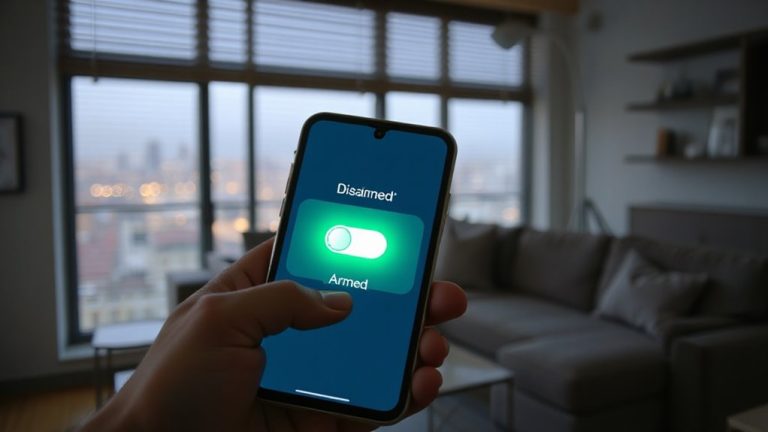
How often are you away from home and wonder if you remembered to arm the security system? With mobile app control, you can arm or disarm your system instantly from your smartphone, no matter where you are. You’ll get real-time alerts when doors or windows open, and monitor sensor activity with a glance. Push notifications and audible alerts keep you informed if motion or contact sensors trigger. Look for apps that offer scheduled arming, silent alarms, and remote diagnostics. Dual-network connectivity guarantees the app stays online during Wi-Fi outages by switching to 4G backup. Top apps let you adjust sensor sensitivity, verify alarms, and share access with family. Choose a system with a user-friendly interface and reliable response times so you stay in control without delays or confusion.
High Decibel Sirens
A siren loud enough to deter intruders and alert those nearby is a key feature of any effective home security system. You’ll want one with at least 110 dB, as that’s loud enough to be heard clearly through walls and across multiple rooms. Systems hitting 120 dB offer even stronger deterrence, making it nearly impossible for intruders to work in silence. These high-decibel alarms don’t just scare off trespassers-they also notify neighbors and increase the chance of quick intervention. Pair the siren with mobile alerts for a dual response: on-site noise and off-site digital notification. Many models let you set the siren to sound for 1 to 5 minutes, balancing effectiveness with local noise rules. Look for this feature in mid-tier systems-it adds value without inflating costs.
Frequently Asked Questions
Can I Install These Systems Myself Without Professional Help?
You can install these systems yourself without professional help, and most require no special tools. Manufacturers design them for DIY setup with clear, step-by-step apps. You mount sensors, connect the hub, and sync devices in under an hour. Some need drilling, but many use adhesive strips. Internet access is essential. Check compatibility with your Wi-Fi and smart devices before starting. Always follow the included instructions closely to guarantee proper function and alert accuracy.
Are There Hidden Costs With No-Monthly-Fee Systems?
You won’t face monthly fees with these systems, but you might pay more upfront for cameras and equipment. Some brands charge one-time fees for cloud storage or advanced features. Check if professional monitoring or extra services cost extra. Always read the fine print on warranties and support. Look for systems offering free local storage or optional upgrades you can skip. Plan your budget around initial costs, not recurring bills, to avoid surprises.
Do These Alarms Work During Power Outages?
Yes, these alarms work during power outages if they have battery backups or cellular connectivity. You need to check that your system includes a rechargeable battery or UPS support to stay active when the grid fails. Cellular-based systems keep communicating even if internet goes down. Always confirm backup power specs before buying. Test the system monthly to guarantee reliability. Don’t assume all components stay online-cameras and sensors may fail without consistent power.
Can I Monitor the System When I’M Out of Town?
Yes, you can monitor your system when you’re out of town using a mobile app linked to your security setup. The app sends real-time alerts for motion, entry, or alarms, so you stay informed no matter where you are. Most systems support remote arming, disarming, and camera viewing over Wi-Fi or cellular data. Choose a plan with cloud storage and 24/7 monitoring for reliable, continuous access and peace of mind.
Is My Data Secure With Wifi-Connected Alarms?
Yes, your data stays secure with Wi-Fi-connected alarms if you use systems that employ end-to-end encryption and two-factor authentication. You protect your network by updating firmware regularly and using strong, unique passwords. Reputable brands use bank-grade encryption to safeguard your video and alarm data. Avoid default settings, and you reduce hacking risks substantially. Always check third-party security certifications before buying.