Understanding the Role Of Drones in Providing Real-time Surveillance During Large-scale Events Such As Concerts, Sporting Competitions, Or Political Rallies Where Safety Is A Priority
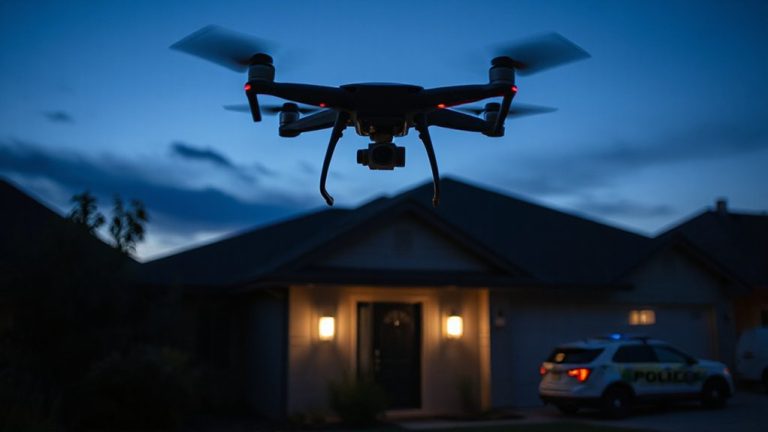
You rely on real-time surveillance to keep large crowds safe, and drones give you that from above. They stream live video, map crowd density, and spot risks like overcrowding or unattended items. With thermal imaging and stable flight times of 30 minutes or more, they work in darkness or smoke. You integrate them with command centers for faster responses, all while using encrypted, anonymous tracking to protect privacy-there’s more to how they enhance your event safety strategy.
Notable Insights
- Drones provide real-time aerial surveillance, enhancing situational awareness during large-scale events like concerts and political rallies.
- They monitor crowd density and movement patterns to identify potential safety risks and prevent dangerous overcrowding.
- Equipped with thermal imaging and high-resolution cameras, drones operate effectively in low visibility or at night.
- Drones enable rapid emergency response by quickly assessing hazards and guiding ground teams to precise incident locations.
- Privacy is maintained through anonymous tracking, data encryption, and limited storage of surveillance footage.
Why Drones Are Essential for Event Safety
While traditional security methods still have their place, drones offer a clear advantage when it comes to monitoring large, crowded events in real time. You can deploy them quickly, giving you a bird’s-eye view that ground patrols can’t match. Drones support faster emergency response by identifying issues early and guiding teams with accurate location data. They also enhance hazard detection, spotting overcrowding, fires, or unattended items before they become serious threats. With thermal imaging and live video feeds, you get actionable data, not guesswork. Most systems integrate with existing security networks, so you don’t need to replace what works. Though initial costs range from $2,000 to $10,000 per unit, the investment often pays off in reduced risk and faster incident resolution. Training and FAA compliance are necessary, but proper planning minimizes delays. Drones aren’t a fix-all, but used wisely, they’re essential for keeping large events safe.
How Real-Time Surveillance Improves Crowd Monitoring
Since you can see the entire event from above, real-time drone surveillance gives you immediate insight into crowd movements and behaviors. You can assess crowd density quickly and spot areas where people are clustering too tightly. This helps you make fast decisions to prevent overcrowding or bottlenecks. Behavior analysis becomes easier when you monitor how groups move, react, or respond to stimuli across large spaces.
| Feature | Benefit |
|---|---|
| Real-time video feed | Immediate situational awareness |
| Crowd density mapping | Identifies high-risk zones |
| Behavior analysis tools | Detects unusual or risky patterns |
You’ll catch potential issues before they escalate. With live data, you respond proactively, not reactively. Drones provide clarity and precision, allowing event managers to maintain order safely and efficiently.
Critical Drone Capabilities for Large Gatherings
When you’re managing a large gathering, having drones with strong real-time streaming and stable flight performance makes a big difference in maintaining safety and coordination. You’ll need thermal imaging to detect elevated body temperatures or spot individuals in low visibility, especially after dark. This capability helps you monitor crowd density and identify potential trouble spots before they escalate. Drones must also resist signal interference, which is common in crowded areas with many wireless devices. Look for models with frequency-hopping spread spectrum tech to maintain control and video feed. Flight time matters too-aim for at least 30 minutes per battery. Make sure the drone integrates with your event’s command center for instant data sharing. These features boost reliability and response accuracy without adding complexity.
Responding to Emergencies With Drones
A fast-moving crisis needs fast information, and that’s where drones really prove their worth. You’ll rely on rapid deployment to get eyes on the scene within minutes, not hours. Drones provide real-time video feeds to emergency response teams, helping you assess crowds, spot hazards, or locate individuals in need. Their mobility allows access to areas that are too dangerous or congested for ground units. With thermal imaging and high-resolution cameras, drones detect heat signatures and movement even in low visibility. This data improves decision-making during evacuations or medical incidents. While drones can’t replace first responders, they enhance situational awareness and speed up coordination. You’ll find most public safety agencies use them alongside traditional methods. Planning includes flight paths, battery rotation, and trained pilots. Cost ranges from $2,000 to $15,000 per unit, depending on features. Overall, drones support faster, smarter emergency response at large events.
Managing Privacy Without Compromising Safety
How do you balance the need for safety with the right to privacy at large events? You use drones equipped with anonymous tracking to monitor crowd movements without identifying individuals. This means facial recognition is avoided, and only general behaviors are analyzed. Data encryption guarantees any information collected stays secure and can’t be accessed by unauthorized parties. You minimize privacy risks while still spotting potential threats in real time. The benefit is clear: you maintain public safety without overstepping personal boundaries. Anonymous tracking limits data storage, reducing misuse chances. Encryption protects live feeds and stored footage. You should plan drone use with strict protocols, guaranteeing compliance with privacy laws. Transparency with the public about how data is managed builds trust. You don’t sacrifice safety-you refine it with responsible tech.
Connecting Drones to Security Operations
You’ve already seen how anonymous tracking keeps large crowds safe without invading personal privacy, but that data only becomes actionable when integrated into broader security systems. Drone integration enables real-time video feeds and threat detection to flow directly to command centers. This strengthens operational coordination between air units, ground teams, and emergency responders. Below is how key elements align:
| Function | Benefit | Challenge |
|---|---|---|
| Live video streaming | Immediate situational awareness | Requires strong data bandwidth |
| GPS tracking | Accurate drone positioning | Signal interference in dense areas |
| Radio communication | Direct link to security teams | Needs encrypted channels |
| Automated alerts | Faster response to incidents | Risk of false positives |
| Multi-drone control | Full coverage of large venues | Complex coordination required |
Effective drone use relies on seamless integration and clear protocols.
The Future of Drones at Mass Events
What might tomorrow’s mass gatherings look like when drones become a standard part of event security? You’ll see fleets of drones using autonomous navigation to monitor crowds without human pilots, reducing delays and human error. These drones will rely on swarm coordination, allowing them to work together like a team, covering large areas efficiently and adjusting in real time. If someone needs help or a threat emerges, the system pinpoints the issue and alerts responders. They operate day or night, using thermal imaging and live video feeds. While setup costs and airspace regulations are challenges, the benefits include faster response times and broader visibility. Training staff and integrating drones with ground teams will be key. You’ll need proper permits and cybersecurity measures too. Over time, this tech could become as common as surveillance cameras, keeping events safer with minimal disruption.
On a final note
You can rely on drones to enhance safety at large events by delivering real-time surveillance, improving crowd monitoring, and supporting quick emergency responses. With thermal imaging, live video feeds, and wide coverage, drones help security teams detect issues early. While privacy concerns exist, clear policies and data limits keep monitoring responsible. Integrating drones into security planning boosts coordination and response times. For best results, choose models with strong battery life, reliable controls, and weather resistance.