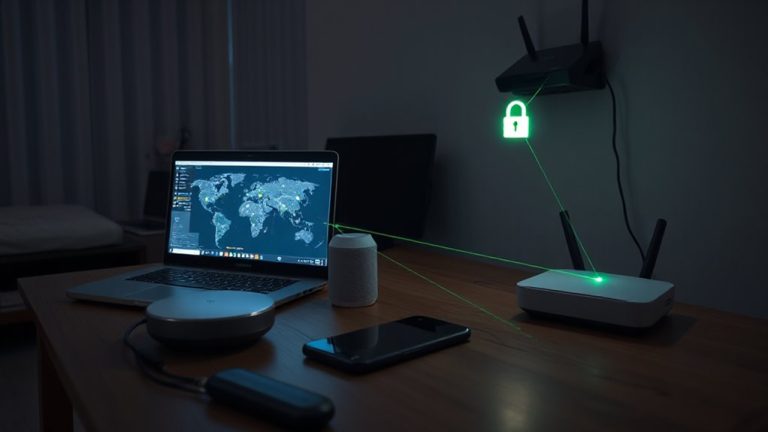
The Importance of Physical Security Measures When Implementing Smart Home Systems
You need to protect your smart home devices physically, not just digitally. Secure your hub in a tamper-proof, ventilated enclosure out of sight, and mount voice assistants with locking kits. Choose smart locks with ANSI Grade 1 certification and tamper alerts, and use cameras with motion sensors to detect interference. Layering physical and digital defenses deters breaches and guarantees systems stay online-there’s more to contemplate for full protection.
Notable Insights
- Secure smart hubs in tamper-proof enclosures to prevent unauthorized physical access and potential system breaches.
- Install voice assistants in supervised locations using tamper-proof mounts to limit physical interference and data exposure.
- Choose smart locks with tamper alerts and ANSI Grade 1 certification to ensure physical and digital resilience.
- Use cameras with motion-based tamper detection and secure mounting to maintain monitoring integrity.
- Combine physical barriers and tamper-evident seals with digital security to create layered, resilient smart home defenses.
Lock Down Your Smart Hub in a Secure Enclosure
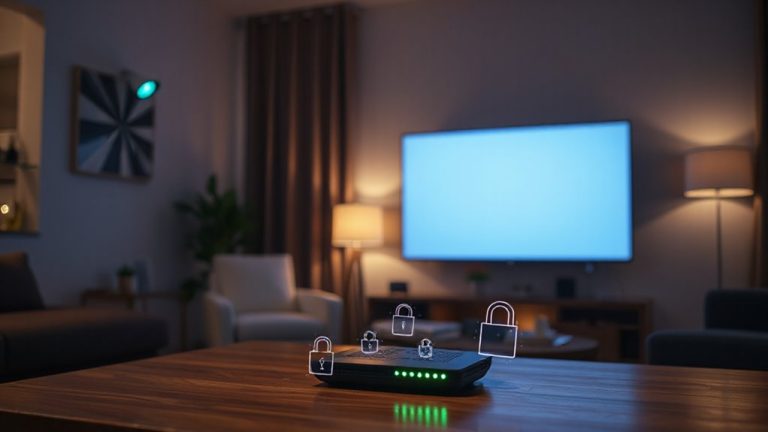
A smart hub acts as the central controller for your connected devices, making it a prime target for tampering or theft. You should install it in a tamper proof enclosure to block unauthorized access and protect internal components. These enclosures resist drilling, prying, and removal, often featuring locking mechanisms and hardened materials. Secure mounting to walls or inside cabinets adds another layer of defense, especially in accessible areas. Choose a location that’s out of reach and not visible to guests or passersby. Units with tamper alerts notify you if someone attempts interference, enhancing monitoring. While most enclosures cost $30–$70, higher-end models offer temperature control and cable management. Proper ventilation is critical, so don’t block airflow. You’ll need tools for mounting, and installation takes about 20–30 minutes. A well-secured hub reduces physical vulnerabilities markedly, giving you stronger overall system integrity.
Block Physical Access to Voice Assistants and Displays
Because voice assistants and smart displays often store sensitive routines and can control entire home networks, keeping them out of reach from unauthorized users is essential. You should use tamper proof cases to prevent physical interference, especially in homes with guests or children. These cases deter casual access and make resetting or disconnecting devices more difficult. Combine that with secure mounting on walls or shelves, placing devices in locations that limit unsupervised access. Mounting kits with locking mechanisms add a layer of control. For shared spaces, position assistants away from edges and out of easy reach. While tamper proof cases may slightly reduce microphone sensitivity, the trade-off in security is usually worthwhile. Secure mounting also protects against accidental damage. Many quality kits cost $15–$30 and install easily. Plan placements during setup to balance usability and protection, ensuring only trusted users can touch or reposition your devices.
Choose Smart Locks That Resist Tampering and Hacks
You’ve secured your voice assistants from tampering, but your smart home’s front door might still be vulnerable if you’re using a lock that lacks robust defenses. Choose smart locks with strong tamper evidence features, like alerts when someone tries to remove or force the device. Look for models built with brute force resistance to block repeated code attempts, which stops intruders from guessing access codes. These locks often use encryption and rate-limiting to reduce risks. Some top options cost $150–$250, with battery life lasting 6–12 months. Check for certifications like ANSI Grade 1 for durability. While wireless convenience helps, avoid models relying solely on Wi-Fi-Zigbee or Z-Wave with local control add layers. Always enable two-factor authentication. A good lock balances ease of use with proven security features, so read independent test results before buying. Top models include Z-Wave locks known for reliable Z-Wave smart locks performance and secure integration.
Install Cameras That Detect Physical Interference
While securing entry points with smart locks is essential, overlooking your cameras’ vulnerability to physical attacks leaves a critical gap in your defense. You need cameras that detect physical interference to prevent camera tampering and guarantee reliable intrusion detection. Look for models with tamper alerts that notify you if someone blocks, moves, or covers the lens. These cameras often include motion sensors and gyroscope-based detection to distinguish between normal vibrations and deliberate interference. Some systems log tamper events and send real-time alerts to your phone. This data helps verify threats and improves response times. Cameras with tamper detection typically cost $20–$50 more than basic models, a small increase for added security. Installation should include secure mounting brackets and placement out of easy reach. Avoid pointing cameras directly at accessible surfaces where they can be easily disrupted. Choose trusted brands with strong encryption and firmware updates to maintain performance over time. Top models like those in the best closed-circuit security cameras roundup offer advanced tamper detection and reliable performance.
Why Physical Access Is a Real Smart Home Threat
Even if your smart home uses strong passwords and encrypted networks, an intruder with physical access can bypass many digital safeguards by directly tampering with devices. Device tampering is a serious risk-someone can reset your smart lock, unplug security cameras, or install malicious hardware. Unauthorized entry doesn’t just mean breaking a window; it can be as simple as someone gaining access to your garage or back door unnoticed. Once inside, digital protections mean little. Physical access allows attackers to disable alarms, steal stored data, or manipulate system settings. Unlike remote hacks, these actions leave fewer digital traces, making detection harder. You can’t rely solely on software; real security combines digital and physical layers. Consider tamper-proof enclosures, secure mounting, and placing devices out of easy reach. Monitoring for signs of interference adds another protective layer. A simple yet effective addition is using a security door stopper to prevent forced entry through vulnerable doors.
How Thieves Bypass Digital Security With Physical Access
A thief’s ability to exploit physical access turns even the most advanced digital security into little more than a speed bump. If you leave a smart lock or hub within reach, they can launch brute force attacks by cycling through passcodes manually or use tools to capture data for device cloning. Once cloned, your legitimate device is no longer unique. They bypass authentication as if they’re you.
| Method | How It Works | Risk Level |
|---|---|---|
| Brute force attacks | Repeated passcode attempts | High |
| Device cloning | Copying device identity | Critical |
| Firmware tampering | Altering internal software | Medium |
| Signal interception | Capturing wireless transmissions | High |
| Physical spoofing | Impersonating user via hardware | Medium |
You can’t rely on digital layers alone-physical exposure enables these workarounds.
Combine Physical and Digital Security Layers
If you want your smart home to stay secure, you need both physical and digital defenses working together. Relying only on passwords or apps leaves gaps a thief can exploit. Combine locks, reinforced doors, and surveillance with digital tools like encryption and secure networks. Use biometric authentication-such as fingerprint or facial recognition-for stronger access control; it’s harder to fake than a password. Pair this with tamper evident seals on hubs, cameras, and smart locks to detect physical interference early. These seals show clear damage if someone tries to open or alter a device. While biometric systems cost more upfront, they reduce the risk of unauthorized access. Tamper evident seals are low-cost and easy to install. Together, layered measures improve detection, deterrence, and response. Plan your setup so physical and digital systems support each other. This integrated approach delivers stronger, long-term security.
On a final note
You need both physical and digital defenses for a secure smart home. Lock down hubs, block access to voice devices, and choose tamper-resistant smart locks. Install cameras that detect physical interference. Thieves can bypass digital security with simple physical access, so combine strong enclosures, access controls, and monitoring. Each layer adds protection, reducing risks effectively and affordably with proper planning.