Top-Rated Home Security Cameras That Keep Your House Safe
You get sharper detail with 2K and 3K cameras like the ANNKE 3K Lite or Aosu 4-Cam Kit, which outperform 1080p models in clarity and zoom. Battery-powered options like Blink Outdoor last up to two years but need a subscription for cloud storage. Wired systems such as ZOSI and ANNKE offer 24/7 recording with local storage and AI detection to reduce false alerts. Solar and hybrid models provide flexibility. Your choice depends on power needs, resolution, and whether you prefer local or cloud storage-each option balances convenience, cost, and reliability in different ways.
We are supported by our audience. When you purchase through links on our site, we may earn an affiliate commission, at no extra cost for you. Learn more. Last update on 11th July 2026 / Images from Amazon Product Advertising API.
Notable Insights
- High-resolution 2K and 3K cameras provide sharp image clarity for identifying people and details at night or from a distance.
- Advanced motion detection with AI reduces false alerts by distinguishing between people, vehicles, and pets.
- Weatherproof, outdoor-rated cameras with infrared or color night vision ensure 24/7 visibility up to 100 feet in darkness.
- Local and cloud storage options, including encrypted loop recording and free cloud trials, protect footage from tampering.
- Long-lasting battery or solar-powered cameras with strong Wi-Fi or extended-range connectivity offer reliable, low-maintenance security.
Blink Outdoor 4 Wireless Security Camera (3-Cam)

If you’re looking for a reliable, low-maintenance outdoor security setup, the Blink Outdoor 4 Wireless Security Camera (3-Cam) kit is a strong choice-especially if you want long battery life and seamless wireless operation. I rely on its 1080p HD video, night vision, and 143° field of view to monitor my property clearly. The dual-zone motion detection works well, and with optional cloud storage, I keep footage up to 60 days. Each camera runs on two AA lithium batteries, lasting up to two years. It needs 2.4 GHz Wi-Fi and a Sync Module Core, which is included.
Best For: Homeowners seeking a reliable, wire-free outdoor security camera system with long battery life and easy integration with Alexa.
Pros:
- Delivers clear 1080p HD video with infrared night vision and a wide 143° field of view
- Long-lasting battery life-up to two years per set of AA lithium batteries under normal use
- Includes Sync Module Core for seamless setup and supports dual-zone motion detection with person alerts
Cons:
- Requires 2.4 GHz Wi-Fi and a subscription for cloud storage beyond the 30-day free trial
- No local storage option with included Sync Module Core-requires separate purchase of Sync Module XR or 2 for local backup
- Cameras powered by non-rechargeable batteries, which must be replaced periodically
TP-Link Tapo C100 1080P Indoor Camera

The TP-Link Tapo C100 1080P Indoor Camera stands out for budget-conscious homeowners who want reliable, no-frills indoor monitoring without mandatory subscription fees. I use its 1080P video and infrared night vision up to 30 feet to clearly see inside my home, day or night. It sends me instant alerts when motion, a person, or crying is detected, all without a required subscription. Two-way audio lets me talk through the app, and the built-in siren helps deter intruders. It works with Alexa and Google Assistant, so I can view live feeds on larger screens. I store footage locally on a microSD card or in optional cloud storage using 2.4GHz Wi-Fi.
Best For: Budget-conscious homeowners seeking a reliable indoor camera with local storage options and no mandatory subscription fees.
Pros:
- 1080P Full HD video and night vision up to 30 feet provide clear day and night monitoring
- No subscription required for motion detection, person alerts, and local storage functionality
- Works with Alexa and Google Assistant for voice-activated live viewing on compatible displays
Cons:
- Limited to 2.4GHz Wi-Fi, which may be slower or more congested than 5GHz networks
- Advanced features like extended cloud storage require additional purchase
- Audio quality may be inconsistent in two-way communication under poor network conditions
ZOSI 8CH 1080p Home Security System

I’ve found the ZOSI 8CH 1080p Home Security System works best for homeowners who want reliable, subscription-free surveillance with smart detection that cuts down on false alerts. Its AI accurately identifies humans and vehicles, reducing false alarms by up to 90%. The system includes a pre-installed 1TB hard drive with H.265+ compression, enabling longer 1080p recording without fees. Cameras have built-in mics for one-way audio, record 24/7, and connect via secure BNC cables. They’re IP66-rated, so rain or heat won’t affect performance. You can monitor remotely using the ZOSI app, customize detection zones, and apply privacy masking-no third-party data storage needed.
Best For: Homeowners seeking a reliable, subscription-free security system with AI-powered detection to minimize false alerts and maintain full local data control.
Pros:
- AI-powered smart detection reduces false alarms by up to 90% by accurately distinguishing humans and vehicles
- 1TB pre-installed HDD with H.265+ compression enables extended 1080p recording without ongoing fees
- IP66-rated weatherproof cameras with one-way audio, remote access, and privacy masking for comprehensive, secure surveillance
Cons:
- No two-way audio functionality for communication through the cameras
- Wired BNC connection limits placement flexibility and requires more complex installation
- Limited AI detection capabilities-does not recognize pets or other specific object types
LaView 4PC 1080P Indoor Security Cameras
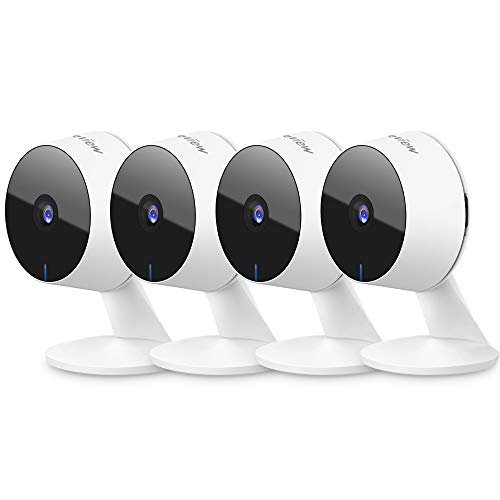
Though I prioritize strong connectivity, I find the LaView 4PC 1080P Indoor Security Cameras best suit households or small businesses needing reliable, multi-camera monitoring over a 2.4GHz Wi-Fi network, since they support 24/7 live streaming across up to nine devices through the LaView app. I appreciate the 1080P HD video and 33 ft night vision, which deliver clear images day and night. Motion alerts notify me instantly, and two-way audio works well for quick communication. The compact design fits anywhere indoors, and I can share access with up to 20 users. I store footage locally via microSD or use the 30-day free cloud trial-AWS encryption keeps data secure.
Best For: Households or small businesses needing reliable, multi-camera indoor monitoring with flexible access and secure storage options over a 2.4GHz Wi-Fi network.
Pros:
- Supports 24/7 live streaming on up to nine devices with clear 1080P HD video and 33 ft night vision
- Offers instant motion alerts and noise-canceling two-way audio for real-time communication
- Provides flexible storage with a 30-day free cloud trial (AWS encrypted) and local microSD card support up to 128GB
Cons:
- Limited to 2.4GHz Wi-Fi, lacking 5GHz support for faster or less congested connections
- Cloud storage requires subscription after 30-day free trial, which may increase long-term costs
- Maximum 128GB microSD card support may be insufficient for extended local recording needs
Wireless Outdoor Security Cameras 2K 2-Pack

You’ll want these 2K wireless outdoor cameras if you need sharp video and reliable performance without running wires through your yard. I use them on my porch and garage, and the 2K UHD footage is clear, even at night-thanks to full-color night vision and infrared. The 3x zoom helps me read license plates or see faces. They connect only to 2.4GHz Wi-Fi, so check your signal strength-you’ll need at least -70dBm. Motion alerts come instantly, but AI detection for people, vehicles, or pets requires a subscription. Two-way audio lets me talk to visitors from my phone. The IP65-rated build handles rain and snow, and the rechargeable battery works well in most conditions. I added a 128GB microSD card for local storage since the free cloud backup lasts just three days. Setup was simple with the VicoHome app-no wires, just screws and an adjustable bracket.
Best For: Homeowners seeking wire-free, weatherproof outdoor security cameras with sharp 2K video, color night vision, and easy installation.
Pros:
- Crisp 2K UHD video quality with full-color night vision and 3x digital zoom for clear identification
- Wire-free, IP65-rated design allows flexible placement in any weather using rechargeable batteries
- Real-time two-way audio and basic motion alerts work without a subscription
Cons:
- Advanced AI motion detection (person/vehicle/pet) and extended cloud storage require a subscription
- Connects only to 2.4GHz Wi-Fi networks and requires strong signal (recommended -70dBm or better)
- Free cloud backup offers only 3-day rolling storage; microSD card (not included) needed for local storage
Blink Outdoor 4 Wireless Security Camera

The Blink Outdoor 4 Wireless Security Camera is a solid pick for homeowners who want a reliable, wire-free setup with long battery life and strong integration into existing smart home systems. I use its 1080p HD video, 143° field of view, and infrared night vision to monitor my property clearly day and night. Two AA lithium batteries per camera last up to two years, depending on usage. It connects via 2.4 GHz Wi-Fi and requires the Sync Module Core, which links to my internet through a power adapter. I get alerts with dual-zone motion detection, and person detection works with an optional subscription. Two-way audio lets me speak through the Blink app. I store clips in the cloud using a subscription-there’s no local storage unless I upgrade to a Sync Module with USB or MicroSD support. It works with Alexa, needs iOS 17 or Android 10, and has a 1-year warranty. Security updates keep it protected over time.
Best For: Homeowners seeking a wire-free, long-lasting outdoor security camera system with smart home integration and reliable motion detection.
Pros:
- Delivers clear 1080p HD video with infrared night vision and a wide 143° field of view
- Long battery life of up to two years per camera with easy setup and no wiring required
- Integrates with Alexa, supports dual-zone motion detection, and offers optional person detection with cloud storage
Cons:
- Cloud storage requires a subscription; no local storage unless using a separate Sync Module upgrade
- Relies on 2.4 GHz Wi-Fi, which may limit compatibility with newer dual-band routers
- Advanced features like person detection are locked behind a paid subscription plan
Aosu Wireless Security Camera 4-Cam Kit

If you’re looking for a reliable, solar-powered outdoor security system that operates without ongoing subscription fees, the Aosu Wireless Security Camera 4-Cam Kit stands out with its local 32GB aosuBase storage hub, which securely retains up to four months of encrypted loop recordings even if a camera is damaged or stolen. I’ve found it efficient: the 3MP cameras deliver sharp 2K video, color night vision up to 33 feet, and 360° pan-tilt tracking. Solar charging needs just three hours of daily sunlight, and setup takes about five minutes. I control all four cameras instantly through the app, view live feeds side by side, and get real-time motion alerts.
Best For: Homeowners seeking a subscription-free, solar-powered outdoor security system with high-resolution video, color night vision, and seamless app-based control.
Pros:
- Solar-powered with 3-hour daily sunlight requirement, enabling eco-friendly, continuous operation
- Local 32GB aosuBase storage provides secure, encrypted loop recording for up to 4 months without subscription
- 360° pan-tilt, auto motion tracking, and 2K/3MP resolution deliver comprehensive coverage and sharp imaging day or night
Cons:
- Limited to Wi-Fi connectivity (2.4 GHz and 5 GHz) with no Ethernet backup for unstable wireless environments
- 32GB storage may fill faster with 4-camera 2K video, potentially reducing retention below advertised four months
- Plastic dome housing may be less durable than metal alternatives in extreme weather or high-impact scenarios
Blink Mini 2K+ Security Camera (2-Pack)

Since sharp 2K video and reliable indoor monitoring matter most to those wanting clear evidence-grade footage, the Blink Mini 2K+ Security Camera (2-Pack) stands out for homeowners prioritizing detail and ease of use. I rely on its 2560 x 1440 resolution and 138° field of view for wide, crisp coverage. It delivers smooth 24/25 FPS video and clear two-way audio with noise cancellation. I mount it easily using the included kit, and it works over 2.4 GHz Wi-Fi with quick app setup. I get person and vehicle alerts with a subscription, which also enables 60-day cloud storage. Without a subscription, I still view live feeds and receive motion notifications. I appreciate the 1-year warranty and guaranteed four-year security updates.
Best For: Homeowners seeking affordable, easy-to-install indoor security cameras with crisp 2K video and reliable smart detection.
Pros:
- Delivers sharp 2K resolution and wide 138° field of view for detailed indoor monitoring
- Simple setup with plug-in power, 2.4 GHz Wi-Fi, and intuitive Blink Home Monitor app
- Offers person and vehicle detection with optional cloud storage up to 60 days
Cons:
- Requires a subscription for advanced features like cloud storage beyond the 30-day trial
- Limited to 2.4 GHz Wi-Fi with no support for 5 GHz networks
- Indoor use recommended; outdoor installation requires a separate weather-resistant adapter
Blink Outdoor 4 XR 6-Camera System

You’ll get the most out of the Blink Outdoor 4 XR 6-Camera System if you need reliable, long-range coverage for a large property, especially where Wi-Fi signals are weak. I rely on its 900MHz XR technology to cut through network congestion, giving me 70% fewer disconnects and 20% faster live access. Each camera runs up to two years on lithium batteries, and I control all six through the Blink app or Alexa. With 1,000-foot open-air range, I place cameras far from the Sync Module XR without signal loss. I store clips in the cloud or locally using a MicroSD card. The package includes everything but the card.
Best For: Homeowners with large properties needing long-range, reliable security coverage in areas with weak Wi-Fi.
Pros:
- Offers 1,000-foot open-air range with 900MHz XR technology for extended coverage and fewer disconnects
- Delivers up to two years of battery life and seamless control via the Blink app or Alexa
- Supports both cloud and local storage options for flexible event clip retention
Cons:
- MicroSD card for local storage not included in the package
- Requires Sync Module XR for full XR technology benefits and optimal performance
- Initial setup may be complex for users unfamiliar with multi-camera security systems
ANNKE 3K Lite Security Camera System

The ANNKE 3K Lite Security Camera System is an ideal choice for homeowners seeking reliable, high-quality surveillance with smart detection and long-term storage. I’ve found its AI Motion Detection 2.0 effective at reducing false alerts by accurately spotting people and vehicles, and the smart search saves time when reviewing footage. It includes eight durable IP67-rated 2MP outdoor cameras, with night vision reaching 66ft in color or 100ft in black-and-white. The system supports up to 3K recording, comes with a 1TB hard drive (expandable to 10TB), and uses H.265+ compression to maximize storage. It’s also flexible, working with TVI, AHD, CVI, CVBS, and IP cameras for future upgrades.
Best For: Homeowners seeking a reliable, AI-enhanced security system with high-quality night vision and flexible camera compatibility for easy expansion.
Pros:
- AI Motion Detection 2.0 accurately identifies people and vehicles, reducing false alerts
- Smart search function allows quick playback filtering for human or vehicle events
- Supports hybrid camera inputs (TVI, AHD, CVI, CVBS, IP) for future DIY upgrades
Cons:
- Maximum 3K/5MP recording limited to 20fps, which may not suit high-motion environments
- 66ft color night vision range is shorter than some competitors with advanced full-color tech
- 1TB pre-installed HDD may fill quickly without proper motion-triggered recording settings
Factors to Consider When Choosing Home Security Cameras
You’ll want to take into account video resolution and clarity first, since sharper images help you identify faces and details more easily. Night vision, power options, and motion detection also matter-these features determine how well your camera works in the dark, how often you need to charge or plug it in, and whether it alerts you to real threats without false alarms. Finally, think about storage and cloud options, because your footage is only useful if it’s saved securely and accessed when needed.
Video Resolution and Clarity
Sharp image quality starts with resolution, and when it comes to identifying faces or reading license plates, 2K and 3K cameras deliver noticeably clearer detail than standard 1080p models. You’ll get more usable footage because higher resolution captures finer features without blurriness. Pair that with a wide field of view-up to 143°-to cover more area without losing clarity at the edges. Look for cameras with strong digital zoom, like 3x to 6x, so you can enlarge footage while still seeing important details. Modern compression like H.265+ helps too, saving storage by reducing file size without sacrificing image quality. That means longer recording times and fewer gaps in coverage. While color and infrared night vision matter, they’re a separate factor. For pure clarity, prioritize resolution, sensor quality, and smart compression to get reliable, sharp video day and night.
Night Vision Capabilities
When darkness falls, your camera’s ability to deliver clear, reliable footage depends heavily on its night vision technology, so choosing the right system matters. Most cameras use infrared (IR) LEDs to capture sharp black-and-white video in total darkness, typically reaching 30 feet or more-higher-end models with multiple, powerful LEDs can see over 100 feet. For richer detail, some offer full-color night vision using built-in spotlights or ambient light, preserving color within about 33 feet. Advanced systems automatically switch between IR and visible light, providing color footage when motion triggers the camera. Keep in mind that digital zoom reduces clarity at night, especially beyond 2x, due to lower light and pixel density. For best results, pick a camera with strong IR illumination or hybrid lighting, especially if monitoring large or dimly lit outdoor areas.
Power and Battery Life
While power options might seem like a background detail, they directly impact your camera’s reliability and maintenance needs. If you choose battery-powered models, you’ll get up to two years on non-rechargeable lithium batteries, though usage, settings, and weather affect lifespan. Rechargeable batteries demand regular charging, and their life shortens with frequent motion alerts, weak Wi-Fi, or extreme temperatures. Solar-powered options work well when they receive at least three hours of direct sunlight daily, maintaining charge even in cloudy conditions. For hassle-free operation, plug-in cameras draw constant power from an outlet, eliminating battery changes or charging. Keep in mind that features like night vision and video streaming increase power use, so consider your camera’s location and expected activity when choosing the best power source for steady, long-term performance.
Motion Detection Features
You’ll want a motion detection system that reliably identifies real threats without overwhelming you with false alerts, and today’s smart cameras deliver by combining advanced sensors with AI-powered analytics. You can set customizable motion zones to monitor only key areas, reducing irrelevant notifications. Dual- or multi-zone detection lets you track activity in separate regions with individual alerts, enhancing control. AI distinguishes humans, vehicles, pets, and other movements, cutting down on false alarms caused by swaying trees or passing animals. Unlike basic systems that trigger on any pixel change, smart cameras use embedded computer vision to analyze movement patterns in real time. This improves accuracy, but full features often require a subscription. Look for models with on-device processing for faster response and lower latency. When comparing, prioritize cameras that balance precision with privacy, and check if advanced detection works without ongoing fees. It’s a key factor in long-term reliability and convenience.
Storage and Cloud Options
A reliable storage solution guarantees your security camera footage is preserved and accessible when needed, and your choice between local, cloud, or hybrid options directly impacts cost, convenience, and data security. You can use microSD cards or internal hard drives for local storage, avoiding monthly fees while storing footage for days or even months, depending on capacity and compression like H.265+. Cloud storage encrypts your video and often includes a free trial, with paid plans offering up to 60 days of retention, though you’ll need steady internet. Free cloud options usually keep only 3 days of rolling footage. If you want backup and flexibility, hybrid storage saves event clips both locally and in the cloud, protecting against device theft or failure. While local storage is cost-effective, cloud services add convenience and remote access. Choose based on your budget, internet speed, and how long you want to keep recordings.
Weather Resistance and Durability
Just as storage and cloud options shape how long and where your footage is kept, the physical resilience of your security camera affects how well it holds up over time-especially outdoors. Look for an IP66 or IP67 rating to guarantee protection against heavy rain, snow, and dust. These cameras handle extreme weather reliably. They typically operate in temperatures from -4°F to 113°F, so they work in freezing winters and hot summers. Airtight enclosures and corrosion-resistant materials prevent damage from moisture and temperature swings. Some models include dual lighting- infrared and visible light-delivering clear, color night vision even in tough conditions. UV protection keeps the housing from fading or cracking under long-term sun exposure. Choosing a durable, weather-resistant camera means less maintenance and longer life. You’ll get consistent performance year-round, without unexpected failures when conditions turn harsh.
Smart Home Compatibility
While choosing a security camera, considering how well it integrates with your existing smart home ecosystem can greatly impact both functionality and convenience. You can control many cameras using voice commands through popular assistants like Alexa or Google Assistant, especially on compatible smart displays and speakers. If your system supports smart home platforms, you’ll view live feeds directly on large screens without grabbing your phone. Cameras tied to automation ecosystems can trigger actions-like turning on lights or locking doors-when motion’s detected. Some apps let you watch multiple camera feeds at once in a unified interface. Just remember, most require a 2.4 GHz Wi-Fi band for stable performance, so double-check your network. Choosing a camera with strong smart home compatibility saves time and boosts effectiveness.
Frequently Asked Questions
Can These Cameras Work Without Wi-Fi?
No, most home security cameras can’t work without Wi-Fi, since they rely on it to send video feeds, alerts, and updates to your phone or cloud storage. Some models offer local storage via SD cards, so you won’t lose footage during outages, but you’ll still lose remote access. For full functionality-like live streaming or push notifications-Wi-Fi is essential. Consider battery-powered or LTE cameras if connectivity’s unreliable.
Are There Monthly Fees for Cloud Storage?
Yes, you’ll usually pay monthly fees for cloud storage with most home security cameras. Plans start around $3–$10 per month, depending on video quality and clip length. Some brands offer free basic storage with limited features, but reliable, long-term access needs a subscription. You can avoid fees by using local storage via SD cards or hard drives, though that limits remote access and backup protection. Choose based on your budget and need for convenience.
Do They Have Night Vision Capabilities?
Yes, they have night vision capabilities, so you can monitor your property in the dark. Most use infrared technology to capture clear black-and-white footage up to 30 feet away. Check the range and resolution-higher-end models offer better clarity and wider coverage. Some also include color night vision with ambient light. Look for at least 1080p resolution and a minimum 20-foot infrared range to guarantee reliable performance. Test the camera’s night view during setup to confirm coverage.
How Easy Is Installation for Beginners?
You’ll find most home security cameras easy to install, even as a beginner. You mount them with screws or adhesive, connect to power, and sync with an app in minutes. Wired models take longer but offer reliability. Wireless ones give flexibility but may need strong Wi-Fi. You’ll follow clear on-screen steps and check camera angles yourself. Always test motion alerts and night vision after setup to confirm they work right.
Can I View Footage on My Smartphone?
Yes, you can view footage on your smartphone. Most systems offer apps for iOS and Android that let you stream live video, review clips, and get alerts instantly. You’ll need a stable Wi-Fi connection and account setup through the app. Some apps include two-way talk, night vision, and motion zones. Check compatibility with your phone’s OS before buying. Subscription plans often enable longer cloud storage and advanced features, though local storage options avoid ongoing fees.