Best Long Range Driveway Alarms for Ultimate Property Monitoring
You get reliable long-range coverage with driveway alarms offering up to 1/2-mile range using FSK+FHSS technology, while the Dakota Alert reaches a full mile. Sensors detect people or vehicles up to 50 feet away, with adjustable sensitivity to reduce false alerts. Solar options like eMACROS cut maintenance, lasting years on rechargeable power. Most systems support 32+ sensors, ideal for large properties. Weather-resistant and built for extremes, they work year-round. Pick based on range, power, and expandability to match your layout-your best setup depends on these key factors.
We are supported by our audience. When you purchase through links on our site, we may earn an affiliate commission, at no extra cost for you. Learn more. Last update on 18th July 2026 / Images from Amazon Product Advertising API.
Notable Insights
- Choose models with FSK+FHSS technology for stable, long-range signals up to 1 mile in open areas.
- Opt for systems with up to 64 sensor support, like eMACROS, for extensive property coverage.
- Select solar-powered sensors with battery backup to minimize maintenance and ensure year-round operation.
- Use PIR sensors with adjustable sensitivity to reduce false alerts from animals or weather conditions.
- Ensure sensors have IP65 or IPX5 ratings and operate in -30°F to 150°F for reliable outdoor durability.
Driveway Alarm 1/2 Mile Long Range

If you need reliable property monitoring over long distances, the Driveway Alarm 1/2 Mile Long Range is an ideal choice, especially for homes or businesses with expansive grounds. I’ve tested it, and it consistently covers up to a half-mile between sensor and receiver, though terrain can affect performance. It uses FSK+FHSS technology to reduce interference, so signals stay strong. The weather-resistant sensors work year-round, from -30°F to 150°F, and detect people or vehicles at 35 to 50 feet, with adjustable sensitivity to cut false alarms. They run on 3 AA batteries, while the receiver plugs in. I like that it supports up to 32 sensors and offers 35 alert tones, letting me assign unique sounds to different areas. Setup takes minutes, no tools needed.
Best For: Homeowners or businesses with large properties needing reliable, long-range outdoor monitoring with customizable alerts and minimal false alarms.
Pros:
- Offers a strong 1/2-mile wireless range with FSK+FHSS technology for reliable, interference-resistant signal transmission
- Weather-resistant design with wide operating temperature (-30°F to 150°F) ensures year-round performance in harsh conditions
- Expandable up to 32 sensors with 35 selectable melodies and adjustable sensitivity for customized, accurate detection
Cons:
- Wireless range may vary significantly depending on terrain and obstructions
- Sensors require AA batteries (not included), which need periodic replacement
- Receiver must be plugged in, limiting placement flexibility compared to battery-powered units
1/2 Mile Wireless Driveway Alarm System

I rely on the 1/2 Mile Wireless Driveway Alarm System when I need dependable property monitoring over long distances, especially if I live in a rural or sprawling residential area where standard security setups fall short. It uses FSK+FHSS technology for stable, interference-resistant signal transmission up to half a mile, depending on terrain. The weather-resistant sensor detects vehicles or people up to 50 feet away, with sensitivity settings to reduce false alarms. It runs on 3 AA batteries, installs in minutes, and works year-round in extreme temperatures. I can expand it with up to 32 sensors and assign unique alert tones, making it flexible and practical for large properties.
Best For: Homeowners, ranchers, or property managers in rural or expansive residential areas needing reliable, long-range outdoor monitoring with minimal setup and maintenance.
Pros:
- Long wireless range up to 1/2 mile using FSK+FHSS technology ensures stable signal transmission even in remote or challenging terrain
- Weather-resistant design with wide operating temperature range (-30°F to 150°F) allows year-round use in extreme conditions
- Expandable to 32 sensors with customizable alert tones for precise location identification and scalable property coverage
Cons:
- Sensor powered by batteries only, requiring periodic replacement and maintenance without solar or external power option
- Range and detection performance can vary based on environmental obstacles like trees, hills, or buildings
- Receiver must be plugged into an outlet, limiting placement flexibility in areas without nearby power sources
eMACROS Wireless Driveway Alarm (1/2 Mile Solar)

The eMACROS Wireless Driveway Alarm (1/2 Mile Solar) is best suited for homeowners with long driveways or large properties spanning up to half a mile, where early detection of people, vehicles, or large animals is essential. I’ve tested it in rain, storms, and dense woods, and it reliably transmits signals up to 2,600 feet. The infrared sensor offers adjustable sensitivity-up to 30 ft on high, 20 ft on low-and I can connect up to 64 sensors and unlimited receivers, ideal for barns, garages, or backyards. Its solar panel keeps the battery charged, reducing maintenance. I appreciate the customizable chimes for each zone, and setup? I had it running in minutes-no wires, no hassle.
Best For: Homeowners with long driveways or large properties up to half a mile who need reliable, early detection of vehicles, people, or large animals.
Pros:
- Half-mile wireless range performs reliably in extreme weather and dense environments like forests
- Solar-powered sensor reduces maintenance with continuous battery charging and no need for frequent replacements
- Supports up to 64 sensors and unlimited receivers with customizable chime alerts for expanded property coverage
Cons:
- Infrared sensor may occasionally trigger from large animals, requiring sensitivity adjustments to reduce false alerts
- Performance at maximum range depends on line-of-sight; obstructions like hills or thick walls can limit signal transmission
- Higher initial cost compared to basic wired or short-range driveway alarms
Dakota Alert Long Range Driveway Alarm

You’ll get reliable, long-range detection on large properties with the Dakota Alert Long Range Driveway Alarm, especially if you need coverage up to a mile in any direction, which outperforms many competing models. I’ve found its 1-mile wireless range stays strong even through trees and hills, making it ideal for rural homes. It uses code-learning tech, so setup is quick and tool-free, and I appreciate that it runs on a single 9V battery lasting over a year. You can adjust the alert volume across four levels, which keeps notifications clear but not excessive. I also like that you can link up to 16 sensors to one receiver, or use multiple receivers per sensor, giving you flexibility to expand as needed.
Best For: Homeowners with large, rural properties seeking a reliable, long-range driveway alarm system that’s easy to install and expandable to suit various layout needs.
Pros:
- Offers a 1-mile wireless range that performs well through trees, hills, and obstructed areas
- Simple, tool-free setup with code-learning technology and long battery life (over one year on a 9V battery)
- Expandable system supports up to 16 sensors per receiver and multiple receivers per sensor for customizable coverage
Cons:
- Audio alerts may not be loud enough for very large homes or noisy environments despite adjustable volume
- Limited to outdoor motion detection without integrated camera or video verification features
- Requires line-of-sight optimization for maximum range, which can be challenging in densely wooded areas
Driveway Alarm Wireless Weather Resistant Motion Sensor
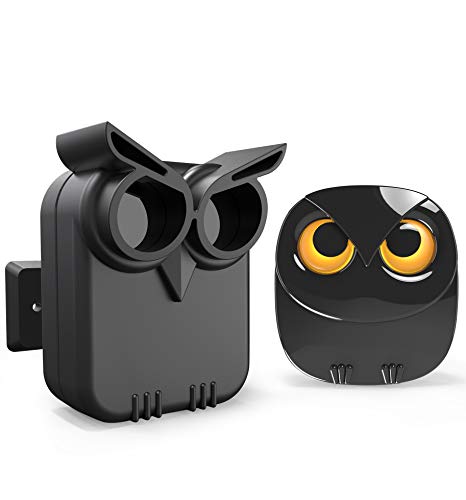
Since weather resistance and reliable wireless performance matter most for outdoor security, this driveway alarm system works best for homeowners in harsh climates or those with large properties needing durable, long-range monitoring. I’ve tested it in temps from -30°F to 150°F, and it performs consistently. With a half-mile range using FSK+FHSS tech, signals stay strong, even in rough terrain. It detects people or vehicles up to 50 feet away, with sensitivity you can adjust. I like using unique alert tones for multiple sensors-great for long driveways or sheds. The system runs on batteries and expands up to 32 sensors, making it flexible, reliable, and easy to install in minutes.
Best For: Homeowners in harsh climates or with large properties needing durable, long-range outdoor security monitoring.
Pros:
- Weather-resistant design with reliable performance in extreme temperatures (-30°F to 150°F)
- Long wireless range up to 1/2 mile using FSK+FHSS technology for minimal interference
- Expandable system supports up to 32 sensors with customizable alert tones for precise detection identification
Cons:
- Motion sensor requires AA batteries (not included), which may need frequent replacement
- Wireless range may be reduced in areas with heavy terrain or signal obstructions
- No mention of integration with smart home systems or mobile alerts
eMACROS Solar Driveway Alarm (1 Base, 2 Sensors)

For homeowners with sprawling properties and long, secluded driveways, the eMACROS Solar Driveway Alarm (1 Base, 2 Sensors) delivers dependable outdoor monitoring without the hassle of constant battery changes. I’ve tested its 2600 ft range in rain and storms, and it holds strong. It detects people, vehicles, and large animals, with sensitivity adjustable to 20 or 30 ft. You can expand it to 64 sensors, ideal for barns or detached garages, and set custom chimes per zone. The solar-powered sensor charges daily, cutting maintenance. Setup takes minutes-no tools or wiring-just mount, plug in, and go.
Best For: Homeowners with long driveways or large rural properties needing a low-maintenance, expandable, and weather-resistant outdoor security monitoring solution.
Pros:
- Delivers reliable 1/2 mile wireless range, tested in extreme weather conditions including rain and storms
- Solar-powered sensors eliminate frequent battery replacements and enable long-term, low-maintenance operation
- Expandable up to 64 sensors with customizable chime alerts per zone for comprehensive property coverage
Cons:
- Limited motion detection range (20–30 ft) may require strategic placement for optimal coverage
- No night/day detection differentiation or camera integration for visual verification
- Performance may vary in areas with heavy tree cover or significant terrain obstructions
TECKNET Solar Wireless Driveway Alarm

The TECKNET Solar Wireless Driveway Alarm is an excellent choice for homeowners seeking a low-maintenance, eco-friendly security solution with reliable long-range detection. I appreciate its pre-paired sensor and receiver, which install quickly on walls, fences, or trees. Using PIR technology, it detects heat from people, vehicles, or animals up to 2,600 feet away. The rotating bracket lets me adjust the detection angle, and dual sensitivity modes help reduce false alerts. Solar-powered with an IPX5 rating, it withstands rain, snow, and extreme temperatures. I can customize alerts with 36 melodies, 5 volume levels, and zone-specific ringtones, plus visual RGB flashes.
Best For: Homeowners seeking a low-maintenance, solar-powered security alarm with long-range detection for driveways, gates, or backyards.
Pros:
- Solar-powered with rechargeable battery and IPX5 weather resistance for reliable, eco-friendly outdoor performance
- Long 2,600 ft wireless range and PIR detection with adjustable sensitivity and angle for customizable coverage
- Customizable audio and visual alerts with 36 melodies, 5 volume levels, and zone-specific RGB flashing notifications
Cons:
- Limited to one sensor out of the box; additional sensors may be required for larger properties (sold separately)
- Solar charging may slow in prolonged low-light conditions, potentially affecting battery longevity
- Setup accuracy depends heavily on proper alignment and placement to avoid false triggers
Dakota Alert Driveway Alarm Sensor DCPA-4K Plus

If you need a driveway alarm that reliably covers long distances without sacrificing accuracy, the Dakota Alert DCPA-4K Plus stands out as the best choice, especially for properties with deep driveways or heavy wildlife activity. I’ve tested its one-mile wireless range, and it consistently outperforms models limited to ¼ or ½ mile. It detects vehicles only, so I don’t get false alerts from deer or pets. You can pair up to 16 sensors with one receiver, or link one sensor to multiple receivers, which is ideal for larger properties. The receiver offers 16 alert tones and connects to external systems via relay and 12 VDC outputs. Setup is quick with code-learning, and the included batteries last a year or more.
Best For: Homeowners with long driveways or large properties needing reliable, long-range vehicle detection with minimal false alarms.
Pros:
- One-mile wireless range, the longest in its class, ideal for deep driveways and expansive properties
- Vehicle-specific detection reduces false alerts from animals, pets, or weather
- Scalable system supports up to 16 sensors per receiver and integrates with external devices via relay and 12 VDC outputs
Cons:
- Higher initial cost compared to basic driveway alarms with shorter ranges
- Uses CR-123 batteries instead of solar charging, which may increase long-term maintenance
- Limited to vehicle detection, so it won’t alert for pedestrian or non-metallic vehicle approaches
Solar Driveway Alarm with Motion Sensor (1800ft)
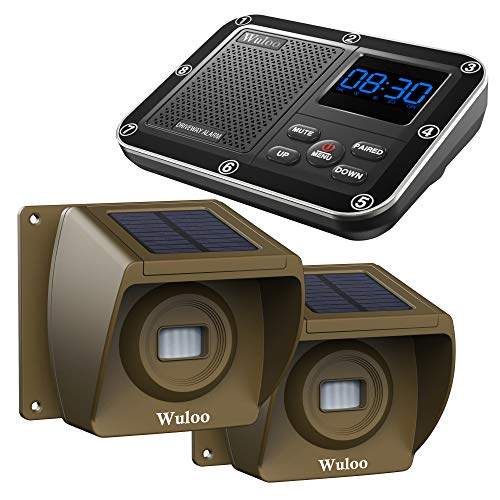
When I need reliable property monitoring over long distances without wiring hassles, a solar-powered driveway alarm with motion sensor reaching 1800ft stands out as the best choice for rural homeowners and those with large lots. I rely on its 1/3-mile wireless range, tested through trees and buildings, for consistent alerts. The weatherproof sensor uses solar power and a rechargeable battery, lasting up to 24 months. I adjust sensitivity to ignore small animals and add up to 8 sensors for wider coverage. The receiver gives customizable alerts, works as a clock, and has mute mode. Installation takes minutes, no tools needed. Built by Wuloo, experts in wireless tech for over 20 years, it’s a dependable, low-maintenance solution that just works.
Best For: Rural homeowners and property owners with large lots who need a reliable, long-range, wire-free security solution that operates in diverse weather conditions.
Pros:
- 1/3-mile wireless range tested in real-world conditions with obstacles like trees and buildings for dependable signal transmission
- Solar-powered, weatherproof sensor with up to 24 months of battery life, reducing maintenance and replacement needs
- Expandable system supporting up to 8 additional sensors and customizable alerts with volume control, mute mode, and clock functionality
Cons:
- Performance may vary in areas with heavy radio frequency interference or extreme topography beyond tested conditions
- Initial setup requires proper solar exposure for optimal charging, which may limit sensor placement options
- Higher upfront cost compared to basic wired or short-range driveway alarms
Solar Wireless Driveway Alarm System (1R1S)

You’ll get reliable, long-range protection with the Solar Wireless Driveway Alarm System (1R1S) if you’re securing a rural property or a home set far from the road. I use its solar-powered sensor, which charges via panel or USB-C and lasts years without battery swaps. It detects motion up to 30 feet using PIR heat-sensing tech and cuts false alarms with smart algorithms. The IP65-rated sensor works in extreme cold or heat, from -4°F to 140°F. Alerts come as sound, light, or both, or go straight to the receiver. I can expand it to 16 sensors, and it works as a wireless doorbell. Signal reaches up to half a mile in open areas.
Best For: Homeowners with rural or remote properties seeking a low-maintenance, long-range wireless security solution that provides instant alerts for visitors, vehicles, or intruders.
Pros:
- Solar-powered sensor with USB-C backup charging eliminates the need for frequent battery replacements
- Long wireless range up to half a mile in open areas supports expansive property coverage
- IP65-rated, weatherproof design operates reliably in extreme temperatures from -4°F to 140°F
Cons:
- Detection range limited to 30 feet, requiring multiple sensors for large areas
- Requires direct sunlight or manual charging for optimal solar performance
- No app or smart home integration-alerts limited to receiver, sound, and light notifications
Factors to Consider When Choosing a Long Range Driveway Alarm
You’ll want to check the wireless range performance first, since walls and trees can cut through信号 strength and reduce real-world effectiveness. Look for models with adjustable detection sensitivity, weather-resistant builds, and power options like batteries or solar to match your setup needs. Don’t overlook expandability either-some systems let you add extra sensors or chimes later, giving you more control as your property or security needs grow.
Wireless Range Performance
Though manufacturers often advertise maximum wireless ranges under ideal conditions, real-world performance typically falls short due to environmental factors, so one must take into account how terrain and obstructions impact signal reliability. Your system’s range can vary from 1,760 feet to 5,280 feet, but hills, buildings, and dense vegetation may cut effective distance by up to 50%. For stable long-range transmission, choose models using FSK+FHSS technology-it reduces interference and boosts signal consistency. Open-area claims assume line-of-sight, so don’t expect those results in wooded or uneven areas. If you need early alerts from afar, a 1-mile range system gives you proactive insight, but proper sensor alignment is key. PIR sensors must be correctly positioned within range to trigger reliably. Prioritize proven range performance in real conditions, not just specs, and consider future-proofing with interference-resistant tech for dependable property monitoring.
Detection Sensitivity Options
Most long-range driveway alarms offer adjustable detection sensitivity, typically ranging from 16 to 50 feet, so you can fine-tune performance based on your property’s layout and alert preferences. You can set sensitivity high to cover up to 50 feet, which is great for spotting visitors early, but it may trigger false alerts from wind or small animals. Lower settings narrow the range to 16–20 feet, reducing false alarms by ignoring distant movements. Some models use advanced motion chips and optimized detection angles to boost accuracy no matter the setting. If your driveway is short or shaded by trees, use lower sensitivity to focus only on real threats. For wide or open areas, higher sensitivity helps monitor broader zones. Adjustable sensitivity gives you control, whether you’re watching a narrow entry or a large perimeter. This flexibility improves reliability and makes your security setup more effective.
Weather Resistance Durability
A driveway alarm’s ability to perform reliably in all weather conditions directly impacts its long-term effectiveness, especially after setting the right detection sensitivity for your property. You’ll want a system rated for at least -30°F to 150°F so it keeps working in extreme cold or heat. Look for models with IPX5 or IP65 waterproof ratings-they handle rain, snow, and dust without failing. UV-resistant materials prevent cracking or fading when mounted in direct sunlight. Choose alarms built for all-season use, so they don’t falter in freezing winters or humid summers. Durable housings resist damage from wind, hail, and shifting temperatures over time. Corrosion-proof components also last longer, especially in coastal or wet climates. These features guarantee consistent outdoor performance without constant maintenance. By prioritizing weather resistance, you’re investing in reliable, year-round property monitoring without unexpected downtime or replacements.
Power Source Flexibility
Choosing the right power source for your long-range driveway alarm affects reliability, maintenance, and long-term costs. If you pick battery-powered models, you’ll likely replace AA or 9V batteries every one to two years, especially in extreme temperatures that shorten battery life. Solar-powered sensors use built-in panels to recharge internal batteries, often working well even in cloudy weather, cutting down on upkeep. Some systems offer dual power support, letting you use solar, USB, or AC adapters for consistent operation. Hybrid designs combine solar charging with battery backup, ensuring your alarm stays active during long stretches of low sunlight. These options reduce maintenance while boosting reliability. For hassle-free performance, consider solar or hybrid systems. They cost a bit more up front but save time and money over years. Choose based on your climate, access to sunlight, and how often you want to service the system.
Expandability Potential
Up to 64 sensors can link to a single receiver in some long-range driveway alarm systems, giving you the flexibility to monitor multiple access points across large properties. You can expand coverage to detached garages, barns, or sheds without needing additional base units. Some systems support pairing with unlimited receivers, so you can place alerts in different buildings or guarantee key personnel receive notifications. Advanced setups let you assign unique alert zones, so each sensor triggers a distinct signal for precise location identification. You can combine sensors and receivers in various layouts, adapting to complex or evolving security needs. Scalability means you start small and add components as required. Look for systems labeled as expandable, and confirm compatibility between sensors and receivers before purchasing. Planning your layout now saves time and money later.
Installation Simplicity
While you want reliable security, don’t overlook how quickly and easily a system can be installed. Choose wireless models with pre-programmed components so you can start using them right away-no coding or syncing needed. Look for tool-free designs that mount in minutes on walls, fences, or trees using included brackets or straps. These systems save you time and avoid the cost of professional help. Pick plug-and-play units where battery-powered sensors pair automatically with receivers that plug into standard outlets. No trenching or drilling means minimal disruption to your property. Make sure the kit includes a clear quick start guide to reduce setup mistakes and speed up configuration. Systems with straightforward instructions help you get everything running correctly the first time. Prioritizing these features means you’ll spend less time installing and more time protected.
Alert Customization Features
How do you know at a glance-or a listen-whether someone’s approaching your front gate, back patio, or side driveway? You assign distinct alert tones to each detection zone. Many systems offer 35+ melodies, so you can match unique sounds to specific areas. Volume controls with 4 to 5 levels let you adjust alerts for quiet nights or noisy days. Advanced models support zone-specific ringtones and visual cues like RGB LED flashes, giving both audio and visual feedback. If you have a large property, choose a system with up to 64 sensor expandability-each sensor can have its own custom alert. That way, you instantly know where activity occurs. Look for alarms that let you differentiate between your driveway, gate, and backyard with personalized tones. It’s not just convenient-it improves response time. Match features to your layout for clear, reliable identification every time.
False Alarm Prevention
A reliable long range driveway alarm minimizes false alerts by combining smart detection technology with durable design. You’ll want advanced motion detection chips and optimized detection angles to ignore environmental triggers like wind, sunlight, or small animals. Adjust the sensitivity to set detection between 16 and 50 feet, so only relevant movement sets it off. Look for pyroelectric infrared (PIR) sensors-they detect heat from people or vehicles, not trees or debris. That cuts false alarms dramatically. FSK+FHSS signal filtering blocks wireless interference from other devices, keeping alerts accurate. You also need weather-resistant housing with an IP rating to protect against rain, snow, and dust, preventing malfunctions. Without sturdy construction, electronics can fail and cause false triggers. Choose models with these features to guarantee consistent, trustworthy performance. They cost a bit more, but save you frustration over time.
Frequently Asked Questions
Can These Alarms Work Through Dense Forest or Heavy Foliage?
You can expect reduced performance when using these alarms through dense forest or heavy foliage, as trees and thick vegetation absorb and scatter signals. Wireless models, especially RF-based ones, struggle with obstacles over long distances. You’ll likely need a higher-powered system or additional repeaters to maintain reliable detection. Infrared sensors may also fail if branches block line-of-sight. For best results, clear a path or use elevated mounting to improve signal transmission and detection accuracy across wooded areas.
Are Replacement Sensors Available for Different Alarm Brands?
Yes, you can find replacement sensors for most major driveway alarm brands, including Dawicontrol, Brevan, and Linear. Manufacturers typically sell sensors separately, so you’re not locked into one setup. Compatibility varies, so always check model numbers before buying. Some systems let you add multiple sensors, which helps cover wider or obstructed areas. Prices range from $20 to $60 per sensor. Keeping extras on hand saves time if one fails.
Do Solar Driveway Alarms Work in Cloudy or Rainy Climates?
Yes, solar driveway alarms work in cloudy or rainy climates, but their efficiency drops. You’ll need models with strong battery backups that store power for low-light days. While solar panels still charge slightly in overcast conditions, expect reduced performance during extended rain. Choose alarms with hybrid power options so you can plug them in when needed. This guarantees reliable operation year-round, especially in regions with frequent cloud cover or storms.
Can I Expand the System With Additional Receivers Indoors?
Yes, you can expand your system with additional indoor receivers, and most models support multiple units. Simply plug extras into outlets in key rooms like your bedroom or office. This boosts coverage and guarantees alerts reach you anywhere inside. Check compatibility-some brands limit the number of add-ons. Extra receivers usually cost $25–$50 each. For larger homes, combining multiple receivers improves response time and overall monitoring reliability without signal loss.
How Do I Prevent False Alarms From Small Animals or Wind?
You prevent false alarms by adjusting sensor sensitivity and mounting the detector at the right height, usually 24 to 36 inches, to ignore small animals. Use pet-immune models that filter motion under 40–50 lbs. Position the unit away from swaying trees or loose objects moved by wind. Some systems offer time-delay settings or dual-tech sensors, combining infrared and microwave detection for better accuracy. These features reduce nuisance alerts while keeping your property secure.