Best Cellular Security Cameras for Uninterrupted Surveillance
You get reliable, uninterrupted surveillance with 4G LTE cellular cameras that work without Wi-Fi. Top models offer 2K to 4K video, 360° viewing, and AI detection for people, vehicles, and packages, cutting false alerts by up to 98%. Solar-powered options with 6000mAh to 10,400mAh batteries last months, while IP65-rated builds withstand harsh weather. Built-in SIM cards use U.S. 4G networks, with data plans starting at $10/month. Local SD and cloud storage give backup options. Each feature helps you stay protected-knowing more guarantees the right choice.
We are supported by our audience. When you purchase through links on our site, we may earn an affiliate commission, at no extra cost for you. Learn more. Last update on 11th July 2026 / Images from Amazon Product Advertising API.
Notable Insights
- Choose 4G LTE-enabled cameras with built-in SIM cards for reliable connectivity in remote areas without Wi-Fi.
- Opt for solar-powered models with high-capacity batteries to ensure year-round, uninterrupted surveillance.
- Select cameras with AI-powered detection to reduce false alerts and capture relevant motion events instantly.
- Prioritize models with 360° pan, 120° tilt, and 4K resolution for comprehensive, high-clarity coverage.
- Use hybrid storage (microSD + cloud) with unlimited data plans to maintain continuous recording and remote access.
SEHMUA 4G Solar Security Camera

If you’re managing a remote property like a farm, barn, or vacation home without reliable Wi-Fi or electrical wiring, the SEHMUA 4G Solar Security Camera is one of the few systems that delivers full standalone operation. I rely on its 6W solar panel and 10400mAh battery for continuous power, and it runs on 4G LTE networks-no wires needed. It includes a built-in SIM card (U.S. only), though you’ll need a subscription after the 7-day trial. I get clear 2K video, 360° viewing, color night vision, and motion alerts through the Ubox App. Two-way audio, IP65 weather resistance, and 32GB storage help me monitor remotely, and I can expand to 128GB or use 30-day cloud trials.
Best For: Remote property owners like farmers, ranchers, or vacation home managers who need a wire-free, solar-powered security camera with 4G connectivity in areas without Wi-Fi or electrical access.
Pros:
- Solar-powered with 6W panel and 10400mAh battery for continuous, off-grid operation
- Runs on 4G LTE network with built-in SIM card (U.S. only), eliminating the need for Wi-Fi or wiring
- Delivers 2K resolution, color night vision, 360° viewing, and two-way audio for comprehensive remote monitoring
Cons:
- Requires a 4G subscription after a 7-day trial, adding ongoing cost
- Limited to 4G coverage areas and incompatible with Wi-Fi networks
- Built-in SIM card only available for use in the U.S., restricting international users
eufy 4G LTE Cam S330 4K

The eufy 4G LTE Cam S330 4K is built for people who need reliable, off-grid surveillance with no compromises on video quality or connectivity. I rely on its 4K resolution and 360-degree pan-tilt to capture clear detail, even at night, thanks to color night vision and an 8-meter spotlight. It runs on a 9,400 mAh battery and solar power, so it stays online without wiring. Dual-mode 4G LTE and Wi-Fi guarantee constant connection, automatically switching networks if one fails. The included SIM supports major U.S. carriers, and AI detects people or vehicles accurately. I appreciate the 32GB SD card and easy app control-it’s ready right out of the box.
Best For: Outdoor security users who need a reliable, solar-powered, 4G-connected camera with 4K resolution and AI detection for off-grid or remote monitoring.
Pros:
- Solar-powered with a large 9,400 mAh battery and 4G LTE/Wi-Fi dual connectivity for uninterrupted, off-grid operation
- 4K video with color night vision, 360-degree pan-tilt, and AI-powered person and vehicle detection for comprehensive surveillance
- Includes SIM card, 32GB SD card, and solar panel-everything needed for quick, out-of-the-box setup and installation
Cons:
- Limited to 32GB local storage with no cloud subscription option mentioned, potentially restricting long-term recording
- Plastic build may be less durable in extreme weather despite IP55 rating
- 4.5W power consumption may require optimal sunlight for consistent solar charging, depending on location
4G LTE Solar Security Camera No WiFi
I rely on a 4G LTE solar security camera with no WiFi when I need reliable surveillance in remote areas where power and internet connections are unavailable. It runs on a 3.2W solar panel and 9000mAh battery, charging automatically in sunlight, with no cords or wiring needed. The built-in 4G LTE SIM offers unlimited data for one month free, then requires a $19.9/month or $199.9/year subscription. It supports 2K HD video, 355° pan, 120° tilt, 33ft color night vision, and 2-way audio. A 10-level PIR sensor reduces false alerts, while AI detects people, vehicles, pets, and packages. It works only on 4G, not 2.4G or 5G WiFi.
Best For: Outdoor and remote area surveillance where power and WiFi are unavailable, ideal for farms, ranches, construction sites, and home security in off-grid locations.
Pros:
- Solar-powered with a 3.2W panel and 9000mAh battery for continuous, wire-free operation
- 4G LTE connectivity with unlimited data 1-month free trial enables setup without WiFi or power cords
- Advanced AI detection for people, vehicles, pets, and packages reduces false alarms by 98%
Cons:
- Requires ongoing subscription ($19.9/month or $199.9/year) for cloud and 4G service after trial
- 4G-only connectivity; does not support 2.4G or 5G WiFi networks
- MicroSD card (up to 256GB) sold separately for local storage
4G LTE Solar Security Cameras (2-Pack)
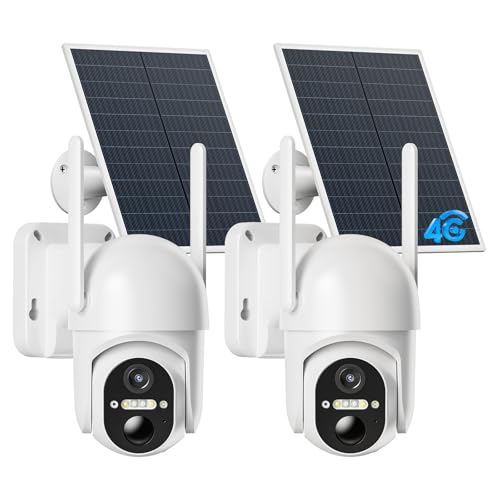
You’ll want these 4G LTE solar-powered security cameras if you’re monitoring a remote cabin, farm, or construction site far beyond any WiFi reach. I rely on their 4G LTE connectivity, which works over Verizon, AT&T, or T-Mobile networks, and includes a prepaid SIM with a 7-day data trial-unlimited data plans are supported, but the SIM only works in the U.S. The white-colored, IP65-rated cameras handle rain, snow, and harsh sun, powered by solar energy and a 38.4 Wh battery, each unit using 1 C battery. I get clear 2K HD video with color night vision, 360° pan-and-tilt, and accurate motion detection via PIR sensors.
Best For: Remote property owners needing reliable, solar-powered, WiFi-free surveillance on farms, ranches, vacation homes, or construction sites across the U.S.
Pros:
- Operates without WiFi using 4G LTE (Verizon, AT&T, T-Mobile) for seamless connectivity in remote areas
- Solar-powered with IP65 rating and 38.4 Wh battery for year-round, weather-resistant, off-grid use
- Delivers 2K HD video with color night vision, 360° pan-and-tilt, and PIR motion detection for accurate alerts
Cons:
- Included SIM card only works in the U.S. and limits network flexibility outside the country
- Requires separate purchase of unlimited data plan after the 7-day trial expires
- 128GB microSD card not included-additional cost for local storage expansion
4G LTE Solar Security Cameras 2-Pack
While many surveillance systems rely on WiFi and wired power, I find the 4G LTE Solar Security Cameras 2-Pack best suits users needing reliable, off-grid monitoring in remote or outdoor locations, especially where internet access is limited or unavailable. Each camera runs on 4G LTE with a built-in SIM and requires a separate $19.90/month data plan after the 7-day unlimited trial. Solar-powered and IP65-rated, they operate year-round in harsh weather. I get 2K night vision up to 65 feet, 355° pan, 100° tilt, and 4X zoom via the UBox app. PIR sensors trigger alerts, and two-way audio lets me respond remotely. White light and siren alarms add deterrence. I appreciate customizable detection zones, local SD storage up to 128GB, and 30-day free cloud access-though continued use demands a subscription. I can share access securely with others.
Best For: Individuals seeking a fully wireless, off-grid security solution for remote or outdoor locations without reliable WiFi or power access.
Pros:
- Operates independently of WiFi using 4G LTE with solar charging for year-round, hands-free use
- Delivers 2K color night vision up to 65 feet and wide 355° pan/100° tilt coverage for comprehensive monitoring
- Features customizable motion detection, two-way audio, and alarm alerts for enhanced security and control
Cons:
- Requires a separate monthly data subscription ($19.90/month) after a 7-day trial, increasing long-term costs
- No WiFi connectivity option, limiting setup flexibility and remote access to cellular network coverage
- Cloud storage requires a subscription after a 30-day free trial, adding to ongoing usage expenses
LIWAN 4G LTE Solar Security Camera

Ideal for remote locations without reliable WiFi, the LIWAN 4G LTE Solar Security Camera works anywhere with cellular coverage, making it a strong choice for securing farms, cabins, construction sites, and barns. I rely on its 4G LTE connectivity with built-in SIM, supported by Verizon, T-Mobile, and AT&T, plus unlimited data via UBox subscription. Solar-powered with a high-capacity battery and IP66 rating, it runs continuously in harsh weather. I get 2K HD video, 355° pan, and 100° tilt, plus color night vision and AI human detection that cuts false alerts. Two-way audio, SD and cloud storage - up to 128GB - keep me connected and recorded.
Best For: Remote property owners without reliable WiFi who need a solar-powered, cellular-enabled security camera with nationwide coverage and advanced smart detection.
Pros:
- Operates on 4G LTE networks with built-in SIM and unlimited data via subscription, ideal for WiFi-free locations
- Solar-powered with high-capacity battery and IP66 rating for reliable all-weather outdoor performance
- 2K HD video with color night vision, 355° pan, 100° tilt, and AI-powered human detection to reduce false alerts
Cons:
- Built-in SIM card is non-replaceable and only offers a 7-day free trial; ongoing service requires a UBox subscription
- No included microSD card despite support for up to 128GB of local storage
- Limited to US cellular networks (Verizon, T-Mobile, AT&T), reducing international usability
Xega 4G Cellular Security Camera (Built-in SIM)
The Xega 4G Cellular Security Camera stands out for users who need reliable, wire-free surveillance in areas without consistent Wi-Fi access, since it runs entirely on a 4G LTE network with a built-in SIM card. I rely on its 3MP HD video and color night vision for clear footage up to 50 feet, even in darkness. With a 6000mAh battery, it lasts about a month under typical use. I mount it easily indoors or out-it’s IP65-rated and weatherproof. I use the app for live view, two-way audio, and motion alerts. I store videos on a microSD card or cloud. A monthly data plan costs $19.90.
Best For: Users seeking a wire-free, Wi-Fi–free security camera with reliable 4G LTE connectivity for indoor or outdoor use in remote or low-infrastructure locations.
Pros:
- Operates on 4G LTE with built-in SIM, eliminating the need for Wi-Fi or network wiring
- Long-lasting 6000mAh battery and IP65-rated weatherproof design suitable for diverse environments
- Offers 3MP HD video, color night vision up to 50 feet, and two-way audio with motion alerts
Cons:
- Requires a mandatory monthly data plan ($19.90) for unlimited data, adding ongoing cost
- No solar panel included, limiting extended off-grid use
- No option to insert a different SIM card or use alternative networks, reducing flexibility
LIWAN 4G LTE Security Camera Outdoor
If you’re looking for a reliable outdoor security solution where Wi-Fi isn’t available, the LIWAN 4G LTE Security Camera stands out as a top contender. It runs on 4G networks, working with Verizon, T-Mobile, and AT&T, and includes a built-in SIM with a 7-day unlimited trial-though you’ll need a paid data plan afterward. I plug it in using the 106-inch cord since it lacks solar support. The 2K video and 360° view deliver sharp, complete coverage, and the three night vision modes, including full-color recording with the LED spotlight, perform well in darkness. I store footage locally on a microSD card (up to 128GB) for 24/7 recording or use cloud storage for 10-second motion clips. Through the Ubox app, I get real-time alerts, set motion zones, adjust sensitivity, and communicate via two-way audio. I share live views with family, download clips, or watch directly in the app. Setup’s quick-just scan the QR code. While it doesn’t support Wi-Fi or solar, its cellular independence and solid 2K video make it a practical choice for remote or off-grid surveillance.
Best For: Outdoor security in remote or Wi-Fi-free areas where cellular connectivity and continuous 2K video surveillance are priorities.
Pros:
- Operates on 4G LTE without needing Wi-Fi, compatible with major US carriers for reliable off-grid connectivity
- Delivers 2K resolution with 360° viewing and advanced night vision options, including full-color recording with built-in spotlight
- Offers flexible storage with local microSD (up to 128GB) for 24/7 recording and cloud backups for motion-triggered clips
Cons:
- Requires ongoing data subscription after the 7-day unlimited trial, adding to long-term costs
- Wired power only with no solar support, limiting placement flexibility
- Cloud storage is limited to short 10-second event clips, not continuous recording
4G LTE Trail Camera 2-Pack 360° Live Streaming
You’ll get reliable, real-time surveillance in the most remote locations with this 4G LTE trail camera 2-pack, especially if you need continuous monitoring without Wi-Fi or grid power. I rely on its built-in SIM and 4G connectivity to send me 2K video and alerts automatically, no internet needed. The cameras deliver sharp 20MP photos, night vision up to 98 feet, and 360° coverage with pan-tilt control. I appreciate the solar charging and durable IP66 housing, which keeps them running year-round in extreme weather. A required data plan adds ongoing cost, but for off-grid security, hunting, or wildlife tracking, these rugged, app-controlled cameras offer solid, evidence-backed performance where traditional systems fail.
Best For: Outdoor enthusiasts, hunters, and property owners seeking reliable, off-grid surveillance with real-time 4G LTE connectivity and 360° live streaming capabilities in remote locations.
Pros:
- Delivers 2K video and 20MP photos with 360° pan-tilt coverage and 98 ft night vision for high-quality monitoring
- Solar-powered with 7800mAh battery and IP66-rated durability, enabling year-round operation in extreme conditions
- Built-in 4G LTE with no Wi-Fi needed, allowing real-time alerts and remote access from anywhere in the U.S.
Cons:
- Requires a mandatory data plan subscription for functionality, adding ongoing operational costs
- No Wi-Fi support limits local connectivity and media download options
- Non-removable SIM card restricts network flexibility and potential use outside the U.S.
4G LTE Solar Security Camera 2K
When reliable WiFi isn’t an option, this 4G LTE Solar Security Camera 2K stands out for anyone needing real-time surveillance in remote or off-grid locations, from rural properties to job sites and RVs. I rely on its 4G LTE connectivity, which works without WiFi using a built-in SIM card and supports fast network speeds. It delivers sharp 2K live streaming, with full-color night vision and PIR motion detection that triggers alerts in just 0.2 seconds. The camera is solar-powered, includes two 9V batteries, and has an IP65 rating for weather resistance. I use the UBox app to monitor footage locally on the 32GB SD card or via cloud backup, and two-way audio lets me speak in real time. Its compact, wire-free design installs easily on walls or flat surfaces. I find it effective for home, farm, or vehicle use, and support is available by phone or email from Gailos.
Best For: Individuals needing reliable, wire-free security monitoring in remote or off-grid locations without WiFi, such as rural properties, farms, construction sites, or RVs.
Pros:
- Operates on 4G LTE without WiFi, enabling real-time surveillance anywhere with cellular coverage
- Solar-powered with long battery life and dual storage (local SD + cloud) for uninterrupted off-grid performance
- Delivers 2K resolution with full-color night vision, fast motion detection, and two-way audio for comprehensive security
Cons:
- Requires a cellular signal, limiting usability in areas with poor or no 4G LTE coverage
- Monthly service or data plan may be needed for continuous streaming and cloud access (not explicitly stated but implied)
- Limited local storage at 32GB, which may fill quickly with 2K video without regular maintenance or cloud backup
Factors to Consider When Choosing a Cellular Security Camera
You’ll want to check that your cellular security camera works with the right network bands for reliable signal strength, especially if you’re in a remote area. Think about power options like batteries, solar panels, or wired connections-your choice affects how often you’ll need to recharge or maintain the system. Look at video resolution, motion detection accuracy, and data needs, since higher quality footage and frequent alerts can quickly use up storage and cellular data.
Network Compatibility
Since reliable connectivity is essential for uninterrupted surveillance, choosing a cellular security camera with the right network compatibility makes a critical difference in performance. You should confirm the camera supports 4G LTE bands that match your local network, or it may fail to connect. Models with built-in SIM cards often work only in specific regions, like the U.S., due to carrier restrictions, so check regional limitations before buying. Some cameras connect automatically to the strongest signal across multiple carriers, which boosts reliability, especially in remote areas. Always verify the device supports data-only plans if you plan to use a third-party SIM. Dual-mode cameras offer both 4G and Wi-Fi, switching seamlessly when needed, but dedicated 4G models operate independently of Wi-Fi. Pick based on your location and network access for best results.
Power Source Options
A reliable power source is essential for keeping your cellular security camera running without interruption, and your choice will depend on installation location, maintenance preferences, and environmental conditions. If you want minimal upkeep, go for solar-powered models with 3.2W to 6W panels and 7800mAh to 10400mAh batteries-they recharge daily and work year-round. These systems use as little as 4.5 watts, maximizing efficiency. For off-grid setups, solar units with IP65 or higher ratings protect against rain, dust, and temperature swings. If solar isn’t an option, cameras with rechargeable 6000mAh batteries will need charging every few weeks. Or choose models with standard replaceable batteries like 9V or C-cells-swap them fast without tools. Solar cuts long-term effort but costs more upfront, while replaceable batteries offer simplicity and reliable backup power when unplugged.
Video Quality And Resolution
Sharp video quality starts with resolution, and your choice directly impacts how well you can identify people or objects in footage. You’ll get the clearest images with 4K (2160p), which outperforms 2K (1440p) or 3MP (2304×1296) in detail and clarity. If you need to zoom in without losing quality, look for digital zoom-4X lets you inspect footage closely while staying within resolution limits. A 360° field of view with remote pan and tilt covers more area and reduces blind spots, so you don’t miss critical action. For low-light visibility, choose cameras with color night vision powered by spotlights or advanced sensors, since they deliver full-color video instead of grainy black-and-white. Efficient video encoding like H.264 reduces file size and bandwidth use, helping you store more footage without sacrificing quality. These features work together to guarantee reliable, high-quality surveillance.
Motion Detection Features
Clear footage means little if your camera can’t reliably detect what matters, so pairing high-resolution video with smart motion detection makes your surveillance system both proactive and efficient. You’ll want cameras with Passive Infrared (PIR) sensors, since they detect heat from people and animals, cutting down false alerts from wind or trees. Look for models using AI to tell apart people, vehicles, pets, and packages-this can reduce false alarms by up to 98%. Adjustable sensitivity and custom detection zones let you focus on key areas, like a driveway or doorway. Some cameras wake up in just 0.2 seconds, capturing motion almost instantly. Motion-activated recording saves battery and data by recording only when needed. Prioritize these features to boost reliability and keep your setup responsive without wasting resources.
Storage And Data Plans
Since you’ll want your footage accessible and secure, choosing the right storage and data plan is essential for reliable surveillance. You can store video locally using microSD cards, often up to 128GB or more, allowing continuous or event-based recording without relying on the cloud. Some cameras come with 32GB onboard, holding days or even weeks of footage depending on settings. Cloud storage usually includes a 7–30 day free trial, but you’ll need a subscription afterward-typically $10 to $20 per month per camera-for remote access and video backup. Many models support both cloud and microSD storage, giving you redundancy and flexibility. Keep in mind, cellular data plans are required for connectivity, and unlimited data usually falls within that same price range. Factor in long-term costs when choosing, and pick a system that lets you balance local access with offsite backup.
Frequently Asked Questions
Can These Cameras Work in Extreme Weather Conditions?
Yes, these cameras handle extreme weather when built with rugged, weatherproof materials. You’ll find most have IP65 or higher ratings, meaning they resist rain, snow, and dust. They operate in temperatures as low as -20°F and as high as 120°F. Always check specs for operating ranges and mounting options. Models with heated lenses prevent ice buildup, ensuring clear footage. For best results, pick cameras rated for your region’s climate and install them properly to avoid exposure gaps.
Do They Require a Monthly Subscription Fee?
Yes, they require a monthly subscription fee. You’ll pay for cloud storage, app access, and firmware updates. Plans start around $5–$15 monthly per camera. Some models offer local storage to reduce costs, but you’ll still need service for remote viewing. Check the provider’s data usage-unlimited or high-capacity plans prevent overage fees. Always compare features against subscription costs to guarantee long-term affordability and reliable performance.
Are There Hidden Installation Costs?
You won’t face hidden installation costs with most cellular security cameras since they’re designed for DIY setup. You mount them yourself, connect to power, and activate the service. Some models need a data plan, but that’s a known monthly fee, not a surprise. Always check if mounting brackets or power supplies are included-few extras might cost more. Planning helps avoid unexpected charges, so review what’s in the box and what you’ll need.
How Secure Is the Cellular Data Transmission?
You can trust cellular data transmission because it uses encrypted protocols like LTE with end-to-end encryption, protecting your video feeds from unauthorized access. Carriers also employ secure SIM authentication, reducing hacking risks. While no system is 100% immune, cellular is generally more secure than Wi-Fi, especially in areas with strong signals. Check for models supporting 256-bit encryption and regular firmware updates to maintain protection over time.
Can I Access Footage From Multiple Devices?
You can access footage from multiple devices using most cellular security cameras, as they support multi-user logins and companion apps for iOS and Android. You’ll need to create an account, then share access securely with trusted users. Some systems allow role-based permissions, letting you control who views or manages footage. Check the app’s features to confirm simultaneous streaming and user limits, since performance varies by brand and data plan.