Best Smart Locks for Home Assistant: 5 Matter & Wi-Fi Picks
You get reliable Home Assistant integration with smart locks like the ULTRALOQ Bolt and Aqara U400, which use Matter over Thread for seamless, low-latency control. Wi-Fi models such as the Philips Wi-Fi Smart Lock and Veise VE029 offer direct remote access, real-time alerts, and voice support. Look for AES-128 encryption, ANSI Grade 1 or 2 ratings, and auto-lock customization. Battery life ranges from 6 to 18 months, with Thread models lasting longer. You’ll find how each model balances convenience, security, and compatibility.
We are supported by our audience. When you purchase through links on our site, we may earn an affiliate commission, at no extra cost for you. Learn more. Last update on 19th July 2026 / Images from Amazon Product Advertising API.
Notable Insights
- ULTRALOQ Bolt supports Matter over Thread, enabling seamless integration with Home Assistant and voice control via Alexa, Google, and Apple Home.
- Aqara U400 uses Matter over Thread and works with Home Assistant when paired with a Thread border router for reliable, low-latency smart home automation.
- Wi-Fi-enabled eufy Smart Lock C220 offers direct remote access and real-time alerts but lacks native Home Assistant support without third-party integrations.
- Veise VE029 leverages built-in Wi-Fi and supports Home Assistant via custom integrations, offering fast fingerprint recognition and remote access without a hub.
- Kwikset HomeConnect requires a Z-Wave hub and is less ideal for Home Assistant unless paired with a compatible Z-Wave controller and MQTT bridge.
Philips Wi-Fi Smart Lock with Alexa & Google Compatibility

If you want a smart lock that works seamlessly with Home Assistant and cuts out the extra hub, the Philips Wi-Fi Smart Lock is a solid pick, especially since it connects directly to your 2.4GHz Wi-Fi. I use it daily, and it supports app control, passcodes, fingerprints, physical keys, and voice commands through Alexa or Google Assistant. I can store up to 100 codes and share one-time or timed access remotely. Built-in Wi-Fi allows me to lock or open from anywhere, though I keep my router within 65 feet for stable performance. I get real-time alerts, set auto-lock from 10 to 180 seconds, and use Away Mode for added security. It fits standard door thicknesses and installs with just a screwdriver. I rely on 4 or 8 AA batteries, which last months. I reset mine easily by holding the button five seconds. An installation video helps, and I’ve reached US-based support by phone during weekdays or anytime by email. While it lacks a door position sensor, I find the full activity log and remote access reliable for my home setup.
Best For: Homeowners seeking a hub-free Wi-Fi smart lock with versatile access options and reliable remote control via app or voice.
Pros:
- Connects directly to 2.4GHz Wi-Fi for remote access without requiring a separate hub
- Offers multiple unlocking methods including app, passcode, fingerprint, physical key, and voice control with Alexa or Google Assistant
- Supports up to 100 passcodes with remote sharing and scheduling, plus auto-lock and real-time activity alerts
Cons:
- Lacks a door position sensor to detect if the door is open or closed
- Requires AA batteries (not included), which may need periodic replacement
- Wi-Fi range is limited to 65 feet for optimal performance, potentially affecting reliability in larger homes
Aqara Smart Lock U100 Gray
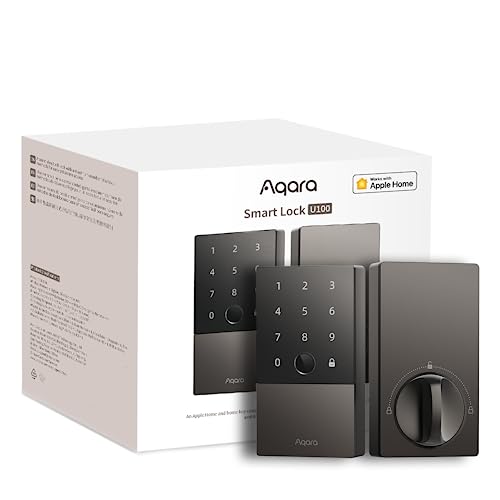
The Aqara Smart Lock U100 Gray stands out for users invested in a broad smart home ecosystem, especially those who rely on Apple HomeKit and Home Key support for secure, convenient access without needing a charged device. I appreciate its multiple access methods, including fingerprints, keypad codes, and NFC, plus robust AES encryption and BHMA Level 3 certification for peace of mind. It demands a Zigbee 3.0 hub for remote access but integrates smoothly with Google, Alexa, and IFTTT. With IP65 rating and extreme temperature tolerance, it’s ideal for harsh environments. Four included AA batteries last about eight months, and a USB-C port enables emergency power.
Best For: Users deeply integrated into smart home ecosystems, particularly Apple HomeKit and Zigbee-based setups, who need secure, multifunctional door access with outdoor durability.
Pros:
- Supports Apple Home Key and HomeKit with emergency unlock even when phone battery is dead
- Multiple unlocking methods including fingerprint, keypad, NFC, and mechanical key with strong security via AES encryption and BHMA Level 3 certification
- IP65-rated and operates in extreme temperatures, making it highly durable for outdoor and harsh environments
Cons:
- Requires a separate Aqara Zigbee 3.0 hub for remote access and automation features
- Uses non-rechargeable AA batteries only, with no built-in rechargeable option despite USB-C emergency charging
- NFC card not included and must be purchased separately
ULTRALOQ Bolt Smart Lock with Wi-Fi & Fingerprint

I often recommend the ULTRALOQ Bolt Smart Lock with Wi-Fi & Fingerprint to Home Assistant users who want reliable, hub-free integration and strong smart home automation without sacrificing physical security. It supports 7-in-1 access, including fingerprint, app control, voice commands, and up to 50 user codes. Built-in 2.4G Wi-Fi and Matter over Thread guarantee seamless compatibility with Apple Home, Alexa, Google Assistant, and SmartThings. I appreciate its 18-month battery life, real-time alerts, and auto-lock feature. The BHMA-certified deadbolt installs in 10 minutes, works for rentals or homes, and includes lifetime mechanical warranty and 18-month electronic coverage.
Best For: Home Assistant users seeking a secure, hub-free smart lock with Matter over Thread integration and multi-user access management.
Pros:
- 7-in-1 keyless entry including fingerprint, app, voice control, and support for up to 50 user codes
- Built-in 2.4G Wi-Fi and Matter over Thread for seamless, hub-free integration with Apple Home, Alexa, Google Assistant, and SmartThings
- BHMA-certified durability, 18-month battery life, and DIY installation in 10 minutes with lifetime mechanical warranty
Cons:
- Batteries not included, requiring separate purchase
- Limited to 2.4G Wi-Fi, no 5G support
- Fingerprint sensor may require occasional cleaning for optimal responsiveness
Aqara UWB Smart Lock U400

You’ll get the most out of the Aqara UWB Smart Lock U400 if you’re already invested in the Apple ecosystem and want reliable, hands-free access powered by UWB technology, since it requires an iPhone 11 or later (not SE or 16e) running iOS 18.5+ or a compatible Apple Watch Series 6+ with watchOS 11.5+, along with a Thread-enabled Apple Home hub like a HomePod mini or Apple TV. I rely on its Matter over Thread connectivity to work smoothly across HomeKit, Alexa, Google Assistant, and Home Assistant. It supports fingerprint, passcode, voice control, and Apple Home Key, with NFC and physical key backup. The rechargeable lithium-ion battery lasts up to six months and charges via USB-C. I appreciate the BHMA certification, IP65 rating, and rekeyable design for long-term security. I use the Aqara App to set Auto Lock, Night Latch Mode, and link it to my Aqara G5 Pro doorbell for remote video access.
Best For: Apple ecosystem users seeking secure, hands-free unlocking with UWB technology and seamless smart home integration via Matter over Thread.
Pros:
- True hands-free UWB unlocking with precise presence, direction, and intent detection for iPhone 11+/Apple Watch Series 6+ users
- Multi-platform compatibility with HomeKit, Alexa, Google Assistant, Home Assistant, and SmartThings via Matter over Thread
- Rechargeable USB-C battery, BHMA certification, IP65 rating, and rekeyable design ensure durability, convenience, and long-term security
Cons:
- UWB hands-free unlocking requires specific Apple devices (iPhone 11+/Apple Watch Series 6+) and a Thread-enabled Home hub, limiting accessibility
- NFC card not included and sold separately, adding extra cost for full functionality
- Limited release date (January 5, 2026) may delay availability for early adopters
eufy Smart Lock C220 with Wi-Fi

For Home Assistant users who prioritize standalone smart lock functionality without the hassle of additional hubs, the eufy Smart Lock C220 with Wi-Fi stands out as a practical, no-compromise choice. It runs on 8 AA batteries and lasts up to 8 months, with a AAA battery powering the included remote. I appreciate the six access methods-fingerprint, app, keypad, key, Apple Watch, and voice via Alexa or Google-plus AI-powered fingerprint learning for faster, more accurate recognition in under 1.5 seconds. Built-in Wi-Fi enables remote access and real-time alerts without a bridge. It fits most standard deadbolts, installs in about 15 minutes, and resists water and extreme temperatures. I find its BHMA Grade 3 certification and 18-month support with 24/7 assistance add reliable peace of mind.
Best For: Home Assistant users seeking a standalone, hub-free smart lock with versatile access methods and reliable security.
Pros:
- Built-in Wi-Fi enables remote access and real-time alerts without requiring a separate bridge
- Six unlocking methods including AI-powered fingerprint recognition for fast, adaptive access
- Quick 15-minute installation fits most standard deadbolts with no drilling required
Cons:
- Limited to eufy ecosystem integration, potentially restricting compatibility with non-eufy smart home devices
- Battery life may vary significantly based on usage frequency and environmental conditions
- Lack of a higher BHMA security grade (rated Grade 3) may not meet preferences for maximum physical security
Veise VE012W Smart Lock with WiFi & Alexa
The Veise VE012W Smart Lock stands out as a strong choice for users who frequently manage access for family, guests, or renters, thanks to its robust remote control and user management features. I appreciate its 6-in-1 access-app, fingerprint, PINs, one-time codes, voice commands, and physical keys-all programmable from my phone. Built-in 2.4GHz Wi-Fi means no hub, and I get real-time alerts and access logs. It meets ANSI Grade 3 standards, uses AES-128 encryption, and lasts longer on 8 AAs. Auto-lock, vacation mode, and smart home compatibility make it reliable. Installation is DIY, fits most doors, and comes with strong warranty and U.S. support.
Best For: Homeowners, landlords, and frequent hosts who need flexible, remote access management for family, guests, or renters with strong security and smart home integration.
Pros:
- Supports 6-in-1 keyless entry including fingerprint, PINs, one-time codes, app control, voice commands, and physical keys-all remotely programmable
- Built-in 2.4GHz Wi-Fi enables hub-free remote access, real-time alerts, detailed activity logs, and smart home compatibility
- Durable, ANSI Grade 3-rated construction with IP55 weather resistance, AES-128 encryption, and a comprehensive warranty with U.S.-based support
Cons:
- Requires 8 AA batteries (not included), which may increase long-term maintenance despite extended battery life
- No native Z-Wave or Zigbee support, limiting integration with certain smart home ecosystems
- One-time codes and PINs must be managed through the app, which may be less convenient for users without constant smartphone access
Kwikset HomeConnect Smart Lock Matte Black

A smart lock that excels in both security and seamless integration, the Kwikset HomeConnect Smart Lock in Matte Black stands out for users invested in a Z-Wave-based smart home ecosystem, especially those pairing it with Ring Alarm. I rely on its Z-Wave 700 Long Range for stable, whole-home connectivity, and SmartStart simplifies setup. It supports 250 user codes, auto-locks on intervals I customize, and runs 12+ months on included AAs. Kwikset’s SmartKey and S2 encryption defend against tampering and hacking, while its BHMA Grade 2 rating confirms durability. It fits most doors, installs tool-free, and works with Ring Alarm-though I need a separate Z-Wave hub.
Best For: Homeowners seeking a secure, Z-Wave-integrated smart lock with robust access control and seamless compatibility with Ring Alarm systems.
Pros:
- Supports up to 250 user codes and features customizable auto-lock intervals for enhanced convenience and security
- Integrates with Z-Wave 700 Long Range and Ring Alarm for reliable smart home connectivity and remote monitoring
- Equipped with Kwikset SmartKey Security and S2 encryption for superior protection against tampering and hacking
Cons:
- Requires a separate Z-Wave hub and Ring Alarm smart hub, increasing overall system cost
- Limited to Z-Wave ecosystem, reducing compatibility with non-Z-Wave smart home platforms
- Battery replacement needed every 12+ months, with no low-battery alerts integrated into some hub systems
ULTRALOQ U-Bolt Pro WiFi Smart Lock
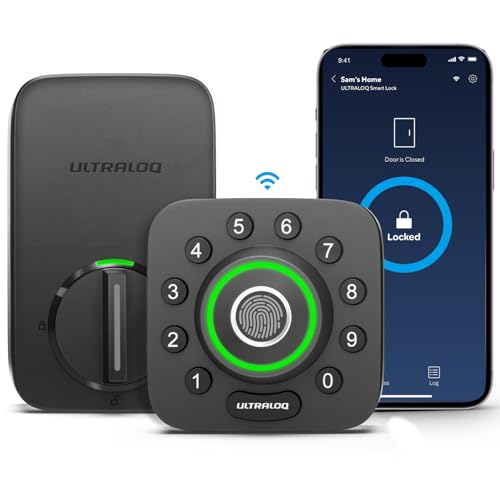
You get full remote access without needing a hub thanks to built-in 2.4GHz WiFi, making the ULTRALOQ U-Bolt Pro WiFi Smart Lock a strong choice for anyone who wants direct smartphone control and real-time monitoring. I can check who entered and when, receive alerts, and see my door’s status instantly. It offers eight entry methods, including reliable fingerprint recognition and a numeric keypad. I integrate it with Alexa, Google Assistant, and SmartThings for automation. It meets ANSI Grade 1 standards, resists dust and weather, and installs quickly on standard doors. I trust its durability and backed warranties.
Best For: Homeowners, renters, and property managers seeking a hub-free, WiFi-enabled smart lock with multiple access methods and strong integration with popular smart home platforms.
Pros:
- Built-in 2.4GHz WiFi enables remote access and real-time monitoring without requiring a separate hub
- Eight keyless entry options including fingerprint recognition, app control, and voice commands via Alexa and Google Assistant
- ANSI Grade 1 certified for security and durability, with IP65 rating for weather and dust resistance
Cons:
- Limited to 2.4GHz WiFi, which may be less reliable in high-interference environments
- Requires a stable home internet connection for full remote functionality
- Higher price point compared to basic smart locks without built-in WiFi
Veise VE029 WiFi Smart Lever Lock
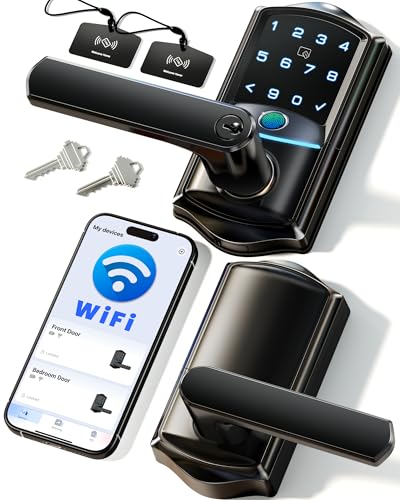
Built-in 2.4GHz Wi-Fi means I can control the Veise VE029 from anywhere without buying a separate hub, making it a strong choice for anyone who wants reliable remote access and full integration with Home Assistant, Alexa, or Google Assistant. I use eight access methods, including fingerprint recognition that works in 0.2 seconds, and I manage over 100 PIN codes with custom access types. The lock meets ANSI Grade 3 standards, resists water and dust with IP65 rating, and uses AES-128 encryption for security. It runs on 8 AA batteries, installs in about 15 minutes, and includes emergency charging via Type-C. I rely on U.S.-based lifetime phone support and a 2-year warranty for peace of mind.
Best For: Homeowners and renters seeking a hub-free, Wi-Fi-enabled smart lock with versatile access options, strong security, and seamless voice assistant integration.
Pros:
- Built-in 2.4GHz Wi-Fi enables remote control and real-time alerts without a hub
- Offers eight unlocking methods including 0.2s fingerprint recognition and customizable PIN codes for flexible user management
- Meets ANSI Grade 3 and IP65 standards with AES-128 encryption for durable, secure, all-weather performance
Cons:
- Requires 2.4GHz Wi-Fi only, limiting compatibility with dual-band routers
- No support for Apple HomeKit or more advanced smart home platforms
- Physical backup key and Type-C emergency charging port may wear over time with frequent use
Philips Smart Door Lock with Alexa Control
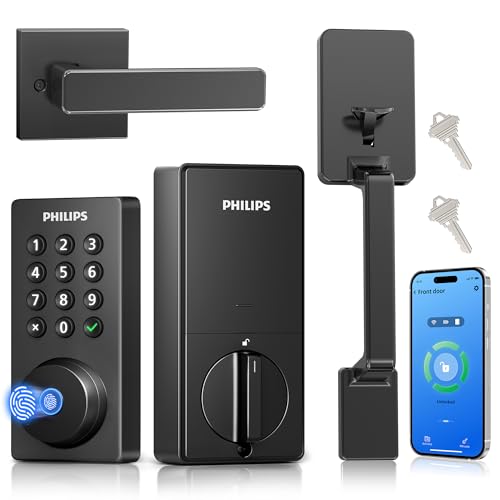
With built-in Wi-Fi that connects directly to 2.4GHz networks, the Philips Smart Door Lock with Alexa Control stands out for users who want seamless remote access without needing a hub. I use the Philips HomeAccess app to check lock status and manage access from anywhere, and I get real-time alerts and unlock history. I open the door using fingerprint, passcode, app, voice, or key-fingerprint access takes just 0.3 seconds and holds up to 20 prints. I set auto-lock between 10 and 180 seconds, which boosts security. It fits standard doors, runs on 8 AA batteries, and has IP53 water resistance.
Best For: Homeowners seeking a hub-free, Wi-Fi-connected smart lock with multiple access methods and voice control via Alexa or Google Assistant.
Pros:
- Built-in 2.4GHz Wi-Fi enables remote access and real-time alerts without a hub
- Fast 0.3-second fingerprint recognition with support for 20 prints and 100 passcodes
- Auto-lock feature, IP53 water resistance, and compatibility with standard door thicknesses
Cons:
- Requires 8 AA batteries with no mention of low-battery warnings or backup power options
- Wi-Fi connectivity limited to 2.4GHz networks only, not dual-band compatible
- No stated integration with Apple HomeKit or other major smart home platforms beyond Alexa and Google Assistant
Factors to Consider When Choosing a Smart Lock for Home Assistant
You’ll want to check if the smart lock connects via Wi-Fi or Zigbee, since that affects reliability and setup complexity. Make sure it works with your voice assistant, supports auto-lock scheduling, and runs long enough on battery to suit your household’s needs. Also, confirm it fits your door’s thickness and style to avoid installation issues down the line.
Wi-Fi Vs Zigbee Support
How do you decide between Wi-Fi and Zigbee when choosing a smart lock for Home Assistant? If you want remote access and real-time alerts without extra hardware, Wi-Fi locks connect directly to your 2.4GHz network and offer easy setup. But they use more power, so you’ll replace batteries more often. Zigbee locks need a compatible hub, adding upfront cost and complexity, yet they run on low-energy mesh networks that improve signal stability across large homes. They also reduce Wi-Fi congestion and scale better with multiple smart devices. While Wi-Fi gives standalone convenience, Zigbee provides stronger integration and efficiency in mature smart home setups. Choose Wi-Fi for simplicity and immediate connectivity, or go with Zigbee if you plan long-term automation and system-wide reliability through Home Assistant.
Voice Assistant Compatibility
A smart lock’s ability to work with voice assistants simplifies daily routines by letting you lock or open doors using simple voice commands through platforms like Google Assistant, Alexa, or Siri. You’ll want a model that supports multiple assistants so you’re not stuck with one ecosystem. Some locks connect directly to Wi-Fi for voice control, while others need a hub like Home Assistant or SmartThings. Make sure your home network is stable-voice commands rely on strong Wi-Fi and updated apps to work well. Check if your phone or lock supports newer features like Home Key or UWB, since those may require specific devices or OS versions. Always verify compatibility before buying, especially if you use less common assistants. Choosing the right lock means balancing convenience, setup needs, and long-term flexibility across your preferred voice platforms.
Auto Lock Customization
While balancing convenience and security, auto-lock customization gives you control over when your smart lock secures the door after use. You can set delays from 5 to 180 seconds, letting you tailor timing to your household’s routine. This feature boosts security by automatically locking the door after manual opening, reducing the risk of leaving it open by mistake. Most systems require the door to be fully closed and the battery sufficiently charged for auto-lock to work, so reliability depends on proper conditions. You’ll program settings through a smartphone app, which lets you adjust preferences remotely and monitor status in real time. If needed, you can disable auto-lock and choose to lock manually using the keypad, app, or deadbolt. Pick a model that offers flexible scheduling and clear app feedback for the best experience.
Battery Life Expectancy
Typically, smart lock battery life lasts between 6 and 18 months, but your actual experience depends on several key factors. If you choose a Wi-Fi model, expect shorter battery life-often closer to six months-since it uses more power than Bluetooth or Thread-enabled locks. Models with Thread or Zigbee connectivity can last up to 50% longer by design, thanks to lower energy demands. Your daily use matters too; frequent access granting, especially over 10 times a day, can cut battery life by 30–40%. To save power, look for features like motion-activated wake or auto-lock timers that reduce unnecessary drain. Some locks use built-in rechargeable batteries, eliminating replacements but requiring periodic charging. While convenient, these may need more effort to power up. Pick a lock with energy-efficient tech and usage patterns that match your home’s routine for the best long-term performance.
Installation Door Compatibility
Door dimensions and hardware specs matter-get them wrong, and even the best smart lock won’t install properly. Your door should be between 1.375 and 2 inches thick, which covers most standard exterior doors. Check for a 2-1/8-inch borehole and a backset of either 2-3/8 or 2-3/4 inches-nearly all smart locks use these measurements. Make sure the lock supports both left- and right-handed doors so it fits your door’s swing direction. Confirm whether it needs a specific deadbolt shape, like rectangular or rounded, to match your current hardware. You’ll also need enough clearance between the door edge and frame to prevent the lock’s components from rubbing or jamming. Measure carefully before buying-most returns happen due to poor fit, not performance issues. Proper prep saves time, money, and frustration later.
Encryption And Security Standards
Since security is the foundation of any smart lock, you’ll want to prioritize models that use strong encryption and meet recognized safety standards. Look for AES-128 or higher encryption to protect stored fingerprints and access logs. Choose locks with ANSI/BHMA Grade 2 or better ratings-they’re tested for durability, force resistance, and reliability. Models using S2 encryption for Z-Wave add stronger wireless protection against hacking. If you’re concerned about cloud risks, pick locks with local data storage and end-to-end encryption to keep your info off remote servers. Don’t overlook physical hardening-opt for IP65 or higher-rated devices to resist dust, water, and tampering from weather extremes. These features aren’t just checkboxes; they’re proven layers that work together. You’ll get a smarter, safer lock that truly protects your home without overpaying. Prioritize these standards to make a confident, data-backed choice.
Frequently Asked Questions
Can These Locks Work During a Power Outage?
Yes, you can use these locks during a power outage since they run on batteries. Most models last six to twelve months on a set of batteries, so you won’t lose access unexpectedly. Some locks offer low-battery alerts, giving you time to replace them. If your home loses power, the lock keeps working unless the batteries die. A few models support backup power via USB or mobile power banks, adding extra reliability when needed.
Are They Vulnerable to Hacking or Signal Jamming?
Yes, they can be vulnerable to hacking or signal jamming if not properly secured. You should choose models with strong encryption and regular firmware updates. Some support two-factor authentication, boosting protection. Wi-Fi locks face higher risks than Bluetooth or Z-Wave ones. To reduce jamming, use a hub with interference detection. Always monitor network activity and limit remote access. Investing in a secure gateway adds layers of defense, keeping your home safer over time.
Do I Need a Hub for Wi-Fi Smart Locks?
You don’t need a hub for Wi-Fi smart locks-they connect directly to your home network. This setup simplifies installation and reduces extra costs. However, Wi-Fi locks use more power, so you’ll replace batteries more often. They also depend on your internet stability; outages mean no remote access. Some models offer local control via Bluetooth as a backup. For Home Assistant, check compatibility-many Wi-Fi locks integrate reliably, but always verify firmware support and update frequency.
How Do I Reset a Smart Lock to Factory Settings?
You reset a smart lock to factory settings by pressing and holding the reset button, usually near the battery compartment, for 10–15 seconds. You’ll see a light flash or hear a beep confirming the reset. You’ll lose all user codes and settings, so you’ll need to re-pair it with your network. Check your model’s manual-you might need a paperclip or app command. Always backup codes first.
Can Multiple Users Have Unique Access Codes?
Yes, you can assign unique access codes to multiple users on most smart locks. You maintain control by adding, editing, or revoking codes anytime through the app. Each code logs activity, letting you track who enters and when. Some models support up to 250 codes, ideal for families or guests. Temporary and scheduled codes boost flexibility. Check compatibility with your home system to guarantee seamless management and reliable performance across devices.