How Pet-Friendly Motion Sensors Prevent False Alarms in Homes With Animals
Your pet-friendly motion sensor uses infrared filtering and dual-tech detection to distinguish humans from animals by analyzing heat size and movement patterns. It ignores pets under a set weight-usually up to 80 lbs-especially when installed 6–8 feet high. Advanced lenses and signal processing reduce false alarms by focusing on human-like motion. For best results, pick a model rated 10–20 lbs above your pet’s weight and consider adjustable sensitivity. Top brands like Honeywell and Ring offer reliable options with smart home compatibility. Choosing the right setup means fewer false alerts and better home protection. You’ll find more details on optimizing placement and model features just ahead.
Notable Insights
- Pet-immune sensors use infrared filtering to detect heat signatures and distinguish humans from smaller animals.
- They analyze movement patterns and speed to ignore non-human motion profiles and prevent false alarms.
- Mounting sensors 6–8 feet high reduces detection of pets moving near the floor.
- Dual-tech sensors require both infrared and microwave triggers, increasing accuracy and reducing pet-related false alarms.
- Choosing a sensor rated 10–20 pounds above your pet’s weight ensures a reliable safety buffer.
How Pet-Immune Sensors Work
Motion detection starts with breaking a beam-or, more accurately, spotting a shift in infrared energy. You see, pet-immune sensors use infrared filtering to distinguish between humans and animals by analyzing heat signature size and movement pattern. These sensors don’t ignore pets completely; instead, they’re calibrated to respond only to larger heat sources above a certain threshold. Signal processing then evaluates the input, reducing false alarms by confirming whether the motion profile matches that of a human. Most models support pets up to 40–80 pounds, depending on lens design and mounting height. While higher ceilings improve accuracy, improper installation can reduce effectiveness. Units with advanced signal processing offer better discrimination but may cost $10–20 more. For best results, pair proper placement with sensor models rated for your pet’s weight and typical roaming areas. Top-rated picks often feature pet-immune sensors with enhanced infrared filtering for reliable performance.
Pick the Right Weight Limit for Your Pet
Most pet owners should start by choosing a sensor rated for at least 10–20 pounds more than their pet’s actual weight, since movement angle and body heat can affect detection. This buffer helps guarantee your pet’s size won’t trigger a false alarm under normal conditions. Always check the manufacturer’s weight threshold before buying-many sensors support pets up to 40 or 80 pounds, but limits vary. Small dogs and cats usually stay under most thresholds, but larger breeds need closer attention. Exceeding the weight threshold increases false alerts, so accurate pet size measurement matters. Some sensors allow adjustable sensitivity settings, letting you fine-tune based on your pet’s habits. Installing sensors at the right height also helps reduce risk. When planning your system, balance pet size with detection range and room layout. Confirm specs match your pet’s profile to maintain reliable home security. For optimal results, consider models from the best motion detectors list that are specifically designed with advanced pet immunity technology.
Features in Pet-Friendly Sensors That Prevent False Alarms
While no sensor is completely immune to false alarms, the best pet-friendly models use a combination of advanced technologies to considerably reduce the risk. Signal filtering helps distinguish between pet movement and human intruders by analyzing heat patterns and motion speed. Clever lens design limits detection near the floor, where pets usually move, while focusing on adult height. Dual-tech sensors often combine passive infrared with microwave detection, requiring both triggers to set off an alarm-this cuts down on false alerts without compromising security.
| Feature | Benefit |
|---|---|
| Signal filtering | Reduces false alarms from small animals |
| Advanced lens design | Ignores motion below 3 feet |
| Dual detection | Increases accuracy |
| Adjustable sensitivity | Lets you tailor for your pet |
Best Places to Install Pet-Immune Sensors
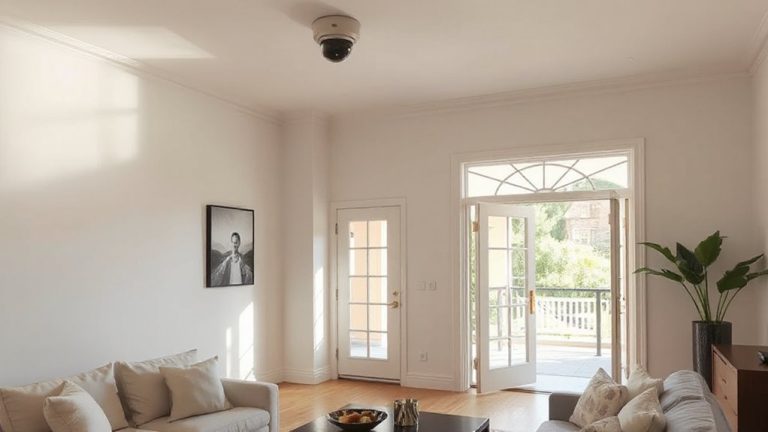
Where should you put pet-immune sensors for the best balance of security and reliability? Focus on entryways and basements, as these are common access points for intruders. Install sensors near doorways and ground-floor windows in entryways to detect break-ins early, while avoiding pet pathways. In basements, especially those with windows or outdoor access, place sensors high on walls-about six to eight feet up-to reduce the chance of pets triggering them. Avoid low-traffic corners where pets nap or play. Mounting sensors at the correct height and angle guarantees they detect human movement across the room, not pets below. Always test placement after installation, letting your pet roam freely to confirm reliability. Proper positioning in these key areas improves detection accuracy, maintains pet safety, and strengthens your overall home security system without unnecessary false alarms. For optimal performance, consider models highlighted in the Best Motion Sensor Alarms roundup to ensure reliable pet immunity and advanced detection technology.
Top Pet-Friendly Motion Sensors: Brand Comparison
When choosing a pet-friendly motion sensor, your priority should be reliability without compromising detection range or response accuracy. Top brands like Honeywell, GE, and Ring offer models that ignore pets up to 80 pounds, using advanced pet-immune algorithms. Brand reliability matters-Honeywell consistently earns high marks for durability and fewer false alarms, while Ring integrates smoothly with smart home systems. GE provides solid performance at a lower cost, making it ideal if you’re on a budget. For price comparison, Honeywell units typically run $40–$60, Ring sensors average $30–$50, and GE options start around $25. Higher cost often means better sensitivity control and longer warranties. Consider installation ease and compatibility with your existing security system. Always check customer reviews and test coverage range to guarantee consistent detection without triggering alarms when your pet moves nearby.
On a final note
You can trust pet-immune sensors to reduce false alarms when installed correctly. Choose models rated for your pet’s weight-most handle up to 40 or 80 pounds. Look for dual-tech sensors that require both heat and motion to trigger, increasing accuracy. Install them in corners away from pet traffic, at recommended heights. Top brands like Ring, ADT, and SimpliSafe offer reliable options with clear pros and mid-range pricing.