Choosing Smart Lighting Systems That Mimic Occupancy to Prevent Burglaries
You should choose smart lighting systems like Philips Hue or TP-Link Kasa that randomize timing and brightness to mimic real activity, making your home 30% less likely to be targeted. Look for adjustable color temperatures, room zoning, and motion integration to simulate natural movement. Pair bulbs with smart plugs for full coverage. Avoid fixed timers-vary schedules and include outdoor lights on dusk-to-dawn settings. Stagger activation and manage window coverings to strengthen the illusion of being home-there’s more to fine-tune for maximum effect.
Notable Insights
- Smart lighting deters burglars by creating uncertainty with randomized on/off patterns that mimic human activity.
- Choose systems like Philips Hue or LIFX for high color accuracy and long bulb life to simulate realistic indoor lighting.
- Enable adjustable brightness and color temperature to reflect natural daily routines and room usage.
- Use room zoning and scheduling to activate lights in different areas at varying times, simulating ongoing occupancy.
- Pair smart bulbs with motion sensors and outdoor lighting to enhance deterrence and avoid predictable activation patterns.
Why Burglars Avoid Homes With Smart Lighting
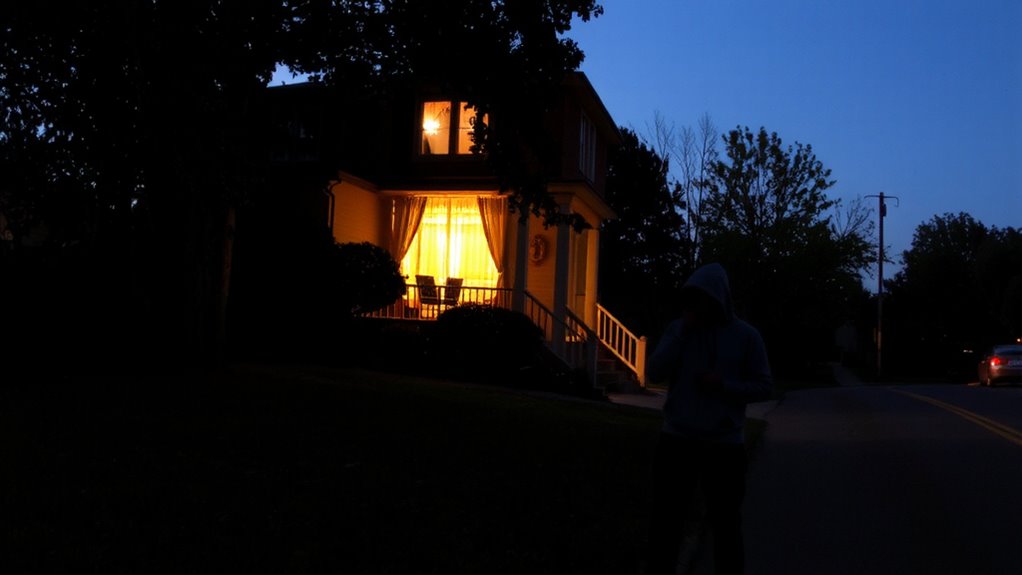
While you might assume that visible signs like alarms or surveillance cameras do most of the work, lighting plays a just as critical a role in deterring burglars-especially when it’s smart lighting. You create uncertainty for intruders when lights turn on without clear motion patterns, making it seem someone’s home. Randomized light timing mimics human behavior, unlike traditional timers with predictable on/off cycles. Studies show homes with inconsistent light timing are 30% less likely to be targeted. Smart systems learn your habits, then vary activation times across rooms, avoiding routines burglars exploit. Unlike basic outdoor lights, smart lighting controls interior brightness and schedules remotely. Pros include energy efficiency and integration with security networks; cons involve setup complexity and initial cost. For best results, combine varied light timing with occasional motion-triggered responses. This mix increases perceived occupancy without signaling empty routines.
Best Smart Lighting Systems That Simulate Presence
A good smart lighting system can make your home appear occupied, even when it’s not, and the best options use advanced features to mimic real human behavior. You’ll want systems like Philips Hue or LIFX, which offer high color accuracy so lights match natural indoor lighting patterns, making activity seem genuine. These brands also boast strong bulb longevity, lasting up to 25,000 hours, which reduces replacement costs and maintenance. TP-Link Kasa provides budget-friendly setups with reliable automation, though color options are more limited. All three support scheduling and randomization, letting you turn lights on or off at varying times. For wider coverage, pair bulbs with smart plugs to control lamps. Most systems work with voice assistants and require a hub or 2.4 GHz Wi-Fi. Initial costs range from $30 to $80 per bulb, but long-term savings come from efficiency and durability.
Key Features That Make Lights Look Occupied
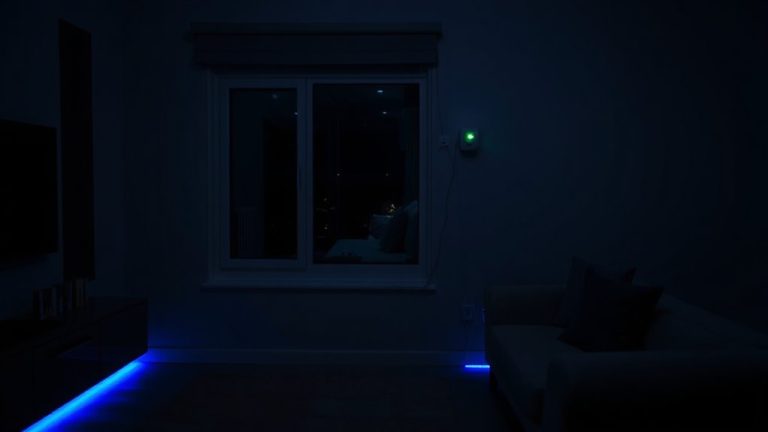
Smart lighting systems that effectively mimic occupancy rely on more than just turning on at set times-they need features that replicate real human behavior. Varying light intensity and color temperature throughout the day makes it seem like someone’s really home. Brighter, cooler light in the morning signals activity, while warmer, dimmer tones at night suggest relaxation. Randomized patterns and room-specific schedules add realism.
| Feature | Benefit | Consideration |
|---|---|---|
| Adjustable brightness | Mimics movement and use | Requires compatible bulbs |
| Color temperature control | Matches natural daylight cycles | Higher initial cost |
| Randomization | Prevents predictable patterns | Needs smart hub or app |
| Room zoning | Lights activate per room usage | Setup time increases |
| Scheduling flexibility | Aligns with typical household routines | Must update when routines change |
How to Make Lights Follow Your Routine
Since your daily habits shape when lights should turn on or off, syncing your smart lighting system to your actual routine makes it far more convincing to potential intruders. You can use light scheduling to program bulbs or switches to activate at times you’re typically home, like turning on the living room light at 7 p.m. and the bedroom lamp at 10 p.m. This predictability mimics real occupancy better than random timers. For even greater realism, combine scheduling with motion integration-devices that detect movement inside your home and trigger lights briefly, just as you would if walking through a room. Most systems let you adjust sensitivity and duration, so false triggers are rare. Look for models that learn your patterns over time, reducing manual updates. Though setup takes a few minutes, the added security is well worth it, especially when you’re away. Consistency is key.
Extend the Illusion Outside: Smart Outdoor Lighting
Why leave intruders in the dark when you can use that to your advantage? You can extend the illusion of occupancy beyond your front door with smart outdoor lighting. These systems use motion sensors to detect activity, turning lights on only when needed, which mimics real human behavior. That sudden activation can deter trespassers who expect an empty home. Program lights to turn on at dusk and off at dawn, or set schedules that match your usual evening routines. Some models offer landscape highlighting, letting you subtly illuminate pathways, trees, or architectural features to enhance both security and curb appeal. LED options are energy efficient and last longer, typically costing $50–$150 per fixture. Integrated Wi-Fi enables remote control and automation. Combine motion sensors with timed landscape highlighting to create a convincing, layered defense that looks lived-in-even when you’re not. For reliable performance, consider best wireless motion sensor lights that balance sensitivity, range, and weather resistance.
Don’t Let These Mistakes Reveal You’re Not Home
How often do you think about the clues you might be leaving for potential intruders? Simple oversights can signal you’re away. Leaving all lights off makes it obvious no one’s home, but running lights on fixed timer settings every night can be just as revealing-patterns become predictable. Use varied timer settings across rooms so activity appears natural. Pair indoor lights with motion sensors outdoors to boost credibility. Avoid syncing everything at the same time; stagger when lights turn on or off. Don’t forget to manage window coverings-blinds up with no activity suggest vacancy. Also, stop pausing deliveries or social media posts, as these draw attention. Smart systems work best when they mimic real behavior, not perfect schedules. Regularly update your timer settings and mix in random motion-sensor activation to simulate presence. Small adjustments make a big difference in long-term security.
On a final note
You can effectively deter burglars by choosing smart lighting that mimics your routine. Systems like Philips Hue and Lutron offer reliable scheduling and randomization features. Use indoor and outdoor lights with motion sensors and dimming options to create a natural look. Avoid predictable patterns and make certain lights turn on at different times. A well-planned setup costs $100–$300 but boosts security without drawing attention.