How Thermal Imaging Enhances Night Vision in Outdoor Security Cameras
You get clearer night vision with thermal cameras because they detect heat, not light. They spot people and animals in total darkness, up to 100 feet or more, using infrared sensors to map temperature differences. Unlike traditional night vision, they work in fog, smoke, and foliage without extra lighting. Heat detection cuts false alarms by ignoring wind and shadows. Higher resolution and proper setup improve accuracy-smart choices save money and boost security over time. More details follow on picking the best one for your needs.
Notable Insights
- Thermal imaging detects heat signatures, enabling clear visibility in total darkness without relying on ambient light.
- It outperforms traditional night vision by functioning in complete darkness, bright light, fog, and smoke.
- No infrared illuminators are needed, reducing maintenance and enhancing stealth in outdoor surveillance.
- Thermal cameras see through environmental obscurants like fog, smoke, and dense foliage for reliable threat detection.
- Heat-based detection reduces false alarms by distinguishing people and animals from inanimate moving objects.
How Thermal Security Cameras Work in Total Darkness
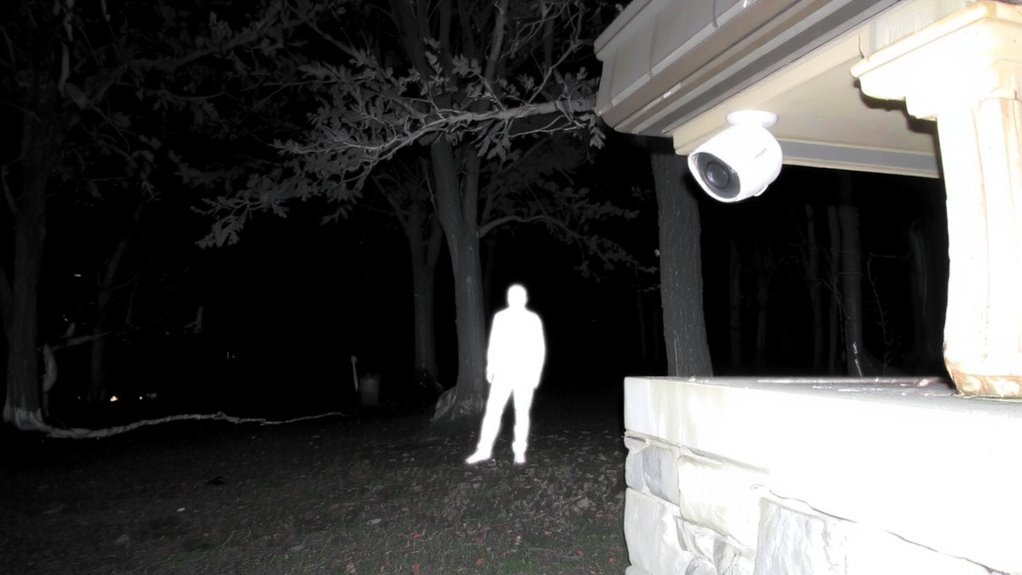
Even though there’s no visible light at night, thermal security cameras can still detect people and animals because they sense heat instead of light. You’re seeing heat signatures emitted by anything warmer than the environment, which show up clearly on screen. These cameras use infrared sensors to capture temperature differences, making object detection reliable in total darkness, fog, or smoke. Unlike regular cameras, they don’t need any ambient light. The image you see is a thermal map, with warmer areas appearing brighter. This makes it easier to distinguish living beings from inanimate objects. Most systems offer accurate detection up to 100 feet or more, depending on sensor quality. Look for models with high thermal resolution and built-in analytics for better object detection. While pricing ranges from $200 to over $600, the added reliability at night often justifies the cost. For optimal performance, consider pairing thermal imaging with traditional night vision devices that enhance visibility using ambient light.
Why Thermal Beats Traditional Night Vision
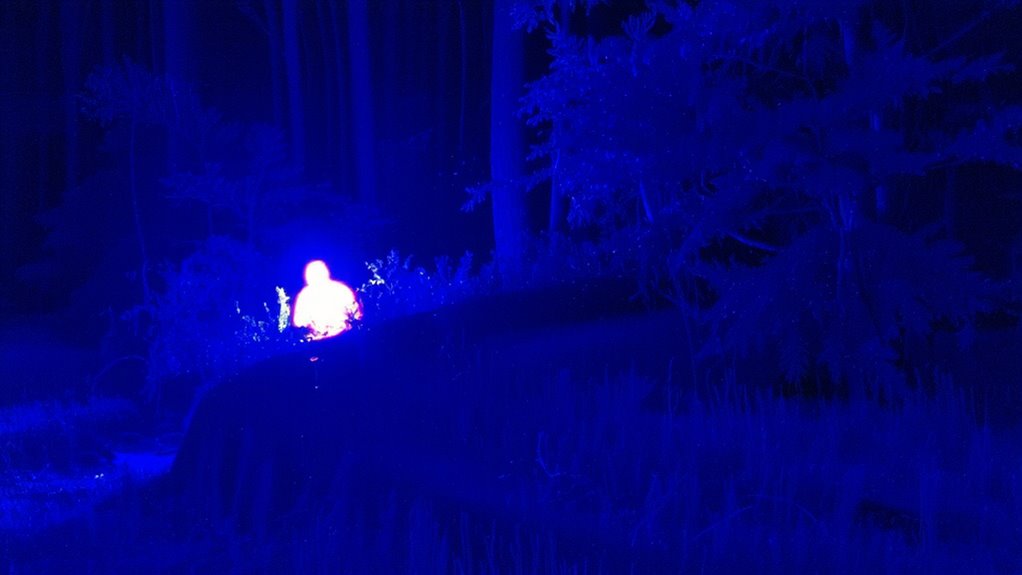
Why do thermal cameras outperform traditional night vision in so many real-world scenarios? You get better image clarity because thermal detects heat, not light, so it works in total darkness, bright light, or glare without washing out. Unlike traditional night vision, which relies on infrared illuminators that can be spotted and drained quickly, thermal needs no extra lighting, boosting its stealth and durability. Image clarity stays consistent, even in challenging environments, helping you identify people or animals more reliably. Plus, you’ll enjoy long-term cost efficiency-fewer parts mean less maintenance and lower power use. While thermal cameras have a higher upfront cost, they save you money over time with minimal upkeep. You won’t need to replace bulbs or worry about damaged components from overuse. For outdoor security, that reliability adds up, giving you continuous monitoring without added expenses.
See Through Fog, Smoke, and Foliage With Thermal Imaging
You already know thermal cameras work in total darkness and handle glare better than traditional night vision, but their advantages go further-they can see through environmental obstacles that would blind other systems. With thermal imaging, you get improved clarity even in fog, smoke, or dense foliage, thanks to superior environmental penetration. Unlike visible light cameras, thermal sensors detect heat signatures, allowing them to cut through obscurants that block conventional optics. Best Cameras for Night Video offer various options, but thermal models stand out for reliability in extreme conditions.
| Condition | Traditional Camera | Thermal Camera |
|---|---|---|
| Heavy Fog | Blinded, blurry | Clear detection |
| Smoke | Limited view | Reliable imaging |
| Thick Foliage | Missed intruders | Improved clarity |
This makes thermal ideal for rural or wooded properties, and areas prone to smoke or fog. Though slightly higher in cost, the reliability offers long-term value. For dependable outdoor surveillance, thermal delivers consistent performance where others fail.
Stop False Alarms: How Heat Detection Knows Real Threats
While traditional motion sensors often trigger alarms from moving branches or headlights, thermal imaging reduces false alerts by detecting heat signatures instead of just movement. You can trust it to distinguish people and animals from inanimate objects because it senses body heat. Advanced systems analyze heat signatures and motion patterns over time, learning what’s normal around your property. If a warm car passes by or leaves residual heat, the camera won’t sound an alarm unless it detects a person-shaped heat source moving toward your home. This means fewer false notifications and more accurate threat detection, especially at night or in poor visibility. Unlike standard sensors, thermal cameras ignore wind-blown foliage or shadows. They focus on sustained heat and logical motion paths-like a person walking, not floating. You’ll get alerts that matter, saving you time and increasing real-time response efficiency. For reliable performance in diverse weather and lighting conditions, consider models recognized in expert outdoor security camera rankings.
Choose the Right Thermal Security Camera for Your Property
How do you guarantee your property gets the right level of protection without overspending? Start by evaluating your property’s size and layout-thermal cameras with wider detection ranges suit large areas but may be overkill for small yards. Check each model’s resolution; higher thermal resolution improves threat identification but increases cost. Consider installation requirements: some cameras need professional mounting and wiring, while others support DIY setup with weatherproofing for outdoor use. Power source matters too-battery models cut wiring but demand frequent charging. Compare long-term maintenance costs; sealed units with no moving parts typically last longer and need less servicing. Infrared models may require lens cleaning, but thermal sensors are less prone to wear. Pick a camera with local or cloud storage based on your monitoring habits. Finally, balance features against your budget-more tech isn’t always better if it inflates expenses unnecessarily.
On a final note
You get reliable night vision with thermal imaging, even in total darkness, because it detects heat, not light. Unlike traditional cameras, thermal ones see through fog, smoke, and foliage, reducing false alarms from shadows or animals. They spot real threats by noticing body heat patterns. When choosing a model, check range, resolution, and weather resistance. Higher-end models cost more but offer better accuracy and coverage, making them worth it for large or high-risk areas.