Setting Up Emergency Communication Systems for Rural and Remote Homes
You’ll need satellite phones like Iridium for reliable off-grid coverage, especially in mountainous or forested areas where signals often fail. Use two-way radios with GMRS licenses for local coordination, and pair them with solar chargers and 20,000 mAh+ power banks to stay powered. Weather radios with SAME alerts give timely emergency updates without cell service. Test systems monthly and plan for coverage gaps, terrain obstacles, and backup needs-essential details follow to strengthen your setup.
Notable Insights
- Use satellite phones like Iridium for reliable off-grid communication in remote or mountainous regions.
- Deploy two-way radios on GMRS or FRS bands for local coordination, ensuring FCC licensing if required.
- Install solar-powered charging systems with at least 20,000 mAh storage to maintain device power.
- Equip your home with a weather radio using SAME technology to receive location-specific emergency alerts.
- Evaluate line of sight and terrain obstacles to optimize radio and antenna signal placement.
Why Emergency Communication Fails Off the Grid
While living off the grid offers independence, it also creates real challenges when emergencies strike and communication systems fail. You rely on limited infrastructure, which often suffers from signal obstruction due to terrain, heavy foliage, or poor antenna placement. Mountains, valleys, and dense forests block radio waves, making cell and radio signals unreliable. Over time, infrastructure decay further weakens connectivity-abandoned towers, outdated equipment, and lack of maintenance reduce coverage. Even local repeaters may be poorly powered or nonfunctional. These issues mean you can’t assume help is just a call away. Planning must include evaluating your site’s line of sight to potential signal sources and checking for nearby service degradation. Without reliable access, emergency alerts go unheard, and rescue coordination stalls. Understanding these risks helps you choose backup systems before crisis hits.
Pick a Satellite Phone That Works in Remote Areas
When you’re miles from the nearest cell tower, a satellite phone can be your most reliable lifeline, connecting you directly to emergency services through orbiting satellites rather than ground-based networks. You’ll want strong satellite coverage, so pick a model that works on global networks like Iridium or Globalstar-these offer reliable connections in polar, forested, or mountainous regions. Iridium provides near-total global coverage, while Globalstar has gaps but often better voice quality in supported zones. Expect some delay or slight distortion in calls; newer models minimize this. Phones vary in size, battery life, and ruggedness-choose one that fits your environment. Satellite plans range from pay-as-you-go to monthly, starting around $50. Activation fees may apply. Test your device regularly. Avoid signal-blocking areas like dense tree cover when calling.
Use Two-Way Radios for Local Emergency Coordination
You can stay connected with family or neighbors during an emergency even when cell service fails by using two-way radios, which send and receive short-range voice messages without relying on networks. Their signal range typically reaches one to five miles, depending on terrain and radio power-higher wattage models offer better performance. For reliable coordination, choose radios with clear channel selection to avoid interference; FRS and GMRS bands are common, with GMRS allowing longer range if you have an FCC license. Invest in models with weather alerts and durable, waterproof builds. Family units should all use the same channel, tested regularly. While cheaper options exist, quality radios priced $30–$100 deliver stronger signal range and clearer audio. Keep spare batteries on hand. Proper channel selection guarantees only your group communicates securely, reducing confusion during critical moments.
Keep Comms Alive With Solar and Backup Power
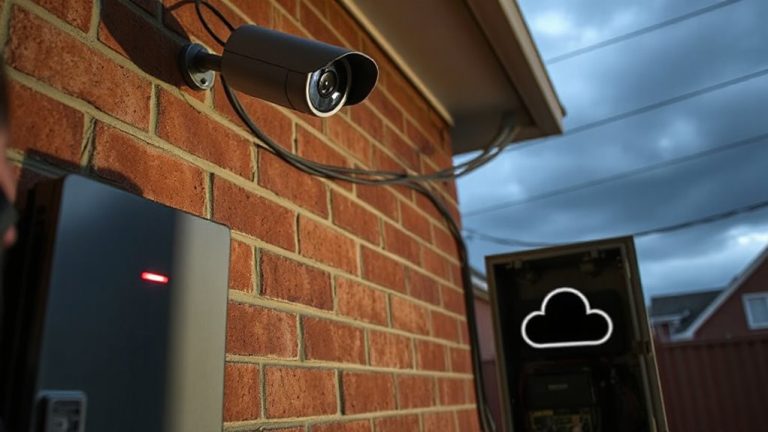
Two-way radios help maintain contact during network outages, but they’re only useful if you can keep them powered. That’s where solar charging comes in-portable solar panels let you recharge batteries even during long blackouts. A basic 20-watt solar charger costs around $50 and can fully recharge a radio battery in 4–6 hours of direct sunlight. For better power resilience, pair solar panels with power banks or deep-cycle batteries. These store energy for nighttime or cloudy days. Lithium-based power banks last longer than lead-acid but cost more. Aim for at least 20,000 mAh capacity to support multiple recharges. Test your setup monthly. Avoid cheap solar units with poor weather resistance. With reliable solar charging and stored power, your communication system stays online when the grid fails. Solar-powered security cameras can also integrate into your emergency setup, providing surveillance and deterrence even during extended outages. Plan now-don’t wait until the storm hits.
Get Emergency Alerts Without Cell Service
How do you stay informed when cell networks go down during a storm or wildfire? You can still get emergency alerts through dedicated weather radios that receive alerts from the National Weather Service. These devices provide real-time weather alerts, including tornado warnings and flash floods, without relying on cell service. Look for models with Specific Area Message Encoding (SAME) to filter alerts by your location. Battery-powered or hand-crank radios guarantee operation during power outages. Some radios also broadcast AM/FM stations, adding useful backup info. Community networks, like amateur radio groups or local alert systems, offer another layer of support, especially in rural areas. They often relay evacuation orders or road closures when cell towers fail. While weather radios cost $25–$70, their reliability makes them a smart investment. Pairing them with community networks boosts your awareness when traditional services fail.
Test and Update Your Emergency Communication Plan
A solid emergency communication plan is only effective if it’s tested and current, so scheduling regular drills matters. You should run family drills at least twice a year to guarantee everyone knows their role during different emergencies, like fires, storms, or medical crises. During these drills, practice using your radios, satellite messengers, or other backup devices. Include signal testing to confirm your equipment reaches key locations, whether from your barn to the house or deep in the woods. Check battery levels, antenna positioning, and message clarity each time. Update contact lists and evacuation routes annually, or after major life changes. If a family member moves or a device fails, fix it right away. Testing reveals weaknesses before a real crisis hits, giving you reliable coordination when it counts.
On a final note
You’ll stay safer off the grid by choosing reliable tools like satellite phones, which work where cell service doesn’t, though they can be costly. Two-way radios help coordinate locally, especially with strong batteries. Solar chargers keep devices running during outages. Always test your emergency plan every six months and update gear as needed. These steps, backed by preparedness data, increase your odds of staying connected and informed when it matters most.