A Detailed Analysis of Different Camera Lenses Used in Outdoor Surveillance Systems
You’ll want a 2.8mm to 12mm lens for most outdoor setups, balancing wide coverage and clear detail. Shorter lenses cover driveways and yards, while longer ones capture faces or plates at a distance. Telephoto lenses like 50mm offer sharp zoom but narrow views, best with high-res sensors. Varifocals adjust to changing needs but cost more and need careful setup. For low light, choose f/1.0 to f/1.4 apertures and IR support. Fixed lenses often perform better at night than varifocals. Multi-coated glass resists glare, weather, and distortion. Proper alignment and durable housing guarantee reliability. You’ll see how lens choice shapes your system’s effectiveness based on where and what you’re watching.
Notable Insights
- Short focal lengths (2.8mm–4mm) offer wide coverage for large areas but sacrifice detail on distant objects like faces or license plates.
- Telephoto lenses (50mm–80mm) provide high detail at long distances but cover narrow fields, ideal for perimeter or driveway monitoring.
- Varifocal lenses allow adjustable zoom (e.g., 2.8–12mm), offering flexibility for diverse outdoor scenes but may have reduced sharpness if misaligned.
- A 90°–110° field of view balances area coverage and detail, suitable for driveways or yards, minimizing edge distortion.
- Lenses with f/1.0–f/1.4 apertures and IR compatibility ensure superior low-light performance and nighttime clarity in outdoor environments.
Why Focal Length Matters for Outdoor Surveillance
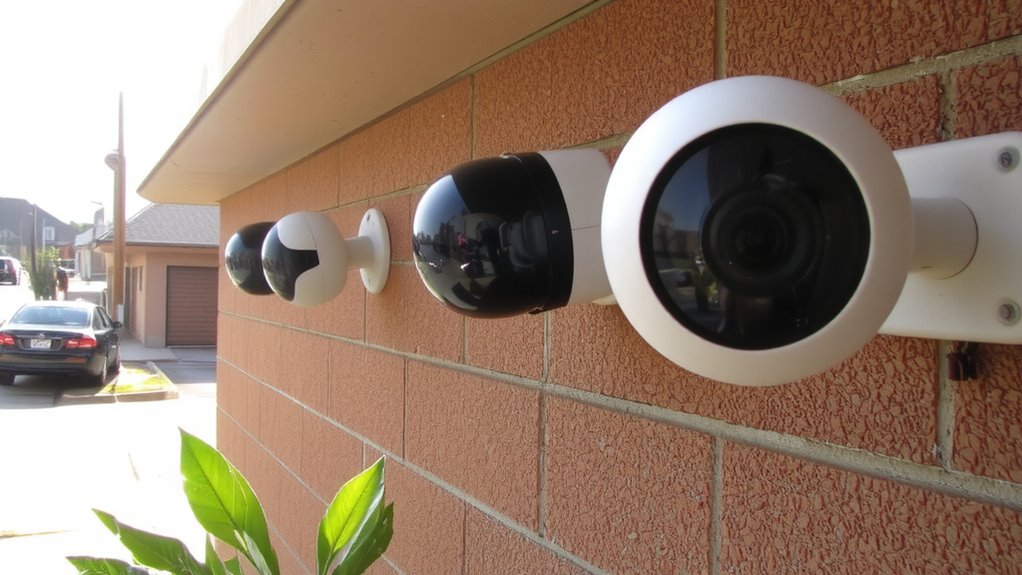
The right focal length shapes how much of your outdoor space you can actually see. If you pick a lens with too short a focal length, you’ll capture a wide area but lose detail, making it hard to identify faces or license plates. A longer focal length zooms in, providing sharper images of distant objects, but reduces the visible area. You also risk increased image distortion at the edges with very wide-angle lenses, especially in poor light. Focus accuracy decreases when the lens struggles to adapt to changing distances, leading to blurry footage. Fixed focal length lenses offer better clarity and consistency than varifocal ones, which can shift focus slightly when zoomed. For most homes, a 2.8mm to 12mm range balances coverage and detail. Check lens spec sheets for distortion ratings and focus performance-data helps you compare. When selecting, consider models featured in trusted best security cameras guides to ensure optimal performance.
Choose the Right Field of View for Your Property
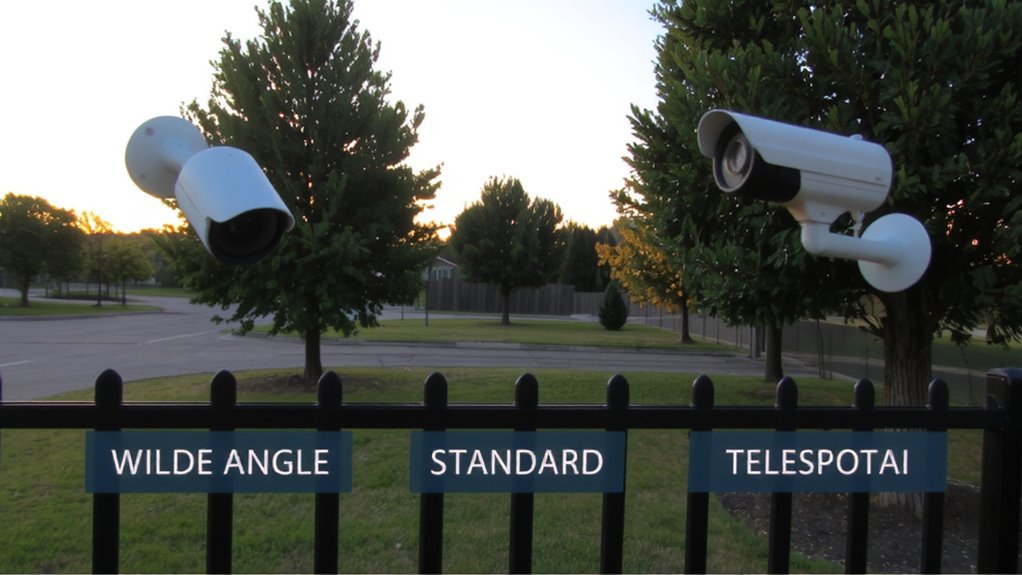
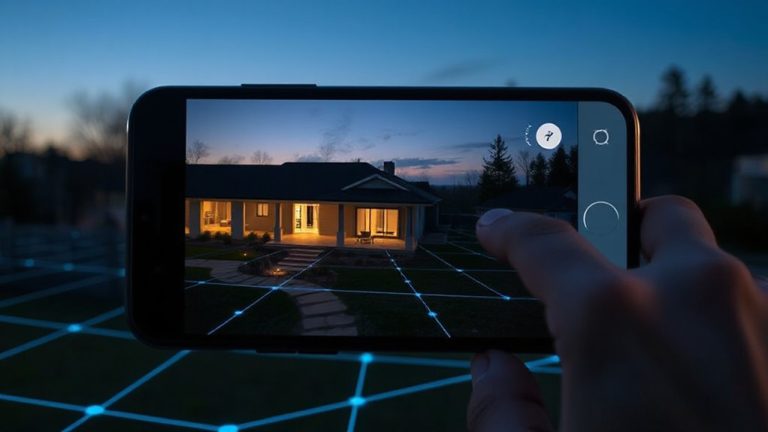
How much of your property do you actually need to see? Choosing the right field of view starts with angle selection based on your space. If you’re covering a large yard or driveway, go wide-around 90 to 110 degrees-so you capture more area. For tighter spots like doorways or gates, a narrower angle works better. Always pair angle selection with accurate distance estimation so you know how far the camera can clearly see. A wider lens might show more but can distort edges, while a narrow field keeps details sharp at longer distances. Measure key zones and use manufacturer specs to match lens performance to your layout. This guarantees you don’t miss critical activity just outside the frame. Proper planning here improves coverage without needing extra cameras.
When to Use a Telephoto Lens for Outdoor Monitoring
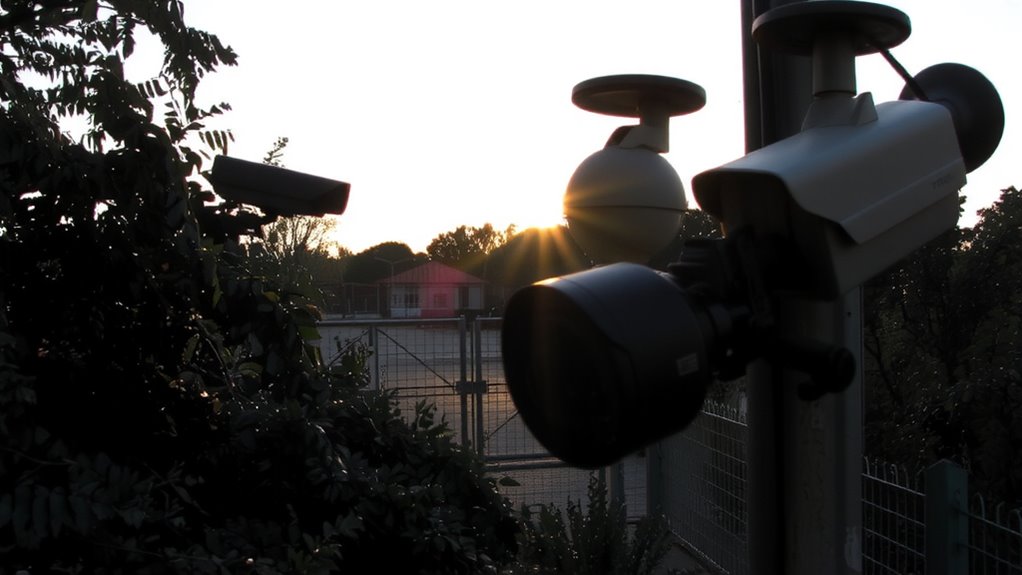
You’ve already mapped out your property’s key zones and picked a camera angle that fits each area, but what if you need to see something far away in sharp detail? That’s where a telephoto lens shines. It delivers strong image magnification, letting you clearly identify faces or license plates hundreds of feet away. If you’re monitoring a long driveway, perimeter fence, or open field, this lens improves distant threat detection by capturing fine details other lenses miss. Fixed focal lengths, like 50mm or 80mm, offer consistent clarity but cover a narrower field of view, so placement matters. Telephoto lenses work best when paired with high-resolution sensors to maintain image quality. While they cost more and may require precise alignment, the trade-off is reliable, close-up surveillance over distance. Use them where detail outweighs wide coverage.
Can Varifocal Lenses Adapt to Outdoor Security?
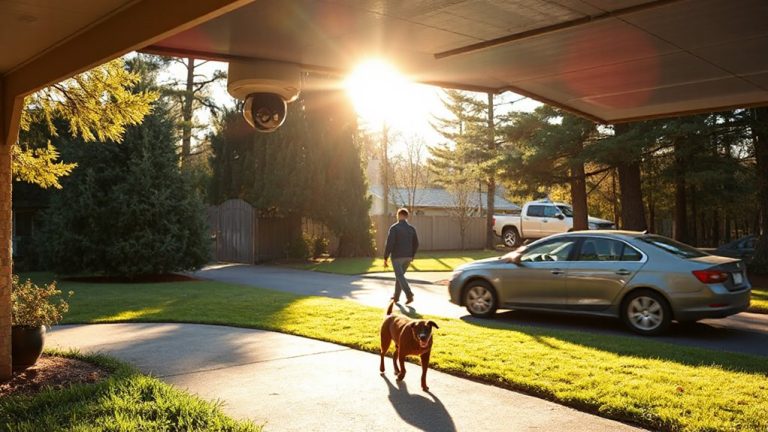
What if your outdoor security needs change over time-could a single lens handle both wide-area views and zoomed-in details? Yes, varifocal lenses can adapt well to shifting outdoor security demands. You’ll appreciate their adjustable zoom range, which lets you fine-tune the field of view from wide angles to tighter shots without swapping lenses. This flexibility is ideal when monitoring driveways, gates, or parking lots where coverage needs vary. With manual or motorized zoom, you maintain precise control. These lenses also offer solid aperture control, maintaining image clarity in changing daylight. While they may cost more than fixed lenses, the versatility often justifies the price. Just note, improper setup can lead to focus issues in some conditions. Overall, if you need adaptability and clear detail at variable distances, a varifocal lens is a reliable, data-backed choice for dynamic outdoor environments. Top outdoor security models often feature these lenses for optimal performance in real-world conditions, making best outdoor security cameras a key consideration when planning adaptable surveillance systems.
Best Outdoor Surveillance Lenses for Low Light
Nighttime security starts with the right lens, one that captures clear images even when light fades. You need lenses with strong infrared sensitivity to detect IR illumination, letting cameras “see” in total darkness. Look for models with aperture optimization-wider apertures like f/1.0 to f/1.4 gather more light, improving low-light clarity. Fixed focal lenses with an f-stop below f/1.4 often deliver sharper night footage than varifocals, though they offer less flexibility. Pair your lens with a camera supporting IR LEDs or external illuminators for best results. Lenses with aspherical elements reduce distortion, enhancing image accuracy. While high-end options provide superior low-light performance, they can cost 20–30% more. Plan your budget accordingly, and prioritize aperture size and infrared sensitivity-two proven specs impacting nighttime effectiveness. Choose wisely, and your system will deliver usable footage when you need it most. Cameras with larger sensors, such as those found in the best cameras for low light, significantly enhance performance in dark environments.
How Weatherproofing Protects Surveillance Lenses
While extreme weather can degrade both image quality and lens durability, a properly weatherproofed surveillance lens remains reliable under harsh conditions. You’ll want a lens sealed against moisture and temperature swings, since humidity and rain can lead to lens corrosion over time. Without protection, metal components degrade, and optics fog, reducing clarity. Dust accumulation is another issue-tiny particles can block the field of view or scratch surfaces during cleaning. A weatherproof housing with an IP66 or higher rating keeps out dust and water, ensuring consistent performance. Thermal shielding also helps, preventing cracks from freeze-thaw cycles. You’ll pay slightly more upfront, but avoiding frequent replacements saves money long-term. Look for gaskets, sealed casings, and corrosion-resistant materials like aluminum or stainless steel. Proper installation tightens the seal. With these features, your system stays effective for years, even in rain, snow, or desert heat.
How Lens Glass and Coatings Affect Outdoor Clarity
Clarity starts with the glass. The quality of lens glass directly impacts how well your outdoor camera captures sharp, accurate images. You’ll want lenses made from high-grade optical glass to minimize lens chromatic aberration, which causes color fringing and blurs details. Multi-coated lenses help too, especially with optical flare reduction, cutting down glare from sunlight or streetlights. That means clearer footage during sunrise, sunset, or at night under bright lighting. Anti-reflective and hydrophobic coatings are practical upgrades, repelling water and reducing smudges. While coated glass costs more, it boosts performance in tough outdoor conditions. Lower-end lenses skimping on coatings often deliver hazy images over time. For reliable surveillance, invest in cameras with fully multi-coated optics. You’ll see truer colors, better contrast, and fewer distortions. Check specs carefully-don’t assume all lenses perform the same.
On a final note
You’ll get the best outdoor surveillance results by matching lens focal length to your needs-wider views for large areas, telephoto for distant details. Varifocal lenses offer flexibility, while proper weatherproofing and coated glass improve clarity and durability. In low light, choose lenses with larger apertures. Plan coverage carefully, weigh upfront cost against performance, and prioritize proven features over hype for reliable, long-term security.