A Guide to Understanding Different Types of Encryption Used in Secure Communication Channels
You use encryption every day to protect your data when logging into accounts or shopping online. Symmetric encryption uses one shared key-fast for large files but needs secure key exchange. Asymmetric encryption uses public and private keys, keeping messages secure and authentic. TLS combines both for safe web browsing, creating unique session keys. End-to-end encryption keeps messages private, while hashing verifies data hasn’t changed. Each method has strengths and trade-offs in speed, security, and use. Understanding how they work together helps you better protect your digital life-and there’s more to how these systems keep evolving.
Notable Insights
- Encryption protects data by converting it into unreadable code accessible only to authorized parties.
- Symmetric encryption uses a single shared key for fast, efficient encryption of large data volumes.
- Asymmetric encryption uses public-private key pairs to securely exchange keys and verify identities.
- TLS combines asymmetric and symmetric encryption to secure web communications with HTTPS and session keys.
- End-to-end encryption and hashing ensure message privacy, integrity, and tamper detection in transit.
What Encryption Is: and Why It Matters

Security is your first line of defense in a digital world full of unseen risks, and encryption is one of its most reliable tools. You use it every day, whether logging into email or shopping online, without even realizing it. Encryption scrambles your data so only authorized parties can read it, protecting your personal information from hackers and breaches. A key part of this process is secure key distribution, which guarantees the right people receive decryption keys without interception. While today’s methods are strong, emerging technologies like quantum computing could someday break current encryption standards. Experts are already preparing quantum-resistant algorithms to stay ahead. Though you don’t need to manage these systems yourself, understanding their importance helps you make smarter choices about which services to trust. Look for end-to-end encryption in messaging apps and strong key distribution protocols when evaluating security apps-these features offer real protection backed by science.
How Symmetric Encryption Works (and Where It’s Used)
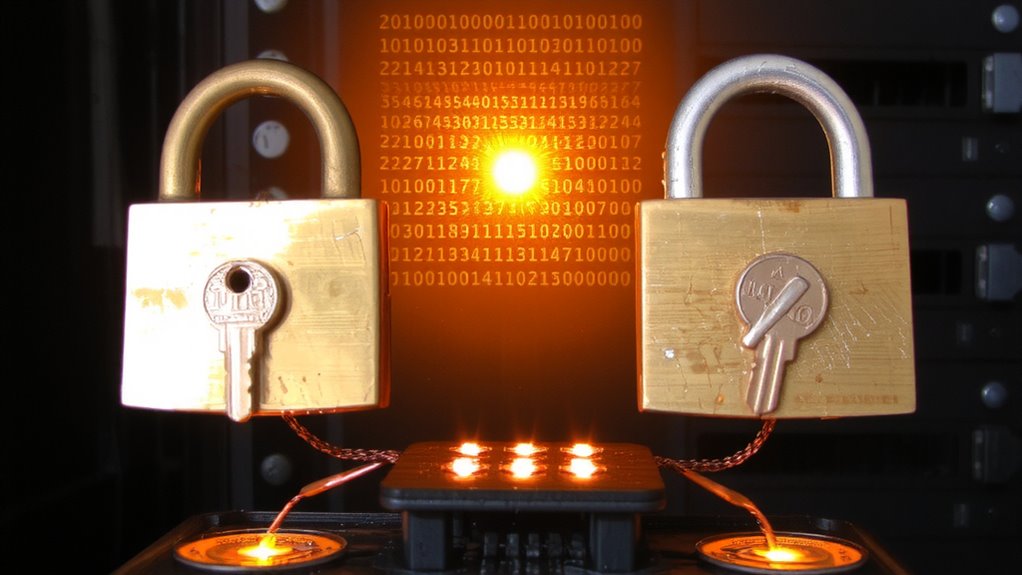
Think of symmetric encryption as locking and opening a door with the same key-only instead of a physical key, you’re using a secret code shared between you and whoever needs access. You encrypt data with this key, and the recipient uses it to decrypt the message. It’s fast and efficient for securing large amounts of data. Two main types handle this: block ciphers and stream ciphers. Block ciphers encrypt data in fixed-size chunks, making them ideal for stored data. Stream ciphers encrypt one bit at a time, best suited for real-time communication. Both are widely used in Wi-Fi security, file encryption, and secure messaging apps. The catch? You must share the key securely-if someone intercepts it, your data’s exposed. That’s why symmetric encryption works best when combined with secure key exchange methods. Use it where speed matters, but plan carefully around key distribution.
Why Asymmetric Encryption Secures Digital Handshakes

You’ve seen how symmetric encryption relies on a single shared key to lock and access data quickly, but that same speed comes with a problem-getting the key to the right person without it being stolen. That’s where asymmetric encryption steps in to secure digital handshakes. With a public and private key pair, you can safely perform key exchange without sharing secrets over open lines. Your public key encrypts data or verifies digital signatures, while only your private key can decrypt or sign them. This system guarantees authenticity and prevents tampering. Unlike symmetric methods, it removes the risk of key interception during transmission. Digital signatures confirm identities, while key exchange setups remain resistant to eavesdropping. Though slower for bulk data, asymmetric encryption is essential for initiating secure connections. It’s the trusted foundation for verifying who you’re communicating with-and keeping that conversation private from the start.
How TLS Combines Both to Protect Your Browsing
When you visit a secure website, your browser doesn’t rely on just one type of encryption-it uses both asymmetric and symmetric encryption together through a protocol called TLS (Transport Layer Security). First, asymmetric encryption verifies the site’s identity and securely exchanges initial data. Then, your browser and the server create temporary session keys for symmetric encryption, which is faster for ongoing communication. These session keys encrypt all data sent during your browsing session. Many modern sites use perfect forward secrecy, meaning each session generates unique keys. If one key is compromised, past or future sessions remain secure. This combination guarantees strong authentication and efficient data protection. TLS is automatic in modern browsers, requiring no setup. Look for the padlock icon and HTTPS to confirm it’s active. It’s a reliable standard for everyday browsing safety.
End-to-End Encryption: Private Messages Explained
How do your private messages stay private, even from the services you use? With end-to-end encryption, only you and the recipient can read what’s sent. When you message someone, a secure key exchange guarantees that encryption keys never leave your devices. That means not even the service provider can access the content. Each message is encrypted on your phone and decrypted only on the recipient’s, protecting your conversations from interception. This system also guarantees message integrity, so you can be confident no one altered the content in transit. While highly secure, end-to-end encryption relies on both users keeping their devices safe. If a phone is compromised, so is the data. Apps using this method often include verification tools to confirm key exchange authenticity. Look for apps with strong reputations, regular updates, and transparent security practices to get the most reliable protection for daily communication.
Hashing vs. Encryption: Ensuring Data Stays Intact
While end-to-end encryption protects your messages by limiting access to just you and the recipient, another important security method-hashing-ensures that data remains unchanged during storage or transmission. You use hashing every time you verify a file’s authenticity or confirm message authentication. Unlike encryption, hashing doesn’t lock data-it creates a unique digital fingerprint. If even one character changes, the hash changes completely, alerting you instantly. This guarantees data integrity, meaning you can trust that information hasn’t been altered. Hashing is fast, reliable, and essential for secure software updates, password storage, and digital signatures. However, it can’t be reversed, so it’s not a substitute for encryption. For full protection, combine both: encryption secures privacy, while hashing confirms data integrity. Use tools that support SHA-256 or similar standards for best results.
On a final note
You now understand how encryption safeguards your data using symmetric and asymmetric methods, combined in protocols like TLS to secure browsing. End-to-end encryption keeps messages private, while hashing verifies data integrity. Each method has trade-offs in speed, complexity, and use cases. Choose tools that balance security and usability, prioritizing encryption in messaging apps, browsers, and home networks. Always enable built-in protections-they’re proven, effective, and essential for modern digital safety.