360-Degree Ceiling Motion Detector Placement: Height & Distance Guide
Center your 360-degree motion detector on the ceiling for full coverage, keeping it at least 12 inches from walls or corners. Mount it 10–12 feet high and avoid obstructions like beams or lights. Stay 3–5 feet from HVAC vents and ceiling fans to prevent false triggers. Position it away from windows and moving objects. Use overlapping sensors in large areas every 25–30 feet, and consider dual-tech models for better accuracy-there’s more to optimizing your setup than just placement.
Notable Insights
- Mount the detector at the center of the ceiling for optimal 360-degree coverage and minimal blind spots.
- Ensure ceiling height is between 10 and 12 feet to maintain effective detection range and sensitivity.
- Keep the sensor at least 12 inches away from walls and corners to avoid obstructed coverage.
- Avoid placing near HVAC vents, ceiling fans, or air ducts to prevent airflow from causing false triggers.
- Position away from windows, blinds, and reflective surfaces to reduce false alarms from moving shadows or light.
Center Your 360-Degree Motion Detector for Full Coverage
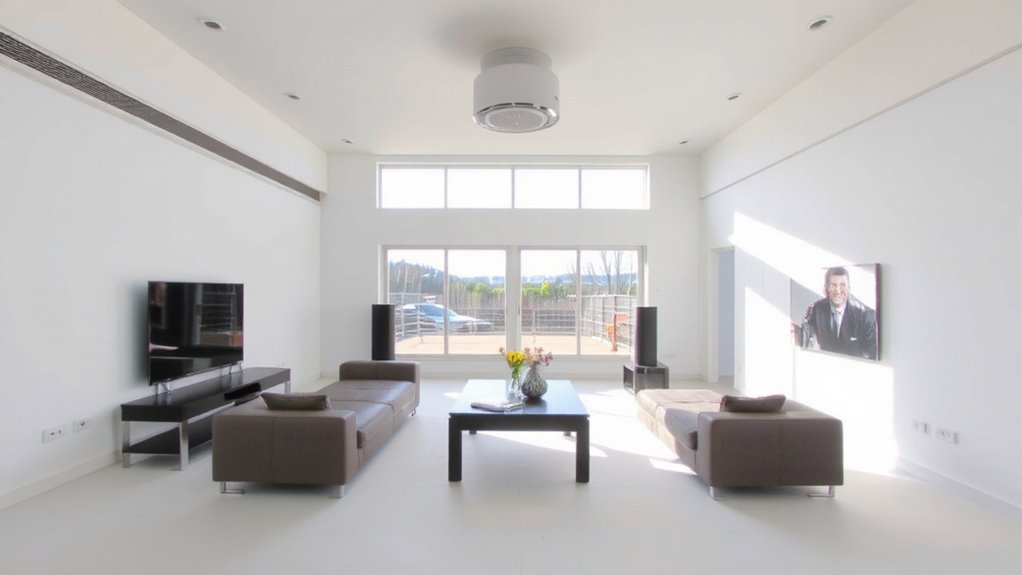
While ceiling mounting gives you the best chance to detect movement across an entire room, you’ll still need to position your 360-degree motion detector right in the center for truly full coverage. Centering guarantees even sensor alignment, minimizing blind spots and maximizing detection accuracy. If the unit’s off-center, motion near walls may go undetected, especially in larger rooms. Your ceiling height also affects performance-most detectors work well up to 10–12 feet; beyond that, sensitivity can drop. Mounting too high without adjusting sensor angle reduces effectiveness. Always follow manufacturer guidelines for best placement. Proper alignment keeps the detection pattern circular and balanced. Avoid shifting the device toward one area, as it compromises overall coverage. For consistent results, use a mounting template if provided. A centered detector, aligned correctly and suited to your ceiling height, delivers reliable, uniform monitoring-ideal for security and automation. Plan placement before installation to save time and avoid costly repositioning. For optimal performance, choose models recognized as the best motion detectors for your home’s layout and security needs.
Avoid Corners and Obstructions That Block Detection
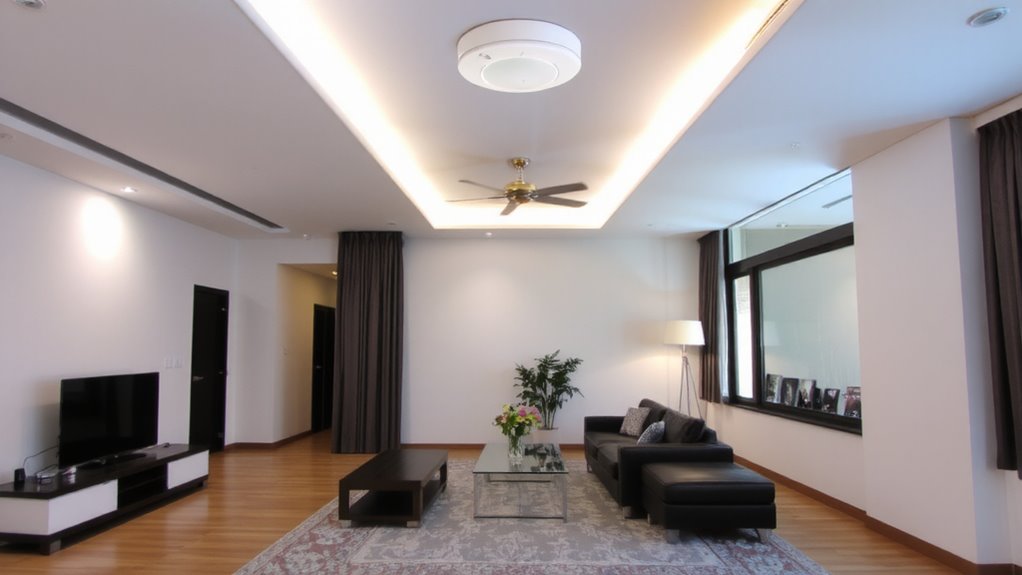
Most ceiling-mounted 360-degree motion detectors lose up to 30% of their effective range when placed too close to corners or obstructed by beams, light fixtures, or HVAC vents. Poor sensor placement creates blind spots, reducing coverage where it’s needed most. You’ll want to install your detector at least 12 inches away from walls and corners to maintain full visibility. Overhead obstructions like ceiling joists or recessed lighting can block infrared signals, limiting detection accuracy. For best performance, position the sensor in an unobstructed central area to guarantee even field coverage. Avoid mounting near decorative ceiling elements that could interfere. Proper planning during installation prevents gaps in motion sensing, especially in high-traffic zones. A well-placed detector minimizes false alarms and maximizes security. Always check the manufacturer’s guidelines for clearance requirements to avoid costly reinstallation.
Keep Away From HVAC Drafts and Air Currents
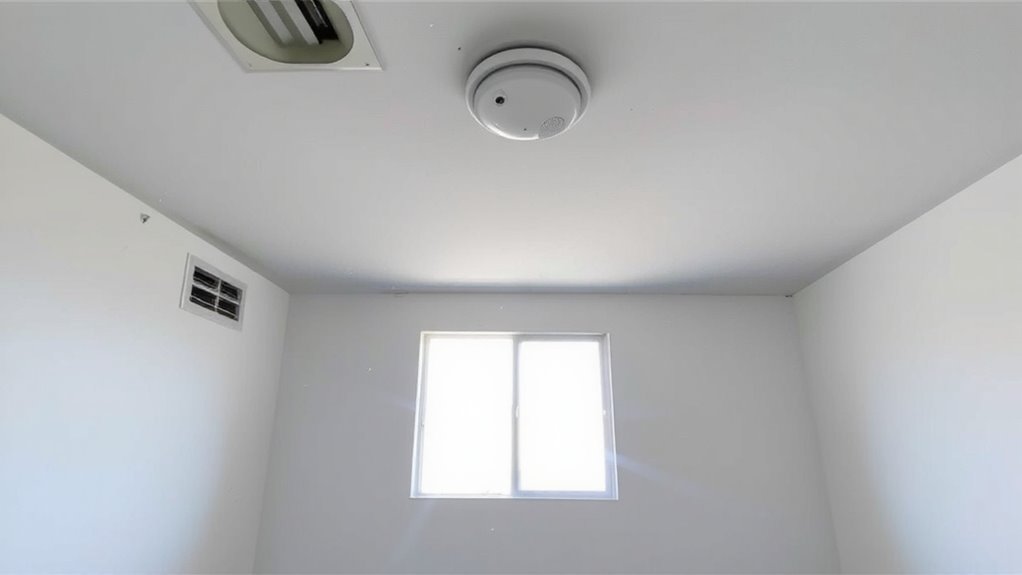
Near heating or cooling vents, airflow can distort a 360-degree ceiling motion detector’s infrared sensing patterns, leading to inaccurate triggers or missed detections. You’ll want to avoid such spots during sensor placement, as HVAC drafts create environmental interference that fools the detector into thinking air movement is motion. Even mild air currents can reduce sensitivity over time. For reliable performance, install the unit at least 3 to 5 feet away from vents, returns, or ceiling fans. This improves accuracy by minimizing temperature fluctuations across the sensor’s field of view. Proper positioning guarantees consistent detection without false negatives. While it might be tempting to place the detector near a vent for easy wiring access, doing so compromises effectiveness. Always prioritize function over convenience. Good sensor placement accounts for room layout and airflow patterns. Plan installations early to avoid rewiring costs later.
Prevent False Triggers From Fans and Moving Objects
Since ceiling fans, blinds, and other moving objects can cast shifting shadows and generate air currents, they may interfere with your 360-degree motion detector’s infrared sensors, leading to false alarms. You should install the sensor away from fan blades and oscillating devices to minimize false triggers. Avoid pointing it directly at windows, as sunlight and window reflections can mimic motion. Most modern detectors offer pet immunity, typically ignoring pet movement under 40–80 pounds, so adjust sensitivity based on your pet’s size. Mounting in a central ceiling location, while avoiding line-of-sight to airflow or reflective surfaces, improves accuracy. Look for models with pulse counting or dual-tech sensors-they require multiple triggers to activate, reducing false alerts. These features cost slightly more but offer better long-term reliability. Always test after installation under real conditions. For optimal performance, consider choosing one of the top picks from expert reviews.
Overlap Sensors in Large or Multi-Room Areas
You’ve taken steps to position your motion detector where airflow and moving objects won’t cause false alarms, but now you need to guarantee full coverage in larger or connected spaces. Overlapping sensors is key-install multiple 360-degree units so their detection ranges intersect slightly, eliminating blind spots. Use zoning strategies to divide open areas into logical sections, assigning each zone a primary sensor. This improves accuracy and helps identify motion location. For best results, enable sensor fusion, which combines data from multiple detectors to verify motion and reduce false alerts. While overlapping increases hardware costs, the improved reliability is worth it in high-traffic or sprawling layouts. Space units every 25–30 feet in hallways or open floors, and test coverage by walking through all pathways. This methodical approach assures consistent detection across multi-room environments.
On a final note
You should mount your 360-degree motion detector in the center of the ceiling for full coverage. This position avoids blind spots and guarantees even detection in all directions. Keep it away from vents, fans, and hanging objects that can block motion signals or cause false alarms. In larger areas, use overlapping sensors to eliminate gaps. A centered, unobstructed location gives reliable, consistent security.