Developing a Standardized Crime Reporting Protocol for Multi-Family Housing Complexes
You need a standardized crime reporting protocol to guarantee quick, consistent responses and build trust in your multi-family community. Establish a clear workflow: record the incident time, collect witness details, and report to authorities immediately. Assign roles-first responder, reporting officer, supervisor, and property manager-to maintain order and accountability. Gather accurate information like suspect descriptions and photos, using standardized forms. Analyze crime data regularly to adjust staffing, improve lighting, and reduce risks. You’ll see faster resolutions and higher resident satisfaction. There’s more to optimize in how you structure and review each step.
Notable Insights
- Establish a clear, step-by-step reporting workflow to ensure timely and consistent incident documentation and response.
- Assign defined roles-first responder, reporting officer, security supervisor, and property manager-to streamline accountability during incidents.
- Immediately secure the scene, preserve evidence, and collect reliable witness statements using standardized collection methods.
- Report all incidents to local law enforcement promptly while maintaining internal documentation for traceability and compliance.
- Analyze crime data by time, location, type, and frequency to identify trends and improve prevention strategies.
Define the Need for a Crime Reporting Protocol
While crime in multi-family housing isn’t always common, having a clear reporting protocol is essential because it guarantees quick, consistent action when incidents do occur. You build community trust when residents know exactly how and when to report concerns. A standardized process secures incident transparency, reducing rumors and confusion. People feel safer when they see timely, fair responses to issues. Without a protocol, reports may be ignored or mishandled, weakening trust and potentially escalating risks. You also protect property values and meet legal obligations more effectively. Data shows properties with formal reporting systems see faster resolution times and higher resident satisfaction. Plus, clear documentation supports cooperation with law enforcement. Establishing the protocol early, even when crime is rare, prepares you for real incidents. It’s a low-cost, high-impact step that strengthens safety, accountability, and communication across your community.
Map the Step-by-Step Reporting Workflow
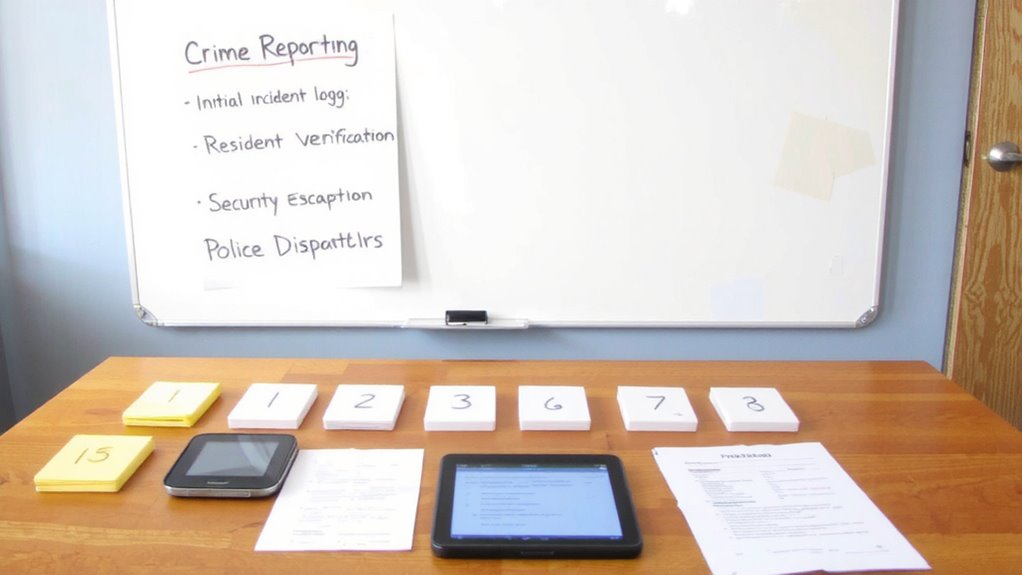
When an incident occurs, knowing exactly what to do matters, because a clear workflow guarantees no step gets missed and response times stay fast. You start by recording the incident timing immediately-this helps law enforcement determine sequence and urgency. Next, gather information from witnesses while their memory is fresh, and assess witness credibility carefully, since reliable accounts improve case outcomes. Report the event to local authorities without delay, then notify property management using the standardized form. Every action gets documented in the system to guarantee consistency and traceability. Using a step-by-step flow reduces confusion and supports accurate follow-up. Including time stamps and credibility notes strengthens the report’s value. You don’t assign roles here-that comes later. This stage is about speed, accuracy, and structure, so response efforts are based on clear, factual groundwork, not assumptions.
Assign Roles: Who Does What During an Incident

Clarity in crisis starts with knowing who does what. Role clarification guarantees quick, organized responses and accurate incident documentation. Assign key responsibilities in advance to avoid confusion. This table outlines core roles and duties during an incident:
| Role | Responsibility |
|---|---|
| First Responder | Assess scene safety, assist victims, call police |
| Reporting Officer | Record details, preserve evidence, manage incident documentation |
| Security Supervisor | Coordinate response, verify protocols are followed |
| Property Manager | Notify stakeholders, review role clarification, follow up post-incident |
You must train staff regularly so everyone knows their tasks. Clear role clarification reduces delays and improves communication. Proper incident documentation supports law enforcement and legal processes. Assign backups in case primary staff are unavailable. Use written protocols to reinforce expectations and guarantee consistency across shifts and locations. Planning now saves time and improves safety later.
Collect the Right Information for Police
Every second counts in crime reporting-not just for safety, but for accuracy. You need to collect precise details that help law enforcement respond effectively. Start by securing the scene to guarantee evidence preservation-don’t touch or move anything unless necessary for safety. Immediately gather witness statements while memories are fresh, noting names, contact details, and what each person saw or heard. Use standardized forms to record times, locations, suspect descriptions, and actions in a clear, consistent way. Photos or video from secure angles can also support evidence preservation if taken without disturbing the scene. Avoid leading questions when taking witness statements to keep information reliable. Share all data with police promptly. The right info speeds up investigations and increases the chance of resolution. Being thorough now strengthens the entire response process.
Use Crime Data to Prevent Future Incidents
Although crime can’t always be predicted, analyzing past incidents gives you a clear advantage in preventing future ones. By using crime analysis, you spot patterns like timing, location, and offense type. This data feeds into predictive policing models to help allocate patrols and resources more effectively. You don’t need advanced tech-start with simple logs and build from there.
| Factor | Benefit | Consideration |
|---|---|---|
| Time of day | Identify high-risk hours | Staffing adjustments may cost more |
| Location | Focus surveillance efforts | Targeted lighting adds security |
| Crime type | Tailor prevention strategies | Training residents takes time |
| Frequency | Measure protocol success | Requires consistent reporting |
| Trends | Support predictive policing | Data accuracy is critical |
Use this insight to update your safety plan and reduce future risks.
On a final note
You now have a clear, step-by-step protocol to improve crime reporting in multi-family housing. Assigning roles guarantees quick, coordinated responses. Collecting accurate data helps police and supports prevention. Use crime trends to adjust security measures, like lighting or cameras. This structured approach boosts safety, strengthens community trust, and relies on evidence-not guesses. Start small, train staff, and refine as needed.