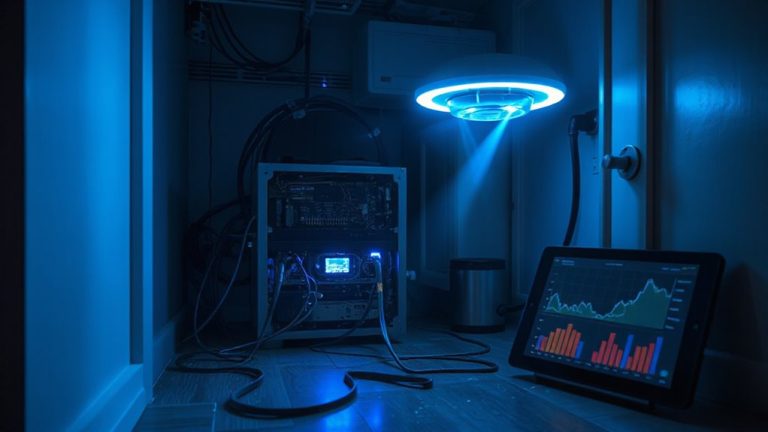
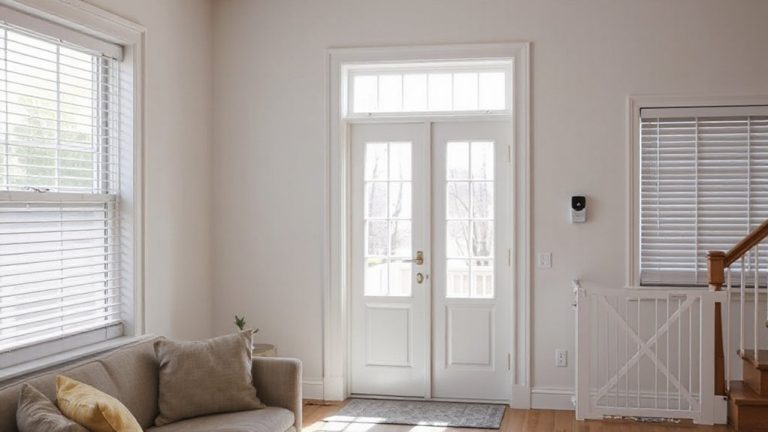
Utilizing Machine Learning to Predict and Mitigate Home Security Threats
You’re already using machine learning when your system ignores pets but flags a stranger loitering at night. Facial recognition, behavior analysis, and sensor fusion help distinguish threats from normal activity, reducing false alerts. Cameras detect motion anomalies; AI learns patterns to predict risks, like repeated circling or odd-hour movements. Systems cost $100–$1,200 upfront, with optional monitoring. Edge processing boosts speed and privacy. Strong encryption and updates are essential. Automation can lock doors instantly-smart, data-driven protection that improves over time, especially when combined with physical deterrents and proper setup. You’ll find guidance on optimizing each layer for real-world effectiveness.
Notable Insights
- Machine learning analyzes facial recognition data to distinguish household members from guests or intruders, reducing false alarms.
- Behavior analysis algorithms detect suspicious actions like loitering or door handle testing by learning normal vs. abnormal patterns over time.
- Sensor fusion combines camera, motion, and door sensor data to improve threat detection accuracy through contextual awareness.
- AI systems use edge processing to analyze video locally, enabling faster response times and minimizing cloud dependency.
- Automated responses, such as door lockdowns, are triggered within seconds of threat confirmation, enhancing real-time security mitigation.
How ML Detects Home Security Threats
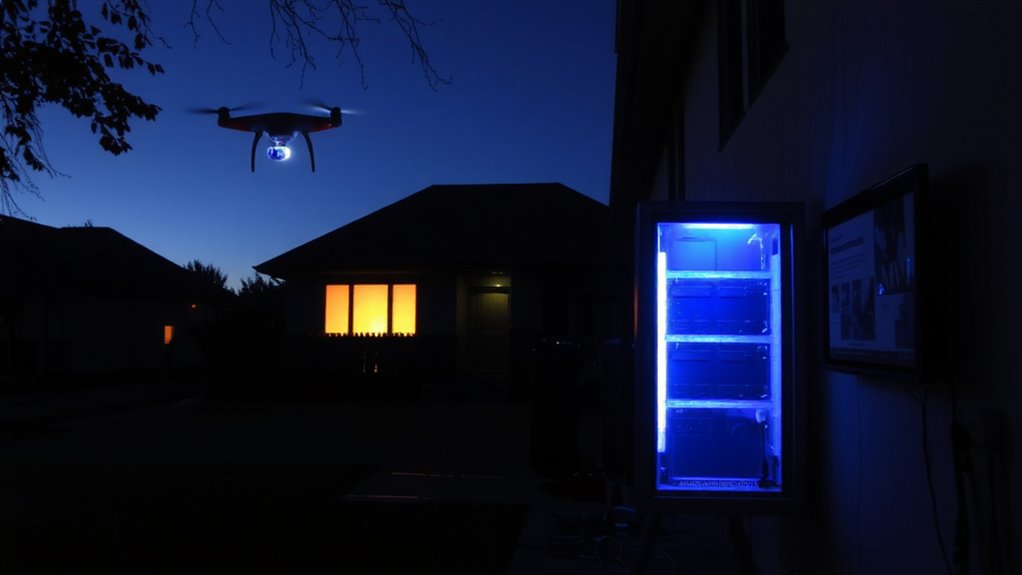
A machine learning system spots potential home security threats by analyzing patterns in data from sensors, cameras, and user behavior. You’ll see facial recognition used to distinguish between household members, guests, and unknown individuals by comparing live camera feeds to stored images. This helps reduce false alarms and increases accuracy. Object classification allows the system to identify items like packages, vehicles, or animals, so it won’t alert you when a cat walks by. These tools work together using algorithms trained on thousands of examples, improving over time. Pros include higher accuracy and automation, while cons involve initial setup costs and privacy considerations. Systems typically range from $200 to $500, not including monthly monitoring fees. For best results, choose models with strong encryption and regular software updates. Planning includes positioning cameras for clear views and managing data storage wisely.
Detecting Anomalies in Live Camera Feeds

While most alerts come from expected activity, spotting unusual behavior in live camera feeds is where machine learning truly adds value. You can rely on ML to detect motion anomalies by learning what normal movement looks like-such as pets walking or trees swaying-then flagging deviations. When the system identifies unusual activity, like someone lingering near a window at odd hours, it sends a real-time alert. These models process video continuously, using pixel changes and movement patterns without storing footage. A key benefit is reduced false alarms compared to basic motion detection. However, privacy concerns exist, so opt for on-device processing when possible. Systems with anomaly detection typically cost $100–$300 upfront plus $5–$15 monthly. Make sure your cameras support high resolution and low-latency streaming to maximize accuracy. Top models like the Arlo Pro 4 offer built-in AI for reliable anomaly detection and seamless integration with smart home systems.
Predicting Break-Ins With Behavior Analysis

How do you know if someone’s just passing by-or sizing up your home for a break-in? Machine learning helps spot criminal intent by analyzing behavior over time. If someone lingers near your windows, tests door handles, or circles your block repeatedly, these actions form suspicious patterns that algorithms can flag. Systems trained on thousands of real-world examples detect subtle cues-like erratic movements or unusual timing-that may escape human notice. You get alerts only when behavior crosses defined thresholds, reducing false alarms. While not perfect, models improve with more data and proper calibration. Setup costs range from $200–$500, plus monthly monitoring if needed. Consider combining behavior analysis with physical deterrents. It’s a proactive step-backed by data-that turns passive cameras into intelligent sentinels watching for real threats.
How Smart Sensors Boost AI Threat Detection
Since security isn’t just about recording footage but understanding it, smart sensors play a key role in making AI threat detection more accurate and responsive. You rely on sensor fusion to combine data from motion detectors, cameras, door sensors, and environmental monitors so AI sees the full picture, reducing false alarms. This integration lets the system distinguish between a pet moving and a potential intruder. With edge processing, analysis happens right on the device, meaning threats are detected faster and data stays more secure since less of it needs to be sent to the cloud. You get quicker alerts and lower latency, essential for timely response. While systems using edge processing and sensor fusion may cost more upfront, they offer better reliability and long-term efficiency. Look for models with strong integration and local processing to maximize protection without overpaying.
AI-Powered Automation for Instant Threat Prevention
What happens when a threat is detected-how quickly can your system respond? With AI-powered automation, your home security reacts instantly. Machine learning identifies risks and triggers a real time response, often within seconds. You get immediate alerts, but the system doesn’t wait for you to act. It initiates an automated lockdown, securing doors, windows, and garage entries without delay. This reduces vulnerability during critical moments, especially when you’re away or asleep. Systems with proven algorithms cut false alarms by analyzing behavior patterns, guaranteeing only real threats prompt action. Most premium packages include this feature, though costs range $500–$1,200 for full integration. Some require professional installation. A reliable internet connection is essential. While effective, guarantee your system allows manual override. Automated lockdown enhances safety, but proper setup maximizes reliability.
Balancing Smart Security and Household Privacy
Smart security systems keep evolving, but your right to privacy matters just as much as protection from threats. You need systems that use strong data encryption to protect recorded footage and personal details, keeping them secure from unauthorized access. Always check that your devices require clear user consent before sharing data with third parties or cloud services. Look for settings that let you control what’s recorded and when, so you decide how much information is collected. Some systems offer local storage instead of cloud backups, giving you more control. While AI helps detect threats faster, it shouldn’t compromise your privacy. Balance convenience with safeguards: enable encryption, review privacy policies, and update firmware regularly. Choosing transparent brands that prioritize user consent builds trust. Plan for systems starting around $150, with subscription options adding $10–$30 monthly. Make informed choices to keep your home secure and your data private. A reliable option is choosing doorbells with no subscription fees to maintain long-term affordability and data control.
On a final note
You can use machine learning to strengthen home security by detecting unusual activity, predicting risks, and automating responses. Systems analyze camera feeds and sensor data to spot intruders or anomalies early. While effective, they require careful setup, ongoing monitoring, and privacy safeguards. Costs vary based on features like real-time alerts or cloud storage. For best results, choose reliable devices, review data policies, and balance automation with personal oversight.