The Role of AI in Enhancing the Performance of Home Surveillance Systems
AI boosts your home surveillance by cutting false alarms up to 80% using motion filtering and pattern recognition. It spots real threats fast with real-time video analysis, often in seconds, while distinguishing people from pets. Facial recognition identifies visitors but works best in good lighting and raises privacy concerns-opt for encrypted models. Systems with onboard AI cost $10–$20 more but improve response and privacy. Most require a $3–$15 monthly plan for cloud features. You’ll see how integration and adaptive learning further sharpen performance.
Notable Insights
- AI reduces false alarms by distinguishing threats from pets or shadows using pattern recognition and motion filtering.
- Real-time threat detection leverages anomaly detection and object classification to identify intruders within seconds.
- Facial recognition verifies identities by matching faces to a database, alerting homeowners to known or unknown individuals.
- AI identifies suspicious behavior by learning household patterns and flagging deviations like loitering or unusual late-night movement.
- Integration with smart devices enables remote monitoring, instant alerts, and voice control via secure cloud connectivity.
How AI Stops False Alarms in Home Security
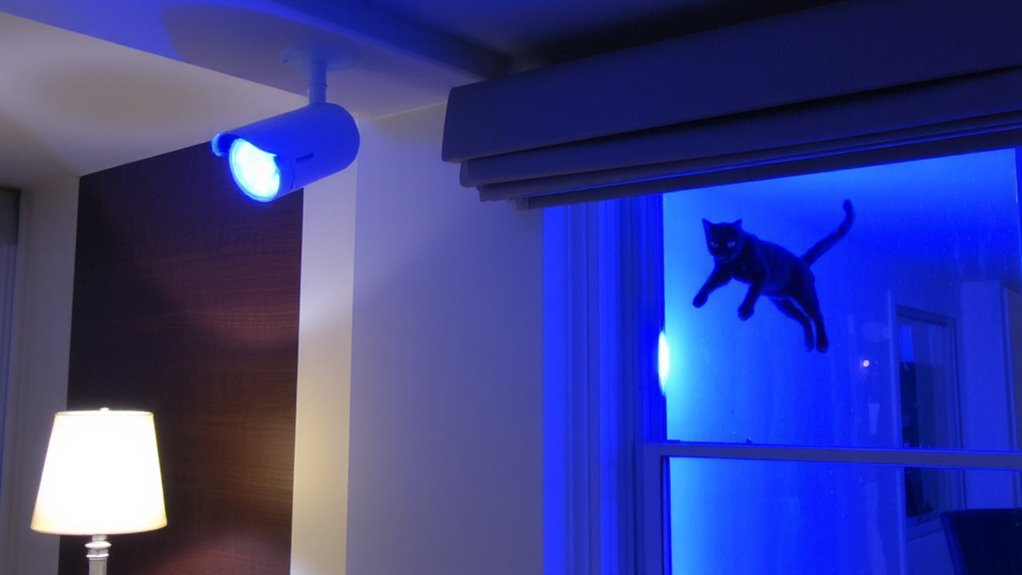
While traditional security systems often flag harmless movements as threats, AI-powered home surveillance uses advanced pattern recognition to distinguish between real intrusions and everyday occurrences-like pets moving or shadows shifting. You benefit from motion filtering that ignores routine activity, reducing false alerts. Audio analysis further refines accuracy by identifying specific sounds, such as breaking glass or forced entry, while disregarding common noises like thunder or barking dogs. These AI features rely on data-trained models to improve over time. Systems with motion filtering typically cost $10–$20 more but save you time and stress. Audio analysis may raise privacy concerns, so guarantee devices support local processing. For best results, pair both features with adjustable sensitivity settings. Planning your setup around high-traffic indoor zones and outdoor blind spots improves performance. Overall, AI minimizes false alarms without compromising security. For optimal integration with AI features, choose best motion sensors compatible with your ecosystem.
Real-Time Threat Detection With AI Surveillance
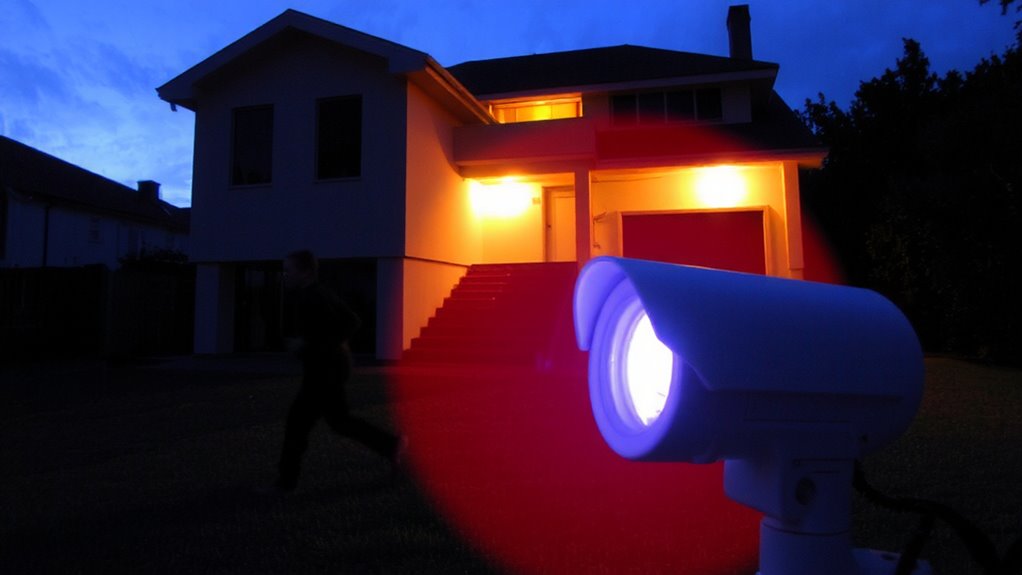
You’ve seen how AI reduces false alarms by learning what’s normal in your home, but it also plays an active role in identifying real threats the moment they happen. Using anomaly detection, the system spots unusual behavior-like someone moving near a window at 3 a.m. or an unexpected object left in your entryway. It then applies object classification to determine if the item or person could be a risk, distinguishing between a stray animal and an intruder. These processes happen in real time, often within seconds. The AI analyzes video data continuously, improving accuracy over time without slowing response speed. Most systems with this feature include cloud processing and require a subscription, typically $10–$15 monthly. While highly effective, they depend on proper camera placement and lighting. Real-time detection gives you faster alerts, so you can respond quickly or notify authorities, making your home surveillance proactive, not just passive.
Facial Recognition: Who’s at the Door?

What if your doorbell could tell you not just that someone’s there, but exactly who they are? With AI-powered facial recognition, it can. The system uses identity verification to match faces against a stored database, alerting you when family arrives or flagging unknown individuals. It’s convenient, especially when granting access to guests or service workers. But it also raises privacy concerns, since data security depends on both the device and your network. Look for systems with local processing or end-to-end encryption to reduce risk. Accuracy varies-some work better in daylight or struggle with diverse skin tones-so check independent test results. Prices start around $200 for capable models. While useful, consider who accesses the data and how long it’s stored. Balancing convenience with privacy guarantees smarter, safer home surveillance without unnecessary exposure. Many top-tier models offering these features are also Alexa-compatible security cameras.
How AI Spots Suspicious Behavior Early
When your security camera detects unusual movement at 3 a.m., it’s not just recording-it’s analyzing. Using pattern analysis, AI learns your home’s normal rhythms, like when you walk through rooms or pets move around. Anything outside that routine-like someone lingering by a window-triggers anomaly detection. This helps spot suspicious behavior early, before it becomes a threat. The system compares real-time video to established patterns, flagging only what’s truly out of place. That reduces false alerts from shadows or passing cars. AI-driven analysis works best with consistent camera placement and regular software updates. While some systems require a subscription for advanced features, many offer local processing to protect privacy. Expect to pay more upfront for cameras with strong onboard AI. These systems aren’t perfect-poor lighting or obscured views can limit effectiveness. But overall, they provide smarter, faster threat identification than traditional motion alerts alone.
Monitor Your Home Instantly With AI
Though traditional security systems rely on motion sensors and manual checks, AI-powered cameras let you monitor your home instantly with far greater accuracy. You get instant alerts when the system detects unusual activity, reducing false alarms from pets or passing cars. These alerts are smart enough to distinguish between a person and general movement, so you’re only notified when necessary. With remote viewing, you can check your cameras from anywhere using a smartphone or tablet, giving you real-time peace of mind. Most AI systems store footage securely in the cloud, often with subscription plans starting around $3–$10 monthly. Setup is typically simple, requiring only Wi-Fi and a power source. While higher upfront costs exist, usually $100–$300 per camera, the long-term benefits in security and convenience make them a solid investment for proactive home monitoring. For those looking to choose the right system, consulting a detailed buying guide can help identify top-rated models and essential features.
How AI Security Works With Alexa and Google
If you already use Alexa or Google Assistant at home, integrating AI security cameras with your voice-enabled devices can streamline how you monitor your property. Voice integration lets you check camera feeds, receive alerts, or arm systems using simple spoken commands-no app needed. With device synchronization, your cameras work alongside smart locks, lights, and sensors, creating a unified system that responds in real time. For example, you can say, “Show me the front door,” and view the stream on a compatible display. Most major brands support both platforms, ensuring broad compatibility. Setup usually takes under 10 minutes through the device app. While voice commands are convenient, always verify sensitive actions to prevent unintended access. Some systems may require a subscription for full features. Plan your budget accordingly, and pick models with strong encryption for security.
How AI Home Surveillance Gets Smarter Over Time
Your AI security system doesn’t just watch-it learns. Through adaptive learning, it analyzes activity over time to distinguish between regular routines and potential threats. Every time you confirm or dismiss an alert, the system refines its understanding, making fewer mistakes. Pattern evolution allows it to adjust to seasonal changes, new pets, or shifted schedules without manual updates. For example, if your kids come home later on Fridays, the AI adapts instead of triggering false alarms. Most systems improve markedly within two to four weeks of use. To maximize effectiveness, guarantee consistent internet and regular software updates. Higher-tier models offer faster processing and local data storage, which enhance privacy and response speed. While these systems cost more upfront, long-term benefits include reduced false alerts and stronger security. Review your camera’s learning cycle and user feedback options monthly to stay in control.
On a final note
You now see how AI improves home surveillance by cutting false alarms and spotting real threats fast. It learns your home’s patterns, recognizes faces, and flags odd behavior. Systems work with Alexa or Google, giving you instant alerts. Over time, they get smarter. While setup costs vary, the boost in accuracy and control is clear. For reliable, data-backed security, AI-powered cameras are a practical choice worth considering.